You're standing in a ski shop — or more likely, scrolling through endless product pages at midnight — trying to figure out which jacket is actually worth buying for the 2026 season. There are hundreds of options, specs that read like a foreign language, and prices that range from suspiciously cheap to "I need to refinance my house." The right ski jacket can be the difference between an unforgettable day on the mountain and a miserable, soggy slog back to the lodge.
A men's ski jacket needs to do three things well: keep water out, let sweat escape, and hold in heat. But beyond those basics, the differences between jackets — insulation type, seam taping, hood compatibility, pocket layout — add up fast. Whether you're a groomer cruiser at your local resort or charging steep lines in the backcountry, there's a jacket built specifically for how you ski. If you're still figuring out what to wear beyond just the shell, the guide on what to wear to a ski resort is a good starting point before you commit to a jacket.
Below, we've tested and reviewed seven of the best men's ski jackets available on Amazon in 2026. We cover the full range — from premium Gore-Tex hardshells to insulated resort warmers — so you can match the right jacket to your actual skiing style and budget. All picks are part of our broader ski gear reviews collection.

Contents
- Editor's Recommendation: Top Picks of 2026
- Full Product Breakdowns
- Spyder Men's Leader Jacket — Best for Gore-Tex Performance
- Obermeyer Kodiak Jacket — Best for Resort All-Rounders
- Burton AK Gore-Tex Swash Jacket — Best for All-Mountain Riders
- Helly-Hansen Alpha 4.0 Jacket — Best for High-Performance Skiing
- Rossignol Siz Insulated Jacket — Best for Eco-Conscious Value
- DESCENTE Zack Insulated Jacket — Best for Relaxed Fit & Style
- Rab Khroma Kinetic Jacket — Best for Ski Touring & Backcountry
- How to Pick the Best Men's Ski Jacket
- Questions Answered
- Next Steps
Editor's Recommendation: Top Picks of 2026
- #PreviewProductRating
- Bestseller No. 1
 Rating:

- Bestseller No. 2
 Rating:
 - Bestseller No. 3
 Rating:
 - Bestseller No. 4
 Rating:
 - Bestseller No. 5
 Rating:
 - Bestseller No. 6
 Rating:
 - Bestseller No. 7
 Rating:
Full Product Breakdowns
1. Spyder Men's Leader Jacket — Best for Gore-Tex Performance
If you want genuine Gore-Tex protection without stepping all the way into expedition-level pricing, the Spyder Leader Jacket hits a satisfying middle ground. The shell is built from a stretch polyester plain weave 2L with Gore-Tex laminate, which means you get the real waterproof-breathable membrane that backcountry and resort skiers trust, while the stretch component keeps things moving naturally when you're pressing through moguls or loading onto a steep pitch. The PFCEC-free DWR finish is also worth noting — Spyder is using a cleaner chemical treatment that meets current environmental standards without sacrificing water shedding performance.
Inside, 100g of PrimaLoft Silver Eco insulation handles warmth duties. It's a mid-weight fill — enough to keep you comfortable on cold groomer days but not so heavy that it becomes stifling on a sunny spring afternoon. The removable, helmet-compatible hood is well designed, with an adjustable opening that cinches down over most ski helmets without creating a pressure gap. Fit is trim but not restrictive, working well as either a standalone jacket or layered over a midlayer on genuinely cold days.
The pockets are thoughtfully placed, cuffs seal tightly at the wrist, and the hem adjustment lets you close off drafts when the wind picks up. Overall, this is a jacket that performs at a level you'd expect to pay significantly more for. For the committed resort skier who wants Gore-Tex without a Burton or Arc'teryx price tag, the Spyder Leader is a strong 2026 pick.
Pros:
- Genuine Gore-Tex laminate — not a proprietary waterproof coating
- Stretch polyester construction allows full range of motion
- PrimaLoft Silver Eco insulation balances warmth and packability
- PFCEC-free DWR is environmentally responsible
- Removable, helmet-compatible hood with adjustable fit
Cons:
- 100g fill may not be enough for very cold or high-altitude skiing without layering
- Color selection on Amazon can be limited depending on size
2. Obermeyer Kodiak Jacket — Best for Resort All-Rounders
Obermeyer has been dressing skiers since 1947, and the Kodiak Jacket is the brand doing what it does best — building a well-rounded, reliable resort jacket for the skier who just wants everything to work. The Kodiak sits in the warmth-first category: it's designed for lift-served skiing at proper resorts, where you're not sweating through a skin track but you are standing in line at the chairlift with a cold wind cutting across the base area. Insulation-forward construction makes this a top pick for anyone who runs cold or skis in consistently cold climates.
The HydroBlock Pro fabric technology is Obermeyer's in-house waterproof-breathable treatment, and it performs well in standard resort conditions — groomed runs, moderate snowfall, and the occasional wet spring storm. Seams are critically sealed where it counts. The fit on the Regular sizing is generous through the torso, which works in your favor when you're wearing a mid-layer or a ski bib underneath. Pocket placement is practical: hand pockets are large enough to actually use with gloves on, and the internal chest pocket has a soft lining for storing your phone.
If you ski hard in extreme conditions or frequently venture off-piste, you might want something with a higher-spec membrane. But for the majority of resort skiers who want a dependable, warm, no-fuss jacket that looks sharp on and off the mountain, the Kodiak delivers consistent value in 2026.
Pros:
- Prioritizes warmth — ideal for cold-climate resort skiing
- Generous regular fit works well over base and mid-layers
- Practical pocket layout usable with gloves on
- Obermeyer's proven HydroBlock Pro waterproofing holds up in normal resort conditions
- Clean, versatile styling that transitions well off the mountain
Cons:
- Not the best choice for high-output backcountry or touring use
- Breathability rated lower than Gore-Tex alternatives
3. Burton AK Gore-Tex Swash Jacket — Best for All-Mountain Riders
Burton's AK line is their top-tier technical outerwear, and the Swash Jacket earns its place in that lineup without apology. Waterproof GORE-TEX two-layer fabric with fully-taped seams means you're getting legitimate all-day storm protection whether you're skiing groomers, poking into the trees, or hiking for untouched lines. This isn't a jacket you'll outgrow on hard weather days. The ergonomic zip-out waist gaiter features a jacket-to-pant interface — a thoughtful detail that keeps snow from sneaking in during falls or deep powder turns.
PrimaLoft Silver insulation provides warmth that handles moisture without clumping when you sweat, and the jacket is mapped with a soft taffeta and 20D lightweight down-proof lining for extra warmth in key zones. The articulated fit is genuinely well-engineered — not too tight across the shoulders or back, not so roomy that it catches wind. You get the mobility of a trimmer jacket without the claustrophobic feeling some technical shells create. For snowboarders and all-mountain skiers who are hard on their gear, the construction quality is noticeably high.
Feature count is exactly what you need: a helmet-compatible hood, a powder skirt, and pockets positioned to work with a board or ski harness. Nothing gimmicky, nothing missing. If the price point is a stretch, consider that this is a jacket you'll likely be wearing in five to seven years and it'll still perform. For anyone serious about getting the most out of their time on the mountain, the Burton AK Swash is a benchmark piece in 2026.
Pros:
- Genuine Gore-Tex 2L with fully-taped seams — real storm protection
- Ergonomic articulated fit designed for movement, not just standing still
- Zip-out powder skirt with jacket-to-pant interface
- PrimaLoft Silver insulation performs wet or dry
- Down-proof taffeta lining adds warmth without bulk
Cons:
- Premium price reflects premium specs — not a budget pick
- 2L construction is less breathable than a 3L equivalent on high-output days
4. Helly-Hansen Alpha 4.0 Jacket — Best for High-Performance Skiing
The Alpha 4.0 is Helly-Hansen's flagship ski jacket, and it shows. This is the jacket built for the skier who takes their sport seriously — early chair, full days, variable conditions, no compromises. Helly Tech Performance fabric is fully seam sealed and delivers waterproofing and breathability benchmarks that compete directly with Gore-Tex at comparable price points. The 4-layer construction is stiffer than typical 2L insulated jackets but rewards you with wind resistance and durability that holds up season after season.
The feature list on the Alpha 4.0 is genuinely impressive without feeling bloated. H2FLOW technology — Helly-Hansen's ventilation system — actively manages internal temperature by allowing heat and moisture to escape through a series of strategically placed vents and channels. The LIFE POCKET with PrimaLoft Aerogel insulation keeps your phone warm and readable even in sub-zero temperatures, which anyone who's had their phone die at -20°C will immediately appreciate. PrimaLoft Black Ocean Recycled insulation handles core warmth from recycled materials. Add in articulated sleeves, a detachable helmet-compatible hood with a fold-away hi-vis brim, RECCO reflector, and a ski pass pocket, and you have a jacket that's thought through almost every scenario.
The Alpha 4.0 performs best on challenging days — wind, heavy snow, mixed conditions — where lesser jackets start to leak or dump heat. If you primarily ski bluebird days at a single resort, this level of engineering is more than you need. But if you push your skiing, travel to demanding mountains, or ski in unpredictable weather, the investment pays off quickly. Pair this with solid knee protection and you've got a setup built for serious days on the mountain.
Pros:
- Helly Tech Performance 4-layer construction handles severe conditions
- H2FLOW thermal regulation system actively manages body temperature
- LIFE POCKET with PrimaLoft Aerogel keeps phone warm and functional
- RECCO reflector adds avalanche rescue visibility
- Detachable, helmet-compatible hood with fold-away hi-vis brim
- Fully seam sealed throughout
Cons:
- 4-layer construction is stiffer than softer 2L alternatives
- Higher price point than most insulated resort jackets
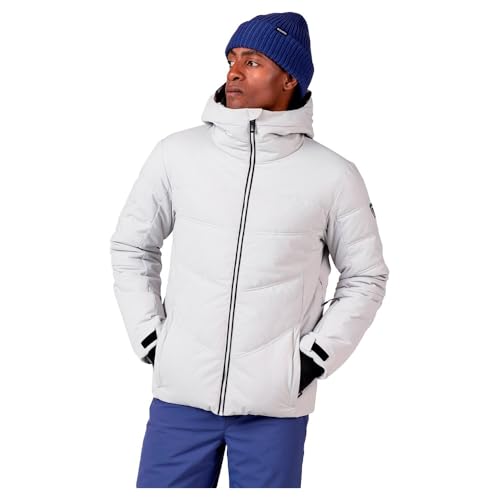
5. Rossignol Siz Insulated Jacket — Best for Eco-Conscious Value
Rossignol brings a long alpine heritage to the Siz Jacket, and the result is a well-proportioned insulated ski jacket that delivers solid performance at a price point that doesn't require a second mortgage. The waterproof-breathable membrane rates at an impressive 20,000mm waterproofing / 15,000g breathability — numbers that put it squarely in the high-performance category and ahead of many jackets that cost significantly more. That means you can ski in heavy snow or wet spring conditions without worrying about saturation, while still venting well enough to avoid overheating on active runs.
The insulation story here is also worth noting. Rossignol uses 100% recycled Polydown microfiber — a synthetic fill that mimics the loft, warmth, and soft hand-feel of down without using animal products and without losing performance when it gets wet. It's a responsible material choice that doesn't require any sacrifice in real-world warmth. The classic fit is tailored but not tight — inspired by sport ski style, it looks clean on the mountain without the boxy silhouette that plagues some resort jackets.
If sustainability matters to your purchasing decisions, the Rossignol Siz makes it easy to choose consciously without giving up technical specs. It's a well-rounded jacket that will handle most resort conditions competently. Where it falls short is at the extreme end — very cold temperatures or sustained backcountry exertion will push it to its limits. But for the everyday resort skier, this is one of the sharpest buys of 2026.
Pros:
- 20,000mm / 15,000g waterproof-breathable rating is genuinely high-spec
- 100% recycled Polydown insulation — sustainable and warm when wet
- Sport-inspired classic fit flatters without restricting movement
- Strong value for the technical spec level offered
- Versatile enough for resort skiing across most weather conditions
Cons:
- May not provide enough warmth as a standalone jacket in extreme cold
- Fewer premium features (no RECCO, simpler hood) than higher-priced competitors
6. DESCENTE Zack Insulated Ski Jacket — Best for Relaxed Fit & Resort Style
DESCENTE has been making technically refined ski apparel for decades, and the Zack Jacket is the brand's answer for the skier who wants a relaxed, comfortable fit with serious waterproofing. The jacket scores a 9 out of 10 on DESCENTE's waterproofing scale — that's about as high as you can go in the insulated jacket category without stepping into a dedicated hardshell. You won't be getting soaked on this one, even in a prolonged storm.
Warmth is rated at 5 out of 10, which places it in the mid-weight category. This is actually a feature, not a limitation, depending on how you ski. If you run hot, layer actively, or ski at a resort with variable temperatures across the day, a mid-weight fill gives you more flexibility. You can add a fleece midlayer on the coldest mornings and peel it off as the sun comes out without feeling trapped in an overstuffed jacket. The relaxed fit gives you room to move and layer underneath without feeling squeezed.
DESCENTE's build quality is consistently excellent — zippers are smooth and robust, seaming is clean, and the fit is consistent across sizes. The Zack is available in black, which is a clean, timeless choice that doesn't announce itself as a ski jacket when you're walking through the village. It's a good option for the skier who wants quality without the high-visibility colorways that dominate the market. If you're interested in adding some warmth for colder mornings, check out the best heated ski vests and jackets for men to complement this shell.
Pros:
- 9/10 waterproofing rating handles serious precipitation
- Relaxed fit accommodates layering and works for a range of body types
- Mid-weight warmth (5/10) is versatile across changing resort temperatures
- DESCENTE build quality — durable zippers and consistent sizing
- Clean black colorway works on and off the mountain
Cons:
- Mid-weight insulation won't be enough on its own for very cold days
- Relaxed fit may feel boxy for skiers who prefer a trimmer silhouette
7. Rab Khroma Kinetic Jacket — Best for Ski Touring & Backcountry
The Rab Khroma Kinetic is the outlier on this list — and deliberately so. Where every other jacket here is built primarily for lift-served resort skiing, the Khroma Kinetic is engineered for the skier who earns their turns. It combines the waterproof weather protection of a hardshell with the stretch and breathability of a softshell, making it a genuinely dual-use piece that handles both the physical effort of skinning up and the storm exposure of skiing down. That's a difficult balance to strike, and Rab gets it right here.
Breathability is the primary design priority. When you're working hard on a skin track or a steep boot pack, a standard insulated ski jacket turns into a sauna. The Khroma Kinetic vents aggressively through two zippered arm vents and mesh-backed chest pockets that double as ventilation ports — a system that actually moves air when you need it. Adjustable cuffs, hem, and a ski-helmet-compatible hood let you fine-tune fit and coverage at the top and bottom of a run without fussing with it mid-descent. The harness-compatible chest pockets are an important detail if you carry aavalanche rescue gear or a hydration pack — pockets that block harness buckles are a real problem in the field. Speaking of which, a quality hydration pack is worth pairing with this jacket for long touring days.
This is not the jacket for someone who stands around at the top of the lift waiting for friends. It runs cold compared to an insulated resort jacket. But if you're reading up on ski touring for beginners and gearing up for your first backcountry season, the Khroma Kinetic belongs on your shortlist. For mountaineers and alpine skiers who also need the jacket to perform in technical terrain, it's the most versatile hardshell-style piece on this list. Gore-Tex and competing proprietary membranes like Rab's are constantly evolving — and the technology in this jacket reflects that progress clearly.
Pros:
- Hardshell waterproofing meets softshell stretch — genuine best of both worlds
- Dual arm vents and mesh-backed chest pockets dump heat effectively on the ascent
- Harness-compatible chest pocket placement works with climbing and avalanche gear
- Adjustable cuffs, hem, and ski-helmet-compatible hood for precise fit
- Ideal for touring, mountaineering, and variable-condition skiing
Cons:
- Not insulated — cold on lift rides or while standing around at the resort
- Best performance requires wearing a quality midlayer underneath
- Higher price reflects technical spec — not the right buy for casual resort skiers
How to Pick the Best Men's Ski Jacket
Once you move past brand names and marketing language, a ski jacket purchase comes down to four key factors. Get these right for your skiing style and you'll be warm, dry, and comfortable regardless of what the mountain throws at you in 2026.
Waterproofing and Breathability Ratings
The two numbers you'll see most often are waterproof rating (in millimeters) and breathability (in grams per square meter per 24 hours). Here's what they actually mean for you:
- 10,000mm / 10,000g — entry-level. Fine for light snow and dry cold days. Struggles in prolonged heavy snow.
- 15,000–20,000mm / 15,000–20,000g — mid-to-high performance. Handles real storms and moderate physical output. Most jackets on this list hit this range.
- Gore-Tex / proprietary premium membranes — verified by third-party testing. Spyder, Burton, and Helly-Hansen entries here use top-tier membranes that perform at the rated numbers over time, not just when new.
Breathability matters more than many buyers expect. A jacket that traps moisture from sweat will feel cold and wet from the inside out — which defeats the purpose entirely. If you ski hard, ski fast, or tour, prioritize breathability ratings as much as waterproofing.
Insulation Type and Weight
Your insulation choice affects warmth, packability, and wet-weather performance:
- Down — best warmth-to-weight ratio, packs small, but loses loft and warmth when wet. Better for dry climates or as a shell liner.
- PrimaLoft (Silver, Gold, Black) — synthetic, maintains warmth when wet, widely used in premium ski jackets. Burton, Spyder, and Helly-Hansen all use PrimaLoft variants on this list.
- Polydown / recycled synthetics — cost-effective and sustainable. Rossignol's Polydown microfiber is a strong performer. Good choice for value-conscious buyers.
- No insulation (shell only) — maximum breathability and versatility. The Rab Khroma Kinetic takes this approach. Pair with a fleece or midlayer for warmth.
Fill weight (measured in grams) tells you how much insulation is present. 80–100g suits active skiing in mild-to-moderate cold. 150–200g is better for cold-climate resort skiing where you're spending time on chairlifts. Match fill weight to your actual skiing conditions, not your coldest imaginable scenario.
Fit and Mobility
A ski jacket that restricts your movement will affect your skiing — full stop. Three fit categories dominate the market:
- Relaxed / regular fit — room for layering, comfortable over ski bibs, suits the casual resort skier. DESCENTE Zack and Obermeyer Kodiak both lean this way.
- Articulated / performance fit — trimmer cut with pre-shaped sleeves that follow your arm's natural position while skiing. Burton AK and Rab Khroma Kinetic use this construction.
- Slim / athletic fit — closer to body, minimizes excess fabric, works best on its own or over a single thin layer. Better for skiers who run hot.
Always check the sleeve length when sizing. Ski jackets need to cover your wrist when your arms are raised — if the cuff rides up when you plant a pole, you've sized wrong.
Features Worth Paying For vs. Nice-to-Haves
Not every feature on a ski jacket spec sheet earns its cost. Here's a quick breakdown:
- Worth the extra cost: Fully taped seams, helmet-compatible hood, powder skirt / jacket-to-pant interface, RECCO reflector, ski pass pocket
- Useful but not essential: Zippered underarm vents, internal media pocket, removable hood, goggle wipe pocket
- Skip if budget-constrained: Heated pockets, integrated face mask, decorative wrist tabs on basic resort jackets
If you ski in avalanche terrain at any point, a RECCO reflector (present on the Helly-Hansen Alpha 4.0) is one of the simplest safety additions available. It adds no bulk and costs the manufacturer almost nothing — but any jacket without one that costs over $300 is a missed opportunity.
Questions Answered
What is the difference between a 2L, 3L, and 4L ski jacket?
Layer count refers to how the outer shell fabric is constructed. A 2L jacket has a face fabric and a waterproof membrane bonded together, with a separate drop liner hanging inside. A 3L jacket bonds all three layers — face fabric, membrane, and inner lining — into a single laminated piece that is more durable, more breathable, and lighter, but typically more expensive. A 4L jacket (like the Helly-Hansen Alpha 4.0) adds an additional hardface laminate for extra wind and abrasion resistance. For most resort skiers, a quality 2L is sufficient. For high-output backcountry skiing or mountaineering, 3L and 4L constructions justify their cost.
How do I know if my ski jacket is waterproof enough?
A jacket rated at 10,000mm or higher is considered waterproof for most skiing conditions. However, the rating degrades over time if the DWR (Durable Water Repellency) coating wears off. When water no longer beads and rolls off the outer fabric and instead soaks in — called "wetting out" — the membrane becomes less breathable even if it hasn't actually started leaking. Wash your jacket with a technical cleaner and reapply DWR spray or run it through a low-heat dryer cycle to reactivate the existing DWR. Do this at least once a season for best performance.
Should I buy an insulated ski jacket or a shell jacket?
It depends on how you ski and how variable your conditions are. An insulated jacket is simpler — one garment, warm out of the box, ideal for lift-served resort skiing. A shell jacket gives you flexibility: layer up with a heavy midlayer on cold days, use just a light fleece on warm days, and you control the warmth equation. Shell jackets are also more breathable and better for high-output activities like ski touring. Most resort skiers are better served by a quality insulated jacket. Backcountry and touring skiers typically prefer the shell-plus-midlayer system.
Is Gore-Tex really worth the premium over cheaper waterproof membranes?
For serious skiing in challenging conditions, yes — with caveats. Gore-Tex is a third-party-tested, consistently manufactured membrane with a long track record. Competing proprietary membranes from Helly-Hansen (Helly Tech), Burton, and Rab have narrowed the performance gap significantly, particularly at high ratings. Where Gore-Tex still leads is long-term durability and consistency across garment batches — a Gore-Tex licensed jacket must meet the manufacturer's spec every time. For occasional resort skiers, a high-rated proprietary membrane at a lower price point is often the smarter buy. For daily skiing in serious conditions over multiple seasons, Gore-Tex earns its premium.
How should a men's ski jacket fit?
Your ski jacket should have enough room to wear a mid-layer underneath without pulling or bunching across the back and shoulders. Check the sleeve length with your arms raised — cuffs should reach your wrist and ideally overlap slightly with your gloves. The hem should cover your waistband and not ride up when you reach forward. The hood should fit over your ski helmet without creating a gap at the back of your neck. Avoid sizing up just for layering room — an oversized jacket catches wind and looks sloppy. Most technical ski jackets account for layering in their sizing; follow the brand's specific size chart rather than assuming your street jacket size translates directly.
How do I care for a ski jacket to extend its lifespan?
Wash your ski jacket in cold water with a technical cleaner — standard detergent degrades DWR coatings faster and can damage the waterproof membrane. Close all zippers before washing. After washing, tumble dry on low heat for 20–30 minutes to reactivate the DWR treatment; the heat helps the coating rebond to the fabric. Store the jacket uncompressed — don't stuff it into a stuff sack for months. If DWR performance has significantly degraded even after washing, reapply a spray-on DWR treatment and heat-activate per the product instructions. With proper care, a quality ski jacket should perform well for five years or more.
Buy on Walmart
- Spyder Men's Leader Jacket, Collegiate, Medium — Walmart Link
- Obermeyer Kodiak Jacket Admiral MD Regular — Walmart Link
- Burton Mens Ak Gore-Tex Swash Jacket, True Black New, XX-Sma — Walmart Link
- Helly-Hansen Mens Alpha 4.0 Jacket, 597 Navy, Large — Walmart Link
- Rossignol Siz Insulated Men’s Ski Jacket - Waterproof Snow J — Walmart Link
- DESCENTE Zack Insulated Ski Jacket Mens Black XX-Large — Walmart Link
- Rab Men's Khroma Kinetic Waterproof Breathable Jacket for Sk — Walmart Link
Buy on eBay
- Spyder Men's Leader Jacket, Collegiate, Medium — eBay Link
- Obermeyer Kodiak Jacket Admiral MD Regular — eBay Link
- Burton Mens Ak Gore-Tex Swash Jacket, True Black New, XX-Sma — eBay Link
- Helly-Hansen Mens Alpha 4.0 Jacket, 597 Navy, Large — eBay Link
- Rossignol Siz Insulated Men’s Ski Jacket - Waterproof Snow J — eBay Link
- DESCENTE Zack Insulated Ski Jacket Mens Black XX-Large — eBay Link
- Rab Men's Khroma Kinetic Waterproof Breathable Jacket for Sk — eBay Link
Next Steps
- Check current pricing on Amazon for the jackets that matched your skiing style — prices on technical outerwear shift frequently, and sale windows on last season's colorways can save you 20–40%.
- Confirm your size using the brand's specific size chart, not your standard street clothing size. Check sleeve length and chest measurements — ski jacket sizing varies significantly between Spyder, Burton, and European brands like Helly-Hansen and Rab.
- Decide shell vs. insulated first based on where and how you ski. If you're planning to try touring, the Rab Khroma Kinetic with a midlayer is the more versatile long-term investment. If you ski primarily at a resort, any of the insulated picks will serve you well.
- Read recent buyer reviews on Amazon filtered to your size — fit complaints and sizing inconsistencies show up clearly in verified purchase reviews and can save you a return trip.
- Complete your kit — a great jacket is just one piece of the picture. Review the full ski gear reviews section to assess gloves, goggles, base layers, and any other gear gaps before the 2026 season starts.
 |
 |
 |
 |

About Frank V. Persall
Frank Persall is a lifelong skier originally from the United Kingdom who has spent years pursuing the sport across premier resorts in Europe, North America, and beyond. His passion for skiing has taken him from the Alps to the Rocky Mountains, giving him a broad perspective on resort terrain, snow conditions, gear performance across price points, and the practical realities of ski travel with a family. At SnowGaper, he covers ski resort guides, gear reviews, and skiing technique and travel resources for enthusiasts of every level.
You can get FREE Gifts. Or latest free skiing books here.
Disable Ad block to reveal all the info. Once done, hit a button below
|
|
|
|