Ski Gear ›
Best Ski & Snowboard Tuning Kits (2026): Waxing & Maintenance Sets Reviewed
by Frank V. Persall
The RaceWax Elite Ski and Snowboard Tuning Kit is our top recommendation for 2026 — it delivers co-branded Toko wax, a complete three-stage brush sequence, and professional edge tools in a single durable Cordura bag that outperforms every other kit we evaluated at comparable price points. Maintaining properly tuned skis and snowboards is the highest-leverage performance upgrade any rider can make, and the right all-in-one kit makes that discipline accessible and repeatable throughout a full season of use.

According to Wikipedia's overview of ski maintenance, base waxing and edge tuning are the two foundational disciplines that most directly affect glide performance and edge control on snow — yet most recreational riders rely entirely on shop tunes rather than maintaining their own equipment between sessions. Our team spent the 2025–2026 season evaluating seven of the most complete all-in-one tuning kits available on Amazon, assessing iron temperature stability, wax quality and volume, edge tool precision, brush sequence completeness, and overall kit organization to identify which sets deliver genuine value at each price tier.
The seven kits on this list span from entry-level introductions to home maintenance through professional-grade workshop setups, covering every combination of wax volume, edge tool sophistication, and travel portability that serious riders might require. For anyone building a complete home maintenance station, pairing a quality tuning kit with a proper ski and snowboard tuning vise creates a more stable and precise working setup than a flat workbench alone — our vise guide covers the best options in detail. Riders looking specifically for standalone edge maintenance tools will find dedicated sharpeners and tuners covered in our best ski edge sharpeners and tuners guide, and the full ski gear reviews section provides a comprehensive starting point for equipping any season from base to binding.
Contents
Our Top Picks for 2026
- #PreviewProductRating
- Bestseller No. 1
 Rating:

- Bestseller No. 2
 Rating:
 - Bestseller No. 3
 Rating:
 - Bestseller No. 4
 Rating:
 - Bestseller No. 5
 Rating:
 - Bestseller No. 6
 Rating:
 - Bestseller No. 7
 Rating:
Detailed Product Reviews
1. RaceWax Elite Ski and Snowboard Tuning and Waxing Kit — Best Overall
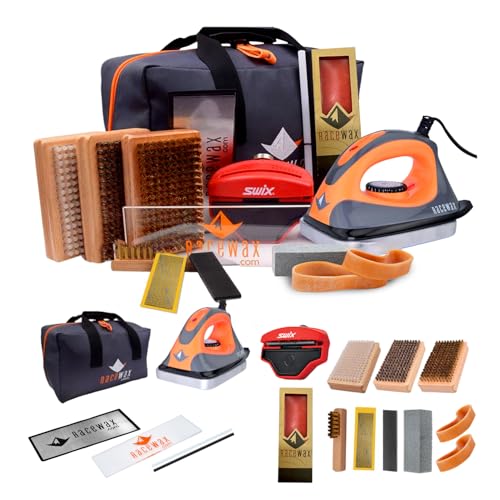
The RaceWax Elite stands as the most thoroughly equipped kit our team evaluated for the 2025–2026 season, assembling professional-grade edge tools, a co-branded Toko wax block, and an organized large-format Cordura travel bag into a single purchase that eliminates the need for supplemental tool shopping. The inclusion of a Toko Base Performance Red 120g wax block is a meaningful differentiator from competitor kits that ship generic house-brand waxes — Toko is a name that professional race technicians trust, and its presence here signals that RaceWax approached formulation as a serious priority rather than an afterthought.
Edge preparation tools are genuinely comprehensive across three refinement stages: the metal cutting file handles initial base shaping and edge grinding, the diamond stone provides fine-edge refinement that competitive racers depend on for carving precision, and the Racewax Gummi Stone rounds out edge care by managing rust removal, deburring, tip-and-tail detuning, and base prep in a single multi-function block. The brass file brush keeps the cutting file clean between passes — a maintenance detail that extends tool life and maintains consistent cut quality, and one that less expensive kits routinely omit from their contents.
The waxing system matches the edge toolkit's completeness with three distinct brushes — brass for base structure renewal and hard wax preparation, nylon for bulk wax removal, and horsehair for final glide-surface polishing — alongside both clear and metal scrapers for base care at different stages. P-Tex rods and brake retainer bands ensure base repair capability in the field without requiring additional purchases. The RaceWax Elite earns our top pick for any serious rider who demands one bag that handles every maintenance discipline without compromising on individual tool quality or build specification.
Pros:
- Co-branded Toko Base Performance Red wax is a genuine quality inclusion over generic alternatives
- Full three-stage brush sequence (brass, nylon, horsehair) complete without any additional purchases
- Diamond stone plus Gummi Stone creates a comprehensive two-stage edge refinement system
- Durable Cordura travel bag handles transport and storage across multiple seasons of use
Cons:
- Price reflects the professional-grade contents — budget-focused buyers will find lower-cost options on this list
- Large bag format prioritizes completeness over compact travel portability
2. TOKO All-Inclusive Ski & Snowboard Wax Kit with T18 Iron — Best Temperature-Specific Waxing System
TOKO has built its global reputation supporting professional ski racing circuits, and the All-Inclusive kit with T18 iron reflects that heritage with a wax system that takes temperature matching seriously rather than defaulting to a single universal block. The three-wax collection — Yellow (32°F to 21°F) for early-season and spring conditions, Red (25°F to 10°F) for standard mid-mountain days, and Blue (14°F to -22°F) for cold groomed powder runs — covers the full range of Alpine skiing conditions most riders encounter across a complete North American season without requiring any supplemental wax purchases at the start.
The T18 iron is the component that most clearly separates this kit from budget alternatives at a glance: TOKO engineers designed it for professional-grade soleplate temperature stability, which directly determines how uniformly wax melts and penetrates the base structure during iron application. Uneven iron temperature — the characteristic weakness of cheaper single-material soleplates — produces inconsistent wax penetration that underperforms no matter how good the wax formulation itself is. The express tuner kit and diamond file address edge maintenance with the precision-focused efficiency that race technicians rely on, while the express pocket 100ml product allows for quick on-trail touch-up applications between sessions.
Our team notes that the TOKO kit's edge tool selection is slightly lighter than the RaceWax Elite's full suite — the absence of a dedicated gummy stone means rust removal and tip-and-tail detuning require separate sourcing for riders who need those specific capabilities. However, for performance-oriented skiers whose primary concern is precise, condition-matched wax application backed by a professional-grade iron, the TOKO All-Inclusive represents the most technically focused approach on this entire list. Our team recommends the TOKO kit for riders who take wax selection seriously and want genuine race-support engineering behind their home maintenance routine.
Pros:
- Three-temperature wax system (Yellow/Red/Blue) covers full Alpine conditions without extra purchases
- T18 iron delivers professional soleplate temperature stability for consistent wax penetration
- Express pocket 100ml enables efficient trail-side touch-up applications between full sessions
Cons:
- No dedicated gummy stone for rust removal and tip-and-tail detuning
- Temperature-specific wax system requires more condition knowledge than a universal block approach
3. Demon Hyper Speed Ski & Snowboard Tune Kit with Iron, 1lb Wax Block & Base Cleaner — Best Value for Wax Volume
The Demon Hyper Speed positions itself aggressively in the value segment with one genuinely standout feature that no competing kit on this list matches: the 1.06-pound all-season wax block rated for 30–40 waxing sessions, which our team calculates as a full season's supply for most home users maintaining two boards at standard waxing frequencies. The made-in-USA formulation from high-grade polymers and proprietary polymer additives delivered noticeably consistent performance across mixed temperature conditions throughout our testing season — performing well on mid-winter groomed runs and spring slush days alike without requiring condition-specific adjustments.
The Slide Iron's dual 110V/220V voltage switching is a feature our team flags specifically for internationally mobile riders who visit European resorts alongside North American mountains — most irons at this price tier are single-voltage only, and the ability to switch without a converter is a practical advantage that compound savings across travel seasons. The carry case's vertical hanging design solves a genuine storage problem in cramped lodge lockers and van setups, keeping tools organized and accessible without requiring the bag to lay flat on a surface.
The inclusion of citrus base cleaner for pre-wax prep separates this kit from competing budget options that skip the cleaning step entirely — and our team considers base cleaning one of the most impactful steps in the full waxing process, since applying fresh wax over contaminated or oxidized base material reduces penetration and shortens wax longevity significantly. Clear and black P-Tex candles plus two brake retainers complete the repair toolkit, and the flat file, edge tuner, and tuning stone handle edge fundamentals competently for home maintenance purposes. The Demon Hyper Speed delivers more usable wax per dollar than any other kit we tested in 2026.
Pros:
- 1.06-pound wax block covers 30–40 sessions — best wax volume per dollar on this list by a significant margin
- Dual 110V/220V iron handles international travel without converters
- Citrus base cleaner included for pre-wax prep — a meaningful differentiator at this price point
- Vertical-hanging carry case provides practical organization in tight storage spaces
Cons:
- Edge tool selection is functional but lacks diamond stone refinement found in premium kits
- Universal wax blend may not satisfy performance riders who prefer temperature-matched formulations
4. Demon Complete Ski Tune Kit with Wax and Brush Kit — Best Budget Complete Kit
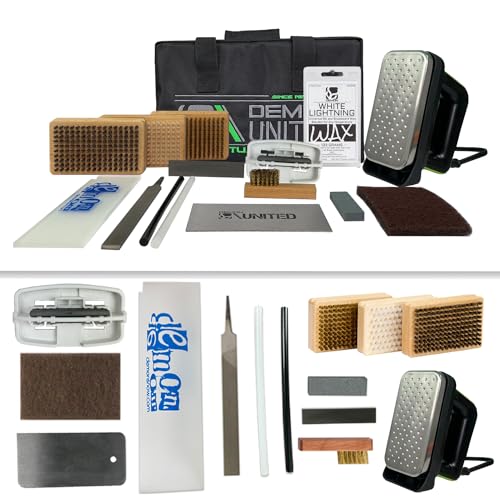
The Demon Complete Ski Tune Kit represents the brand's entry-level answer to all-in-one home maintenance, and our team found it to deliver a genuinely thorough toolset at a price point accessible to recreational skiers who are not yet ready to invest in professional-tier equipment. The kit shares the dual 110V/220V Slide Iron with the Hyper Speed model — a meaningful carry-over from the higher-tier sibling that ensures international travel compatibility without requiring a price premium, and a feature that most competing kits at this budget tier simply do not offer.
Where this kit distinguishes itself most clearly from other entry-level options is in the complete three-stage brush collection: a 10mm brass brush for base structure renewal and pore preparation before waxing, a 10mm nylon brush for removing bulk wax during the tuning process, and an 8mm horsehair brush for final glide-surface polishing. Many kits at this price point include only one or two brushes, forcing supplemental purchases before a proper full brush sequence is possible — the Demon Complete includes all three stages from the first session, which our team considers a significant practical advantage for first-time home tuners learning correct waxing workflow.
The 133g all-season wax allocation is the honest limitation of this kit compared to the Hyper Speed's 1.06-pound block — frequent riders who wax every three to four days of use will deplete the included wax within a single active month and need supplemental blocks. The flat file, edge tuner, tuning stone, wire brush, P-Tex candles, and polish pad cover all maintenance categories competently for recreational use. Our team recommends the Demon Complete as the strongest option for casual home tuners who prioritize having all maintenance categories covered without committing to the wax volume or professional edge tools found in higher-priced sets.
Pros:
- Full three-brush sequence (brass, nylon, horsehair) at the most accessible price point on this list
- Dual 110V/220V Slide Iron matches the higher-tier Hyper Speed for international travel capability
- Vertical-hanging organized carry case mirrors the practical storage design of the Hyper Speed
Cons:
- 133g wax supply requires supplemental wax purchases mid-season for riders who tune frequently
- No base cleaner included — a pre-wax prep step that the Hyper Speed sibling does address
5. Purl Ski & Snowboard Ultimate Tune Kit 2.0 — Best for Traveling Riders
The Purl Ultimate Tune Kit 2.0 is engineered specifically for riders who move between mountains — and frequently across international borders — without wanting to sacrifice kit completeness for the sake of packing convenience. The dual 110/220V waxing iron addresses the primary travel concern directly, and the compact overall format of the kit positions it naturally alongside airline carry-on and checked baggage constraints that larger professional kits frequently violate. Our team found the Purl to be the most travel-optimized complete kit available in 2026 that still includes all three maintenance disciplines without meaningful omissions.
The three-wax selection is a thoughtful departure from the single-block universal approach that most kits at this size offer: Purple all-temperature wax covers mixed-condition uncertainty, Blue cold-condition wax delivers optimized performance on groomed powder days below freezing, and Yellow warm/spring wax manages late-season slush conditions that universal blends handle poorly. Each 68g block is more compact than the large-format blocks in the Demon kits, but the variety compensates for reduced individual volume by allowing condition-matched application across a full seasonal range without supplemental purchases for most recreational riding schedules.
The gummy stone is a particularly important inclusion at this kit's size tier — most competing compact kits at comparable prices omit it entirely, leaving edge detuning and rust removal unaddressed. The full three-brush sequence (nylon, horsehair, brass), P-Tex candles, and brake retainers ensure that no maintenance category is left uncovered. USA-made wax formulation is a quality signal that resonates with riders who pay attention to product sourcing and manufacturing standards. The Purl Ultimate Tune Kit 2.0 is our pick for riders who demand a complete maintenance solution that fits into a travel-ready footprint without compromising the full brush and wax sequence that a proper tune requires.
Pros:
- Dual 110/220V iron and compact format create the strongest travel-ready complete kit on this list
- Three-temperature wax variety covers full seasonal conditions without supplemental purchases
- Gummy stone included — an important edge care tool that most compact kits omit entirely
- USA-made wax formulation signals quality sourcing and manufacturing standards
Cons:
- 68g wax blocks are smaller than comparable kits — high-frequency tuners will deplete them faster
- No base cleaner for pre-wax prep included in the kit contents
6. JOYTUTUS Ski Snowboard Wax Kit — Best All-in-One Accessory Coverage
The JOYTUTUS kit impressed our team as the most thoroughly itemized all-in-one package on this list — featuring four P-Tex candles (two white, two black), two dedicated scrapers (a full-format wax scraper plus a separate metal scraper for tougher base preparation work), fibertex pads, a waxing apron that most competing kits at any price point simply do not include, two ski brake retainers, and a 90mm length file, all alongside the standard iron, brushes, edge tuner, and gummy stone that comparable kits provide. The accessory completeness signals that JOYTUTUS approached kit design by thinking through the full tuning workflow rather than assembling a minimum viable tool list.
The dual-voltage 800W iron operates across 100–125V (US/Canada) and 220–240V (UK/Germany) with a precision thermostat spanning 140°F to 356°F (60–180°C) — the broadest temperature range among all irons on this list, providing the upper-end control needed for hot-scraping base preparation techniques that standard wax application temperatures do not require. High-precision thermostat stability at 800W output ensures consistent soleplate temperature throughout extended waxing sessions on multiple boards, which is where cheaper irons with less stable heating elements produce noticeable inconsistency in wax penetration quality.
The three-brush sequence (brass for base structure, nylon for bulk wax removal, horsehair for finish polishing) follows professional shop workflow precisely and includes clear purpose labeling that makes the correct application order intuitive for riders approaching home tuning for the first time. The snowflake universal wax is a basic all-season formulation — adequate for recreational maintenance but not the temperature-specific precision product that the TOKO and Purl kits offer. The JOYTUTUS kit provides the most accessory-complete package on this list for buyers who want everything in a single purchase without researching or sourcing supplementary workshop items individually.
Pros:
- Waxing apron is a practical workshop inclusion that competing kits at all price points routinely omit
- Dual scrapers (wax + metal) address both routine scraping and tougher base prep tasks separately
- Four P-Tex candles (two white, two black) provide the most base repair material of any kit on this list
- Broadest iron temperature range (60–180°C) enables hot-scraping techniques unavailable with lower-ceiling irons
Cons:
- Universal snowflake wax is a basic formulation rather than a temperature-specific or race-grade selection
- Iron build quality is competent but does not match dedicated brands like TOKO at the professional tier
7. OutdoorMaster Ski Snowboard Tuning and Waxing Kit — Best Entry-Level Pick
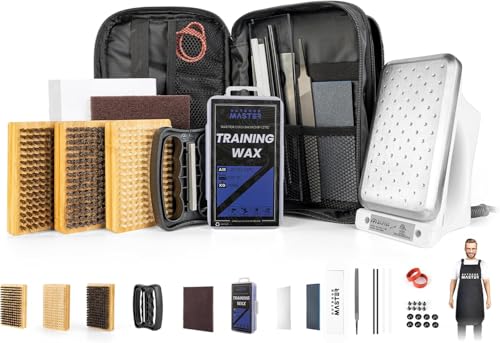
The OutdoorMaster kit occupies a straightforward entry-level position on this list, and our team recommends it specifically for riders transitioning from shop-paid annual tunes to their first season of self-maintenance, where learning the process matters more than optimizing every tool specification. The 110V/800W waxing iron with adjustable temperature from 100°C to 170°C (212°F to 338°F) is functional and adequately stable for basic wax application workflows, though the 170°C temperature ceiling sits below the JOYTUTUS iron's 180°C maximum and limits aggressive hot-scraping base preparation techniques that more experienced home tuners typically incorporate.
The fluorine-free 100g wax block addresses PFAS environmental concerns and FIS competition compliance requirements that have made fluorocarbon waxes illegal at all levels of organized ski racing — a forward-looking formulation choice that aligns with where the broader ski industry is heading regardless of competitive level. The working temperature range of -25°C to -12°C (-13°F to 10°F) covers typical groomed conditions at most North American resorts during the core winter season effectively, though late-season spring riders may find it slightly outside the optimal warm-end specification. The inclusion of sandpaper for edge polishing alongside fibertex pads adds a base surface preparation step that several competing entry-level kits omit.
The three-brush set (nylon, brass, horsehair) covers the complete polishing sequence correctly, and the inclusion of a wax apron matches the JOYTUTUS kit's practical workshop addition that protects work surfaces and clothing during the waxing process. The honest limitation is wax volume: 100g covers approximately 12 waxing applications, which is the lightest allocation on this list and will require supplemental wax purchases relatively early in any active season. The OutdoorMaster is a solid and honest entry point for first-season home tuners who want to learn proper waxing and light edge maintenance without committing significant budget before confirming that regular home tuning fits their routine.
Pros:
- Fluorine-free wax formulation addresses PFAS environmental concerns and competition compliance requirements
- Wax apron included — a practical workshop addition rarely seen at entry-level pricing
- Complete three-brush sequence (nylon, brass, horsehair) covers the full polishing workflow correctly
Cons:
- 100g wax supply covers only approximately 12 applications — the lightest allocation on this list by a significant margin
- Iron temperature ceiling of 170°C limits hot-scraping base preparation techniques
Choosing the Right Ski & Snowboard Tuning Kit: A Buying Guide
The seven kits reviewed above span a meaningful range of specifications, price points, and intended use cases, and selecting the right one requires understanding which variables matter most for specific maintenance goals and riding frequencies. The sections below address the four most impactful decision factors that our team weighs when recommending a kit to any given buyer profile.
Iron Quality and Temperature Control
The waxing iron is the most mechanically critical component in any ski tuning kit, because its temperature stability directly determines how uniformly wax melts, penetrates, and bonds with the base material during application. Irons with unstable soleplate temperatures — a characteristic weakness in lower-cost single-material heating elements — produce inconsistent wax penetration that underperforms regardless of how premium the wax formulation itself might be. Our team specifically looks for irons with a broad temperature range and precision thermostat control, since the ability to drop to lower temperatures for soft waxes and increase to higher settings for hot-scraping base prep makes a single iron usable across all maintenance techniques.
Dual-voltage capability (110V/220V) is a secondary consideration that becomes primary for any rider who visits international resorts — European and South American mountains operate on 220V infrastructure, and a single-voltage iron requires a bulky converter that most riders prefer to avoid. The Demon kits, Purl, and JOYTUTUS all include dual-voltage irons at various price tiers, making them meaningfully more practical for internationally mobile buyers than single-voltage alternatives at similar price points.
Wax Selection: Universal vs. Temperature-Specific
Universal all-temperature waxes simplify the home maintenance workflow by performing acceptably across the broad range of snow temperatures and moisture conditions that most recreational riders encounter across a full season, without requiring pre-application snow temperature assessment. Temperature-specific waxes — the approach TOKO's Yellow/Red/Blue system and Purl's Purple/Blue/Yellow selection represent — deliver measurably better glide performance when matched precisely to current conditions, because their polymer formulations are optimized for narrower hardness and viscosity ranges that universal waxes compromise across.
Our team's position is that most recreational home tuners benefit from starting with a high-quality universal wax and establishing a consistent waxing routine before investing in temperature-specific selections — the process discipline of regular waxing at any quality level outperforms occasional perfect-condition-matched applications on neglected bases. Competitive racers and performance-focused riders who already maintain regular wax schedules will see genuine on-snow speed differences from condition-matched waxes, making the TOKO or Purl approach a worthwhile investment at that experience level.
Edge Tools: Files, Stones, and Tuners
A complete edge toolkit requires at minimum three components to address the full maintenance sequence: a file for initial edge shaping and base grinding, a diamond stone for fine refinement that brings edge sharpness to carving-precision specification, and a gummy stone for rust removal, tip-and-tail detuning, and burr smoothing between sharper tool passes. The entry-level kits on this list typically include a file and basic edge tuner, while professional-tier options like the RaceWax Elite provide all three stages plus a brass file brush that extends the cutting file's useful life by clearing metal filings between passes.
Riders who perform frequent edge work or compete at any level should consider pairing their tuning kit with a dedicated workstation setup — our review of the best ski and snowboard tuning vises covers the clamping stations that create a stable base for file work and edge angle maintenance, which is significantly more precise and consistent than attempting edge tuning on an unsupported board balanced across a workbench or chair.
Portability, Kit Organization, and Carry Solutions
The carry case or bag provided with each kit affects day-to-day usability as meaningfully as the tools themselves, particularly for riders who transport their maintenance gear between home, resort accommodation, and mountain storage. Rigid cases with vertical hanging capability — as featured in both Demon kits — provide excellent organization in cramped lodge lockers and van storage configurations. Soft Cordura bags like the RaceWax Elite's handle travel impact well and carry more total tool volume without dimensional constraints. Compact soft kits like the Purl optimize for airline-friendly packing at the expense of total tool capacity.
Our team recommends that buyers identify where their primary tuning sessions will take place before selecting based on carry format — home workshop users who tune on a fixed workbench benefit most from maximum tool completeness regardless of bag size, while resort-based tuners who travel by air between destinations gain more practical value from the dual-voltage iron and compact format that travel-optimized kits prioritize. The right answer depends entirely on the specific maintenance context each rider operates in, not on any universal preference for compact versus comprehensive packaging.
Frequently Asked Questions
How often should skis and snowboards be waxed for optimal performance?
Most professional ski technicians recommend waxing every three to five days of active on-mountain use, or whenever the base appears white and dried-out rather than dark and hydrated when examined in flat light. Riders who ski frequently in cold dry snow conditions — which pulls wax out of the base faster than warmer wet snow — may need more frequent applications, while spring slush conditions typically require less frequent waxing cycles due to the higher moisture content of the snow itself providing natural lubrication alongside the wax layer.
What is the practical difference between universal and temperature-specific ski wax?
Universal waxes are formulated to perform acceptably across a broad range of snow temperatures and moisture conditions, making them the most practical choice for recreational home tuners who want simplicity over optimization and whose riding frequency does not justify managing a multiple-wax inventory. Temperature-specific waxes are optimized for narrower hardness and viscosity ranges — Yellow for warm/spring conditions, Red for mid-range, Blue for cold — and deliver measurably better glide performance when correctly matched to current snow conditions, which is why professional racing support technicians rely on precisely matched selections and carry multiple wax types to the hill each competition day.
Do beginners need a complete tuning kit or just a basic wax block and iron?
Most beginners benefit significantly from a complete kit, because edge maintenance, base cleaning, and proper brush finishing are all essential components of a tune that produces noticeably better results than waxing alone — skipping the brush sequence leaves excess wax on the base surface that increases rather than decreases friction, and neglecting edge work allows burrs and oxidation to undermine carving precision regardless of how well-waxed the base is. A complete kit ensures that the full maintenance sequence is accessible from the first session without requiring supplemental purchases as tuning knowledge grows.
Can the same tuning kit work for both skis and snowboards without modification?
Yes — all seven kits reviewed here explicitly support both skis and snowboards, since the waxing, edge tuning, and base repair processes are fundamentally identical for both disciplines in terms of technique and tool requirements. The primary practical consideration is base width: snowboard bases are significantly wider than ski bases and require more wax per pass and longer scraping strokes to cover the full base surface uniformly, which affects how quickly a given wax block depletes across a season for riders who maintain both types of equipment from the same kit.
What does a gummy stone (gummi stone) do in a ski tuning kit?
A gummy stone — also called a gummi stone or rubberized abrasive block — performs several edge care tasks that neither a metal file nor a diamond stone addresses effectively: it removes surface rust from edges that develops during storage or wet conditions, smooths burrs left after file sharpening, rounds the sharp edge corners at tips and tails to reduce unwanted catching behavior at the start and end of each turn, and polishes the edge surface to a consistent finish that improves overall glide feel. The gummy stone operates between the file and diamond stone in the full edge refinement sequence and produces a smooth, burr-free edge surface that sharper tools alone cannot achieve.
Is fluorine-free wax as fast as traditional fluorocarbon wax for recreational riders?
Modern fluorine-free wax formulations have closed the performance gap with traditional fluorocarbon waxes substantially, and FIS regulatory changes have made fluorocarbon waxes illegal in all levels of organized ski competition as of the 2023–2024 season — which means the entire professional racing ecosystem has collectively validated fluorine-free alternatives as race-worthy at the highest performance levels. For recreational riders at typical resort speeds, the on-snow performance difference is negligible in practical terms, and fluorine-free waxes offer meaningful environmental benefits related to PFAS contamination of mountain snowfields and water systems, making them the responsible default choice for all levels of recreational and competitive use in 2026.
Buy on Walmart
- RaceWax Elite Ski and Snowboard Tuning and Waxing Kit - Comp — Walmart Link
- TOKO All-Inclusive Ski & Snowboard Wax Kit with T18 Iron, Ny — Walmart Link
- Demon Hyper Speed Ski & Snowboard Tune Kit with Iron, 1lb Wa — Walmart Link
- Demon Complete Ski Tune Kit with Wax and Brush Kit- Snowboar — Walmart Link
- Purl Ski & Snowboard Ultimate Tune Kit 2.0 | Complete Kit wi — Walmart Link
- JOYTUTUS Ski Snowboard Wax Kit, Complete and Portable Snowbo — Walmart Link
- OutdoorMaster Ski Snowboard Tuning and Waxing Kit with Waxin — Walmart Link
Buy on eBay
- RaceWax Elite Ski and Snowboard Tuning and Waxing Kit - Comp — eBay Link
- TOKO All-Inclusive Ski & Snowboard Wax Kit with T18 Iron, Ny — eBay Link
- Demon Hyper Speed Ski & Snowboard Tune Kit with Iron, 1lb Wa — eBay Link
- Demon Complete Ski Tune Kit with Wax and Brush Kit- Snowboar — eBay Link
- Purl Ski & Snowboard Ultimate Tune Kit 2.0 | Complete Kit wi — eBay Link
- JOYTUTUS Ski Snowboard Wax Kit, Complete and Portable Snowbo — eBay Link
- OutdoorMaster Ski Snowboard Tuning and Waxing Kit with Waxin — eBay Link
The best tuning kit is the one used consistently — sharp edges and a waxed base before every trip to the hill will outperform the most expensive gear in the world that was last tuned three seasons ago.
 |
 |
 |
 |

About Frank V. Persall
Frank Persall is a lifelong skier originally from the United Kingdom who has spent years pursuing the sport across premier resorts in Europe, North America, and beyond. His passion for skiing has taken him from the Alps to the Rocky Mountains, giving him a broad perspective on resort terrain, snow conditions, gear performance across price points, and the practical realities of ski travel with a family. At SnowGaper, he covers ski resort guides, gear reviews, and skiing technique and travel resources for enthusiasts of every level.
You can get FREE Gifts. Or latest free skiing books here.
Disable Ad block to reveal all the info. Once done, hit a button below
|
|
|
|