Eight interconnected mountain peaks — that's the full scale of the Sunday River ski resort peaks, making this Maine resort one of the most terrain-rich destinations in the northeastern United States. While most New England resorts operate from a single summit, Sunday River spans eight connected peaks covering 870 skiable acres, more than 135 trails, and 2,340 vertical feet. If you're comparing ski resorts along the East Coast and want genuine variety, this number matters. Planning a snow skiing vacation around eight interconnected summits is a completely different experience than a typical single-mountain resort day.

Sunday River sits in Newry, Maine, and has been growing since the late 1950s, adding peak after peak through deliberate expansion. According to Wikipedia's Sunday River overview, the resort gradually connected its terrain over decades, ultimately linking eight distinct summits into one continuous ski-in, ski-out mountain experience. That kind of connected layout is uncommon even among larger Western resorts.
Each of the eight peaks has its own personality — different trail counts, different elevation profiles, and different ideal riders. Whether you're chasing steep expert chutes or looking for wide groomed cruisers, knowing the mountain's layout before you arrive will save you time and make your days on the snow considerably better.
Contents
- What the Sunday River Ski Resort Peaks Actually Cover
- A Breakdown of All 8 Peaks
- Trail Map and Getting Around the Mountain
- Lift Ticket Pricing and Pass Options
- Matching Each Peak to Your Skill Level
- Common Obstacles When Exploring All 8 Peaks
- Pro Tips for Getting the Most From Sunday River's Terrain
- Frequently Asked Questions
What the Sunday River Ski Resort Peaks Actually Cover
Sunday River's eight peaks aren't separate ski areas — they're one continuous mountain system. You ski across saddles and connecting trails to move between summits without ever unclipping. That's the key distinction. Here's a quick snapshot of all eight:
| Peak | Primary Difficulty | Best For | Notable Feature |
|---|---|---|---|
| White Cap | Expert | Advanced skiers | Highest summit; home to White Heat |
| Barker Mountain | All levels | Everyone | Resort hub; most lifts and base services |
| Aurora Peak | Intermediate/Expert | Strong intermediates | Long top-to-bottom runs |
| Jordan Bowl | Expert | Powder and glade skiers | North-facing; holds snow longer |
| North Peak | Intermediate | Cruisers | Wide, well-groomed trails |
| Oz | Intermediate | Mid-level skiers | Varied, accessible terrain |
| Spruce Peak | Beginner/Intermediate | Families and learners | Gentle slopes; great for building confidence |
| Locke Mountain | All levels | Mixed ability groups | Connecting terrain between peaks |
The total 870 acres sounds large on paper — and it is. For context, that's roughly three times the size of a typical regional New England ski hill. You're not going to cover everything in a single day, and that's intentional.
A Breakdown of All 8 Peaks
Each summit at Sunday River has its own lift access, trail network, and reputation among regulars. Here's what you need to know before you point your skis in any direction.
White Cap
White Cap is the highest peak at Sunday River, and it earns that status. This is expert territory. It's home to White Heat, widely considered one of the most demanding trails in the eastern United States — a sustained steep pitch with exposed ice on cold days and real consequences for a missed edge.
Barker Mountain
Barker is the central hub of Sunday River. Most services, lodges, and lift infrastructure cluster here. You'll find a wide mix of terrain — beginner-friendly green runs to challenging black diamonds — all on the same mountain. If you arrive at the resort without a plan, starting at Barker gives you the most options.
Pro tip: Start your first day at Barker Mountain — it's the easiest place to get your bearings, grab a trail map, and connect to every other corner of the resort from a central starting point.
Aurora Peak
Aurora Peak delivers some of Sunday River's longest continuous runs. Intermediate and strong advanced skiers will get the most out of it. The terrain transitions smoothly between blue and black trails, making it a natural place to push yourself without fully committing to expert-only terrain.
Jordan Bowl
Jordan Bowl is a favorite for skiers who love tree skiing and preserved powder. Its north-facing orientation means snow stays cold and dry longer than on other peaks. Expert-level glades here rank among the best in the East — go after a fresh storm and you'll understand why locals protect this one.
North Peak
North Peak is the cruiser's paradise. Long groomed intermediate runs dominate this area. If you want to rack up vertical at a comfortable pace without committing to expert terrain, North Peak is where you'll spend a lot of time — and where you might start to wonder just how fast you're actually going on those wide-open pitches.
Oz
Oz sits between the beginner-friendly zones and the steep expert peaks, making it a natural progression area. The terrain mix of blue and black trails keeps things interesting. Intermediate skiers who are actively building their skills will find Oz challenging without being overwhelming — the kind of peak you revisit throughout the trip as a confidence check.

Spruce Peak
Spruce Peak is Sunday River's gentlest terrain. Beginners and families with younger kids will feel the most at ease here. Runs are wide, gradients are forgiving, and the atmosphere is considerably calmer than the upper peaks. It's also close enough to Barker's services that you're never far from a warm-up stop.
Locke Mountain
Locke Mountain rounds out the eight and offers a mix of terrain suitable for most abilities. It functions partly as a connector between other peaks, but it has its own trail network worth exploring — especially if you want a quieter experience away from the most trafficked zones of the resort.
Trail Map and Getting Around the Mountain
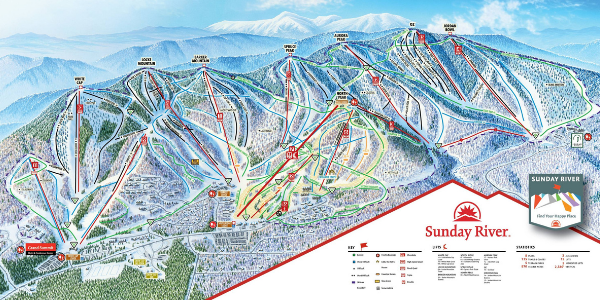
One of the smartest things you can do before your first day at Sunday River is study the trail map. The resort stretches nearly three miles from one end to the other — wide enough that navigating it without a plan costs you real time.
How the Lift Network Works
Sunday River operates 15 lifts across the mountain, including high-speed detachable quads. Here's what you need to know in practice:
- Most lifts cluster around Barker Mountain and North Peak — these are your primary hubs
- Reaching Jordan Bowl requires traversing through Aurora Peak; don't wait until late afternoon
- White Cap has its own dedicated lift access, but it sits at the far eastern end of the resort
- The South Ridge connector trail is the key link between the eastern and western halves of the mountain
- Some connecting routes are flat cat tracks — you'll need to pole or skate to keep momentum
Skiing from Peak to Peak
The resort is designed so you can move between all eight peaks entirely on snow. There's no shuttle required. However, flat connector trails and limited uphill options mean that once you ski to a far peak like Jordan Bowl or White Cap, you've committed to that side of the mountain for a while. Plan accordingly.
Lift Ticket Pricing and Pass Options
Access to all Sunday River ski resort peaks comes with a single lift ticket — there's no peak-specific upcharge. That said, pricing varies significantly depending on when and how you buy.
Your Main Ticket and Pass Choices
- Window tickets — walk-up prices are the most expensive option and can exceed $150/day during peak periods
- Online advance tickets — buying ahead, even a few days, often saves 20–30% off the window rate
- Ikon Pass — Sunday River participates in Ikon; full pass holders get unlimited days, base pass holders get a set number of visits
- Sunday River season pass — covers the full season with no resort-level blackouts
- Multi-day tickets — per-day cost drops noticeably when you commit to three or more consecutive days
If you're planning your ski trip around multiple days at Sunday River, the math on passes versus day tickets becomes very clear very fast. Signing up for the resort's email list is the simplest way to catch early-season promotions before they expire.
Matching Each Peak to Your Skill Level
Sunday River genuinely has terrain for every ability level. But not every peak delivers that same range. Knowing where to go — and where to avoid — makes the difference between a frustrating day and a great one.
Beginners and First-Timers
- Best peaks: Spruce Peak, Locke Mountain
- These areas have the widest, most forgiving runs with minimal exposure to steep terrain
- Instruction and rental centers are closest to Barker — convenient for lesson pickups
- Avoid the far-end expert peaks early in your trip; you could navigate onto terrain above your skill level without realizing it
Intermediate Skiers
- Best peaks: North Peak, Oz, Aurora Peak
- These three peaks offer long groomed runs with manageable challenge and good vertical
- Aurora gives you a taste of steeper terrain when you're ready to push
- North Peak's open pitches let you build speed comfortably and dial in your technique
Advanced and Expert Skiers
- Best peaks: White Cap, Jordan Bowl, Barker's black terrain
- White Heat on White Cap is a genuine test — sustained steepness with limited margin for error
- Jordan Bowl rewards patience; go after a fresh snowfall for the best glade experience
- Barker's black trails are accessible but technical enough to stay interesting for strong skiers
Common Obstacles When Exploring All 8 Peaks
Covering all eight peaks during your stay is a realistic goal — but it takes more planning than most people expect. These are the obstacles that trip people up most often.
Warning: Maine weather shifts fast — ice conditions, wind holds, and lift closures can cut off access to White Cap and Jordan Bowl with little notice, so check the mountain report each morning before committing to a far-peak itinerary.
Getting Stranded on One Side
The resort runs east-west, and the peaks at each end are a significant ski from each other. Spend your whole morning on one side and you may not have the energy or daylight to cross to the other.
- Plan peak-crossing early in the day when your legs are fresh
- Identify mid-mountain lunch spots in advance to avoid backtracking
- Mark your connecting routes on the trail map before leaving the base lodge
Crowd Timing on Popular Peaks
On busy weekends, Barker and North Peak can see noticeable lift lines and congested trails by mid-morning. Experienced local skiers know to push toward Jordan Bowl or White Cap when the central peaks get crowded — and come back to Barker in the afternoon when lines thin out.
Managing Mixed-Ability Groups
If you're skiing with people at different skill levels, route planning gets more complicated. Before committing to any peak, check the trail map for green bailout options — every peak has at least one easier route down, but you need to know where it is before you need it.
Pro Tips for Getting the Most From Sunday River's Terrain
These habits separate a solid day at Sunday River from a genuinely great one. They apply regardless of your skill level or how many days you're spending at the resort.
- Start early. First chair means minimal lines and freshly groomed corduroy on every peak — the conditions won't stay that clean once crowds arrive.
- Work east in the morning. Head toward White Cap and Jordan Bowl first. These peaks get the most wind exposure and can ice up or close as the day progresses.
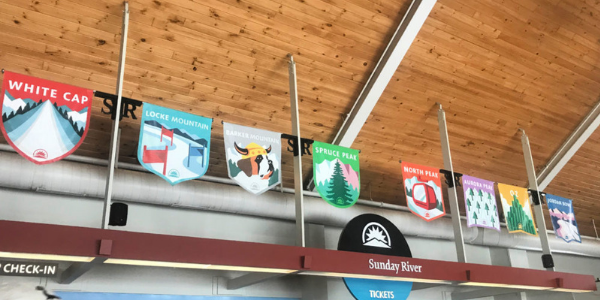
- Use the badge challenge as a framework. Sunday River's collectible peak badge program gives you a built-in reason to visit every summit — and a structured goal if you ski better with a clear objective in mind.
- Stay close to the mountain. Bethel, Maine has several lodging options within striking distance of the slopes. Less commute time means more time exploring what makes this one of the East's top destinations.
- Layer for Maine conditions. Cold, wind, and wet snow can all show up on the same day. A mid-layer system gives you flexibility a single heavy jacket can't match.
- Pace yourself across multiple days. Eight peaks is a lot of vertical over consecutive days. Taking it easier on day two means your legs will still be working on day three.
Frequently Asked Questions
How many peaks does Sunday River ski resort have?
Sunday River has eight interconnected peaks: White Cap, Barker Mountain, Aurora Peak, Jordan Bowl, North Peak, Oz, Spruce Peak, and Locke Mountain. All eight are accessible with a single lift ticket and connected by on-snow trails.
What is the best peak for beginners at Sunday River?
Spruce Peak and Locke Mountain are the most beginner-friendly options. They offer wide, gentle runs without the steep pitch you'll find on the upper expert peaks, and they're close to Barker's services and instruction facilities.
Is Sunday River good for expert skiers?
Yes. White Cap and Jordan Bowl are the standout expert peaks. White Heat on White Cap is considered one of the most demanding trails in the East, and Jordan Bowl's north-facing glades hold quality powder longer than most peaks at the resort.
Can you ski all 8 peaks in one day at Sunday River?
It's physically possible but demanding. You'll need to start at first chair, move efficiently across connector trails, and maintain a solid pace. Most visitors find that spreading the peaks across two or three days leads to a better overall experience.
What pass gives you access to all Sunday River peaks?
Any standard day ticket or season pass covers all eight peaks — there's no peak-specific surcharge. The Ikon Pass also includes Sunday River access, with the number of days depending on whether you hold a full or base pass.
What is the Sunday River peak badge challenge?
Sunday River offers collectible badges for skiing each of the eight peaks. The challenge is a fun, structured way to make sure you visit every summit during your stay — each badge is earned by completing a run on the corresponding peak.
How far apart are the peaks at Sunday River?
The resort spans roughly three miles from one end to the other. White Cap and Spruce Peak sit at opposite ends, so plan your routing carefully and avoid leaving cross-mountain travel for late in the afternoon.
When is the best time to visit Sunday River for all-peak skiing?
Mid-season — typically late January through early March — offers the most reliable snow coverage across all eight peaks. Early and late season may limit access to some terrain, particularly the higher expert summits at White Cap and Jordan Bowl.
Eight peaks on a single lift ticket sounds like a marketing line until you're standing at the top of White Cap looking across at seven more summits waiting for you.
 |
 |
 |
 |

About Frank V. Persall
Frank Persall is a lifelong skier originally from the United Kingdom who has spent years pursuing the sport across premier resorts in Europe, North America, and beyond. His passion for skiing has taken him from the Alps to the Rocky Mountains, giving him a broad perspective on resort terrain, snow conditions, gear performance across price points, and the practical realities of ski travel with a family. At SnowGaper, he covers ski resort guides, gear reviews, and skiing technique and travel resources for enthusiasts of every level.
You can get FREE Gifts. Or latest free skiing books here.
Disable Ad block to reveal all the info. Once done, hit a button below
|
|
|
|