Which ski goggles actually keep fog out when the temperature drops, your face sweats, and you're pushing hard through a mogul field? That's the question every skier asks before the season kicks off. The answer in 2026 is clear: the Oakley Flight Tracker L takes the top spot for most riders, combining Prizm lens technology with a serious anti-fog coating that holds up run after run. But the right goggle for you depends on your head shape, your budget, and how much light versatility you need — so keep reading.
Foggy lenses aren't just annoying. They're dangerous. You can't react to an icy patch or a skier cutting across your line if your vision is a white haze. Ski goggles have come a long way — modern anti-fog systems use double-lens construction, vented foam, and hydrophilic (moisture-absorbing) coatings to keep clarity in every condition. Understanding how these systems work helps you choose the right pair. Whether you're a weekend warrior or planning a full season across multiple resorts, check out our full ski gear reviews section for more expert picks.
We tested and researched the top options on the market for the 2026 season. Below you'll find detailed reviews of the 6 best anti-fog ski goggles, a buying guide packed with practical advice, and answers to the most common questions buyers ask. Let's get into it.

Contents
Top Rated Picks of 2026
- #PreviewProductRating
- Bestseller No. 1
 Rating:

- Bestseller No. 2
 Rating:
 - Bestseller No. 3
 Rating:
 - Bestseller No. 4
 Rating:
 - Bestseller No. 5
 Rating:
 - Bestseller No. 6
 Rating:
 - Bestseller No. 7
 Rating:
Detailed Product Reviews
1. Oakley Flight Tracker L Matte Black Prizm Black Iridium — Best Overall
The Oakley Flight Tracker L earns its top spot by doing the fundamentals exceptionally well. The oversized toric (curved in two directions) lens design gives you a massive field of view — you'll notice the difference the first time you put them on. Oakley built the Flight Tracker L specifically for larger head sizes, and the fit feels intentional rather than just "bigger." The frame integrates cleanly with most helmets, which matters when you're spending a full day on the mountain.
The real magic is in the lens system. Prizm Snow lens technology enhances contrast on snow — it brings out texture in flat-light conditions where generic lenses would leave the terrain looking like a uniform white sheet. The F3 Anti-Fog coating absorbs moisture from inside the goggle rather than letting it condense on the lens surface. Plutonite lens material blocks 100% of UVA, UVB, and UVC radiation, plus harmful blue light up to 400nm. These aren't marketing claims — Oakley's optical standards (HDO, or High Definition Optics) are measured against ANSI testing benchmarks that cheaper brands skip entirely.
For 2026, if you're looking for one goggle that handles everything from groomed blue runs to variable storm light, this is the one to start with. The Prizm Black Iridium tint works best in bright to moderate light. If you ski frequently in low light or at night, check our guide to the best goggles for night skiing for a Prizm tint comparison.
Pros:
- Prizm lens technology dramatically improves contrast and terrain definition
- F3 Anti-Fog coating absorbs moisture for fog-free performance all day
- 100% UV protection including UVC and blue light up to 400nm
- Oversized toric design maximizes peripheral field of view
- Engineered for large-fit helmet compatibility
Cons:
- Prizm Black Iridium tint is not ideal for flat light or overcast days
- Premium price point — lens swapping requires purchasing additional Prizm lenses separately
2. SMITH I/O MAG Snow Goggles — Best Lens Technology
If you ski across a wide range of conditions — sunny mornings, afternoon cloud cover, evening runs — the SMITH I/O MAG is the goggle for you. The MAG system uses magnets to swap lenses in seconds. You're not fumbling with clips or prying at the frame. Pull one lens off, snap another on, and you're back on the lift in under a minute. For serious skiers who carry a second lens in their jacket pocket, this level of lens versatility is a game-changer.
ChromaPop lens technology is Smith's answer to Oakley's Prizm. It works by filtering specific wavelengths of light to boost contrast and natural color definition. The result is that tree lines look sharper, snow texture pops, and icy patches stand out before you're on top of them. The smudge- and moisture-resistant coatings mean your lenses stay clear even when you wipe them with a glove — something cheaper goggles completely fail at. The ChromaPop Everyday Blue Mirror included here covers a wide range of light conditions, making it a smart daily driver lens.
The field of view is what Smith calls "widescreen" — and it lives up to the name. You lose awareness of the goggle frame within minutes of putting them on. Anti-fog performance comes from a combination of the dual-lens construction, ventilation channels in the foam, and the ChromaPop coating's moisture resistance. For women and men with medium-sized faces, the fit is spot-on. If you have a larger head, cross-reference the SMITH sizing guide before buying.
Pros:
- MAG magnetic lens swap system — fastest on the market
- ChromaPop technology enhances contrast, natural color, and definition
- Smudge- and moisture-resistant lens coatings for easy cleaning
- True widescreen field of view minimizes frame awareness
- 100% UV protection
Cons:
- Replacement lenses sold separately add to total cost over time
- Medium-fit frame may not suit all head shapes — check sizing before ordering
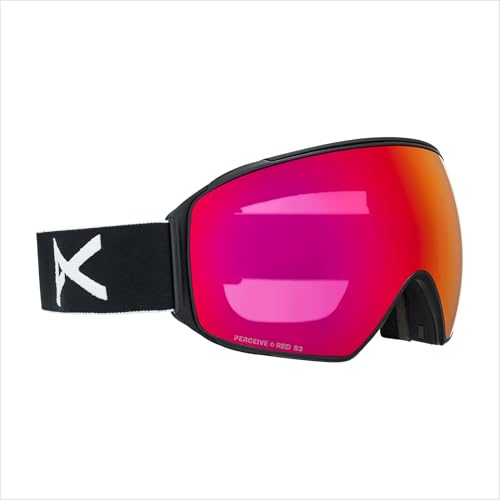
3. Anon M4 Goggles (Toric) + Bonus Lens + MFI Face Mask — Best Premium Pick
The Anon M4 is the full package. You get the goggles, a bonus lens, and an MFI (Magnetic Face Mask Integration) face mask — all in one box. The toric lens shape (curved both horizontally and vertically) reduces distortion at the edges of your vision compared to flat or simple spherical lenses. Perceive lens technology is Anon's proprietary color enhancement system, and the Perceive Sunny Red tint included here is optimized for bright, high-contrast days.
The Magna-Tech magnetic lens change system is Anon's equivalent of Smith's MAG — magnets hold the lens in place securely while still allowing fast swaps. Anti-fog performance on the M4 is exceptional. The dual-lens construction creates a thermal barrier that prevents warm air from your face from hitting the cold outer lens surface — the main cause of fogging. The included bonus lens (lower VLT, meaning it lets in more light) handles cloudy and overcast conditions so you're covered no matter what the mountain throws at you.
The MFI face mask integrates magnetically with the goggle frame — no gap between your goggles and mask, which eliminates the cold air that would otherwise sneak in and contribute to fogging. If you're the type of skier who hates adjusting face coverings mid-run, the MFI system solves that problem completely. The M4 is a premium investment, but you're getting three pieces of gear in one purchase with no compromises on performance.
Pros:
- Includes bonus lens and MFI magnetic face mask — exceptional value for a kit
- Toric lens with Perceive technology reduces edge distortion and boosts contrast
- Magna-Tech magnetic lens system for secure, fast swaps
- MFI face mask eliminates gap fogging at the goggle-mask junction
- Dual-lens thermal barrier for all-day anti-fog performance
Cons:
- Higher price point than most options on this list
- Larger frame profile — check helmet compatibility before purchasing
4. Giro Axis Adult Snow Goggle — Best for Contrast Vision
Giro partnered with Zeiss — the optics company that makes lenses for high-end cameras and medical equipment — to develop VIVID lens technology. That partnership is what separates the Giro Axis from similarly-priced competitors. VIVID optics work by selectively manipulating blue light: letting in the wavelengths that enhance contrast on snow while blocking the UV wavelengths that cause eye strain and long-term damage. The result is terrain definition that makes you feel like someone turned up the resolution of the mountain.
The lens interchange system on the Axis uses self-locating magnets with four snap pins — the magnets guide the lens into position, and the pins lock it there. It's fast, it's secure, and it doesn't fail in cold temperatures the way some all-magnet systems can. EVAK Vent Technology is Giro's anti-fog system: vents release moisture-laden warm air from inside the goggle, and the foam surrounding the vents is made from a non-absorbent material that won't get waterlogged and collapse the airflow over a long day.
If you do a lot of different types of skiing — groomed runs, off-piste, moguls — the Axis handles the variety well. The dual VIVID lenses included (Smoke and Infrared) give you options across a wide light spectrum. The frame is a comfortable medium fit that works with most helmets without requiring adapter foam.
Pros:
- VIVID lens technology co-developed with Zeiss for premium optical clarity
- Magnet-assisted + snap-pin lens system is both fast and secure
- EVAK Vent Technology releases moisture without collapsing in wet conditions
- Dual-lens kit included — Smoke and Infrared cover bright and low-light conditions
- Comfortable medium fit compatible with most ski helmets
Cons:
- VIVID replacement lenses are a proprietary system — harder to find than Smith or Oakley replacements
- Frame design is less forgiving for very wide faces
5. SCOTT React Ski Goggles — Best Wide-View Option
The SCOTT React is the most straightforward option on this list — and that's a compliment. No overly complex marketing language, just a well-engineered goggle that delivers on its three core promises: quick lens changes, wide peripheral vision, and anti-fog double-lens construction. If you want a capable goggle without paying premium-brand prices, the React deserves serious attention.
The optimized frame geometry is what earns it the "wide-view" label here. SCOTT designed the React's lens curvature and frame cutout to push your field of view outward in all directions, particularly at the periphery (edges). You'll notice the expanded awareness immediately when moving through tree runs or crowded resort terrain. The quick lens change system is tool-free — you can swap lenses with cold gloves on, which matters when you're at 9,000 feet and the light changes fast.
Anti-fog performance comes from the anti-fog double-lens system that maintains a thermal air gap between the inner and outer lens. In variable temperatures — the conditions where single-lens goggles fail fastest — the React stays clear. For skiers planning trips to resorts with unpredictable weather, this reliability is worth prioritizing. Whether you're hitting the slopes at Beaver Mountain or exploring international destinations, consistent fog-free optics make every run safer.
Pros:
- Optimized frame geometry for superior peripheral field of view
- Tool-free quick lens change system works with gloves on
- Anti-fog double-lens construction handles variable temperature conditions
- Straightforward design without unnecessary complexity
- Competitive price relative to performance level
Cons:
- Lens technology is functional but not as advanced as Prizm, ChromaPop, or VIVID
- Limited color and tint variety compared to larger brands
6. Electric Visual EG2-T.S Goggle — Best for Variable Light
Electric Visual has been a sleeper pick in ski optics for years, and the EG2-T.S makes a strong case for the brand going into 2026. The headline spec here is the Nuron lens system with a VLT (Visible Light Transmission) range of 16%–47% across S1–S3 tint categories. What does that mean for you? It means one lens that adapts to a wide range of lighting conditions — from bright sunny days down to flat light and overcast grey. That's unusually wide coverage for a fixed lens.
The injected toric polycarbonate lens comes with anti-reflective coating, super anti-fog treatment, and a hard anti-scratch coating — three coatings stacked on one lens. Most goggles pick two of those three. Electric stacked all three here without compromising optical clarity. The lens is engineered with specific pigments (rather than simple dyes) that filter light more precisely, producing colors that feel accurate rather than artificially boosted.
The EG2-T.S is OTG (over-the-glass) compatible, meaning it fits over prescription eyeglasses — a feature that many riders with corrective lenses need but that premium-tier goggles often drop for the sake of a slimmer profile. It's also unisex and helmet compatible. The one-year warranty gives you peace of mind on a mid-range investment. If you hate carrying a second lens and want the widest light coverage in a single piece of glass, this is your goggle.
Pros:
- VLT 16%–47% range covers the widest light spectrum of any goggle on this list
- Stacked coatings: anti-reflective, super anti-fog, and hard anti-scratch
- OTG (over-the-glass) compatible for prescription eyeglass wearers
- Engineered pigment lens technology for accurate color rendering
- 100% UV protection with wide peripheral vision design
Cons:
- Non-interchangeable lens system — less versatile for extreme light changes
- Brand recognition lower than Oakley, Smith, or Giro — harder to find in stores for hands-on fit testing
7. Wildhorn Outfitters Roca Ski Goggles — Best Value
Not everyone wants to spend over $200 on ski goggles — and with the Wildhorn Roca, you don't have to. These goggles are the official supplier to the US Ski Team, which is a meaningful credential for a goggle at this price point. The six N45 rare-earth magnets plus integrated clip locking system is what sets the Roca apart from cheap competition: you get a genuinely fast lens swap system (under 60 seconds, per the brand) and a secure hold that survives crashes without popping the lens out.
Seven Aurora lens options are available across the Roca lineup, covering tints for everything from bright sunlight to low-visibility conditions. UV400 protection blocks 100% of UV rays — the same standard as premium goggles — and the semi-frameless design maximizes your field of view without the bulk of a full frame. Wildhorn designed these in Utah (home of some of the best powder in North America), and the performance reflects that local testing focus.
These are ideal for beginners, kids (check the Junior size option), and budget-conscious riders who want reliable anti-fog performance and interchangeable lenses without maxing out their gear budget. They're also a smart choice as a backup goggle — something you throw in the bag when your primary pair is back in the lodge or lost in a snowbank. If you're newer to the sport and still figuring out what terrain you prefer, read through our tips for beginner skiers before investing in top-tier gear.
Pros:
- Official US Ski Team supplier — performance credibility at a budget price
- Six N45 magnets + clip lock for fast and crash-secure lens retention
- Seven Aurora lens tint options for full light-condition coverage
- UV400 protection matches premium-tier standards
- Semi-frameless design for expanded field of view
- Available in Junior sizing for younger riders
Cons:
- Lens technology doesn't match ChromaPop, Prizm, or VIVID for contrast enhancement
- Foam seal quality is functional but not as plush as premium-tier goggles
Buying Guide: How to Choose the Best Anti-Fog Ski Goggles
With so many options in 2026, picking the right anti-fog ski goggles comes down to matching specs to your actual skiing habits. Here's what to evaluate before you buy.
Anti-Fog System: What Actually Keeps the Lens Clear
Not all anti-fog claims are equal. There are three main approaches, and the best goggles stack multiple layers:
- Double-lens construction — Two lenses separated by a thermal air gap prevent warm face air from contacting the cold outer lens. This is the most effective passive system and is standard on every goggle on this list.
- Hydrophilic coatings (moisture-absorbing, like Oakley's F3) — A chemical coating on the inner lens absorbs moisture vapor before it can condense into fog. Better than no coating, but degrades over time if you wipe the inner lens repeatedly.
- Ventilation systems — Strategically placed vents (like Giro's EVAK) allow warm, moist air to escape. The foam surrounding the vents matters too: non-absorbent foam maintains airflow even when wet.
The goggles most likely to fog are cheap single-lens designs without ventilation. On this list, every pick uses double-lens construction at minimum. If you run hot or ski hard, prioritize goggles with active venting plus a hydrophilic coating — both the Oakley Flight Tracker and Giro Axis deliver that combination.
Lens Technology: Contrast vs. Color Accuracy
Lens quality matters more than most buyers realize. Here's how the main technologies compare:
- Prizm (Oakley) — Boosts specific wavelengths for snow terrain. Excellent contrast in defined conditions. Best in consistent light.
- ChromaPop (Smith) — Enhances color definition and contrast while maintaining natural color balance. Versatile across conditions.
- VIVID/Zeiss (Giro) — Selectively filters blue light for superior contrast on snow. Co-developed with a premium optics partner.
- Perceive (Anon) — Optimized color rendering with proprietary tint spectrum. Strong in bright conditions.
- Standard VLT-rated lenses — Found on SCOTT, Electric, and Wildhorn. Functional and effective, but without the proprietary contrast-boosting processing of the premium technologies above.
If you mostly ski groomed runs in variable weather, ChromaPop or VIVID gives you the most flexibility. For dedicated powder and backcountry days, Prizm shines.
Fit, Helmet Compatibility, and Face Shape
A goggle that doesn't seal against your face will fog — no matter how good the anti-fog system is. Cold air leaks in through gaps and creates condensation. Before buying, consider:
- Face shape — Most brands offer small/medium/large frames. Taller faces need a taller lens height. Wider faces need a wider nose bridge.
- Helmet compatibility — Check that your goggle's top vent doesn't get blocked by your helmet's brow. Oakley and Smith specifically engineer for this.
- OTG (over-the-glass) — If you wear prescription glasses, you need OTG-compatible goggles. The Electric EG2-T.S is the best OTG option on this list.
- Foam thickness and layers — Triple-layer foam creates a better seal and more comfortable long-wear. Premium goggles use face-contoured foam that adapts to different face profiles.
Lens Interchangeability: One System vs. Multi-Lens
Mountain light changes fast. An early morning bluebird day can turn grey by noon. Here's how to think about lens swapping:
- Magnetic quick-swap systems (Smith MAG, Anon Magna-Tech, Wildhorn N45) — Fastest swaps, glove-friendly, ideal for riders who carry a second lens.
- Magnet + mechanical pin systems (Giro Axis) — Adds security over pure magnet designs, preventing accidental lens dislodging in a crash.
- Wide-range fixed lenses (Electric EG2-T.S) — Wide VLT range (16–47%) means one lens handles more conditions without swapping. Best for riders who don't want to manage extra gear.
If you're skiing a destination resort on a multi-day trip — say, one of the top family ski resorts in the USA — bring two lenses. Weather is unpredictable and you want coverage for both bright and flat-light days.
Frequently Asked Questions
What causes ski goggles to fog up?
Fogging happens when warm, moist air from your face comes into contact with a cold lens surface. The moisture condenses into tiny water droplets that scatter light and blur your vision. Cold outside temperatures increase the temperature differential, making fogging more likely. Low-quality single-lens goggles without ventilation are most vulnerable. Premium goggles address this with double-lens thermal barriers, hydrophilic inner coatings, and vented foam to exhaust warm air before it can condense.
Can you re-apply anti-fog coating to ski goggles?
Yes, but with caveats. Anti-fog sprays and wipes are available, and they work — temporarily. They're a useful backup when your goggle's factory coating starts to degrade. However, you should never wipe the inner lens of your goggle with a cloth or your glove, as this strips the factory hydrophilic coating permanently. If your inner lens gets wet, let it air dry. For the outer lens, a microfiber cloth is fine. Anti-fog sprays applied to the inner lens every few days of skiing can extend useful life significantly.
Are more expensive ski goggles actually better at preventing fog?
Generally, yes — but not always in proportion to price. The biggest anti-fog gains come from double-lens construction and effective ventilation, both of which are present in mid-range goggles like the SCOTT React and Wildhorn Roca. Where premium goggles earn their cost is in lens optics quality, foam seal precision, helmet integration engineering, and the durability of their anti-fog coatings over multiple seasons. If fog prevention is your only concern, a $80 double-lens goggle with good vents will outperform a $150 single-lens goggle with a weak anti-fog coating.
What is VLT and why does it matter when choosing ski goggles?
VLT stands for Visible Light Transmission — the percentage of available light that passes through the lens. A high VLT (60–90%) lets in more light, which is what you want in flat, overcast, or low-light conditions. A low VLT (10–25%) blocks more light, which is ideal for bright sunny days on high-altitude snowfields. Most riders benefit from two lenses: one low-VLT for bright days and one high-VLT for cloudy days. Goggles like the Electric EG2-T.S with a 16–47% range cover more ground with a single lens. Matching VLT to conditions directly affects how much terrain detail you can see.
Do anti-fog ski goggles work in extremely cold temperatures?
Yes — but the dynamics change. In extreme cold (below -20°F / -29°C), the biggest risk isn't fogging from face warmth, it's the outer lens becoming so cold that any moisture from breath or precipitation fogs it from the outside. Quality double-lens goggles handle this because the outer lens never gets as cold as ambient air — the trapped air gap insulates it. Active skiers generating significant body heat should look for goggles with robust ventilation systems, since internal fogging remains the main risk during intense effort even in very cold conditions.
How should ski goggles fit with a helmet?
Your goggle and helmet should meet at the top of your forehead with no gap — this is called "gaper gap," and it's both a style issue and a warmth and safety issue. Cold air flowing through a gap accelerates internal fogging and exposes skin to windchill. Look for goggles that include helmet-compatible labeling. The top vent of your goggle should not be blocked by the helmet brow — if it is, warm air has nowhere to exit and fogging increases dramatically. Most goggles on this list — particularly the Oakley Flight Tracker L and SMITH I/O MAG — are specifically engineered for helmet integration and address this problem at the design level.
Buy on Walmart
- Oakley Flight Tracker, L Matte Black Prizm Black Iridium — Walmart Link
- SMITH I/O MAG Snow Goggles – Adult Ski & Snowboarding Goggle — Walmart Link
- Anon M4 Goggles (Toric) + Bonus Lens + MFI Face Mask, Frame: — Walmart Link
- Giro Axis Adult Snow Goggle - Red and Black Thirds Strap wit — Walmart Link
- SCOTT React Ski Goggles – Interchangeable Lens System, Wide — Walmart Link
- Electric Visual - EG2-T.S Goggle Black Tort Nuron +BL Atomic — Walmart Link
- Wildhorn Outfitters Roca Ski Goggles Men, Women, and youth. — Walmart Link
Buy on eBay
- Oakley Flight Tracker, L Matte Black Prizm Black Iridium — eBay Link
- SMITH I/O MAG Snow Goggles – Adult Ski & Snowboarding Goggle — eBay Link
- Anon M4 Goggles (Toric) + Bonus Lens + MFI Face Mask, Frame: — eBay Link
- Giro Axis Adult Snow Goggle - Red and Black Thirds Strap wit — eBay Link
- SCOTT React Ski Goggles – Interchangeable Lens System, Wide — eBay Link
- Electric Visual - EG2-T.S Goggle Black Tort Nuron +BL Atomic — eBay Link
- Wildhorn Outfitters Roca Ski Goggles Men, Women, and youth. — eBay Link
Final Thoughts
The right anti-fog ski goggles make every run safer, sharper, and more enjoyable — and in 2026, the options have never been better. Start with the Oakley Flight Tracker L if you want the best all-around performance, or choose based on the buying criteria that match your skiing style and budget. Head over to our full ski gear reviews section to find the rest of your kit, then get out there and make the most of the season.
 |
 |
 |
 |

About Frank V. Persall
Frank Persall is a lifelong skier originally from the United Kingdom who has spent years pursuing the sport across premier resorts in Europe, North America, and beyond. His passion for skiing has taken him from the Alps to the Rocky Mountains, giving him a broad perspective on resort terrain, snow conditions, gear performance across price points, and the practical realities of ski travel with a family. At SnowGaper, he covers ski resort guides, gear reviews, and skiing technique and travel resources for enthusiasts of every level.
You can get FREE Gifts. Or latest free skiing books here.
Disable Ad block to reveal all the info. Once done, hit a button below
|
|
|
|