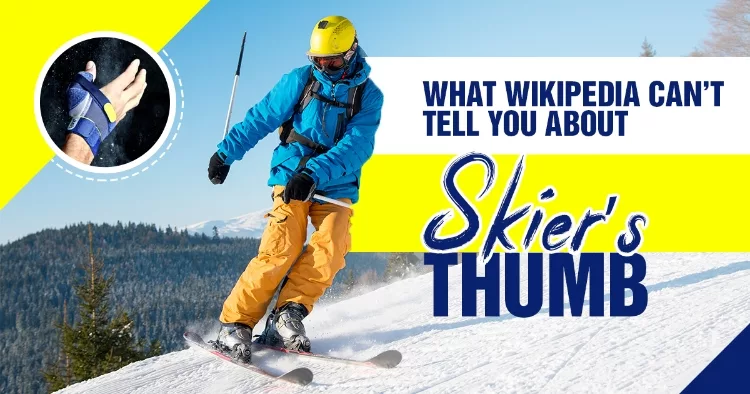
Skier's thumb injury treatment starts with one decision: stop skiing and get your hand assessed before the next run. Skier's thumb is a sprain or complete rupture of the ulnar collateral ligament (UCL) at the base of your thumb's metacarpophalangeal (MCP) joint — it's one of the most common hand injuries in skiing, caused when a fall forces your thumb sharply away from your palm, often with a pole strap acting as the lever.
The good news: most Grade I and Grade II injuries heal completely with conservative care if you act quickly. The bad news: ignoring symptoms converts manageable sprains into surgical cases with 4–6 month recovery timelines. The difference between those two outcomes is how fast you respond and how faithfully you follow through on treatment.
Falls are an unavoidable part of the sport. But knowing what to do when you land wrong — and what you should never do after an injury — changes your outcome entirely. Our guide on how to fall on skis without hurting yourself covers the body mechanics that reduce your chance of landing exactly like this in the first place.
Contents
- The Anatomy Behind Skier's Thumb
- Recognizing Skier's Thumb: Presentations by Severity
- Skier's Thumb Injury Treatment: A Step-by-Step Recovery Plan
- When to See a Doctor — and When You Can Wait
- Why Your Thumb Isn't Healing
- Grade I vs. Grade III: Comparing Injury Severity
- How Experience Level Shapes Your Risk
- Frequently Asked Questions
The Anatomy Behind Skier's Thumb
What the UCL Actually Does
The ulnar collateral ligament runs along the inner (ulnar) side of your thumb's MCP joint — the knuckle at the base of your thumb. Its sole job is resisting lateral stress: it keeps your thumb from bending radically away from your palm when you grip, pinch, or brace against impact. Pinch strength, grip stability, holding a pole, opening a jar — all of it depends on an intact UCL.
According to the Wikipedia overview of UCL thumb injuries, this ligament is under significant mechanical load during skiing because pole planting constantly stresses the MCP joint in exactly the direction the UCL is designed to resist. When a fall adds sudden, violent force to that same direction, the ligament gives.
Why Ski Poles Make Everything Worse
The injury mechanism is consistent: you fall, the pole strap anchors the pole to your wrist, and the pole shaft acts as a lever that wrenches your thumb outward beyond the UCL's tensile limit. The strap keeps the pole attached to your hand. The pole punishes you for that attachment. Removing pole straps entirely is one of the most effective single-step changes you can make to reduce UCL injury risk.
Pro tip: Grip your poles without wrist straps — if you fall, letting go of the pole is far safer than having it lever your thumb sideways under your body weight.
Recognizing Skier's Thumb: Presentations by Severity
Grade I, II, and III Defined
Not all UCL injuries are equal. The grade determines whether you're looking at four weeks in a splint or six months of surgical recovery:
- Grade I: The ligament is stretched but structurally intact. Expect localized pain, mild swelling, and tenderness directly over the UCL. Joint stability is preserved under stress testing. You can grip without significant strength loss.
- Grade II: Partial tear. Moderate pain, noticeable swelling, some instability when the joint is stressed. Grip strength is reduced. This is the most clinically variable grade — some cases resolve conservatively, others edge toward surgical territory depending on tear percentage.
- Grade III: Complete rupture. The joint opens excessively under valgus stress, a palpable lump is often felt near the MCP joint (the Stener lesion), and grip strength collapses. Pain may paradoxically ease as the ligament completely fails — don't mistake reduced pain for improvement.
The Stener Lesion Problem
A Stener lesion occurs when the completely ruptured UCL retracts and folds over the adductor aponeurosis — a tendon that now physically blocks the ligament from returning to its anatomical position. It cannot heal through immobilization alone. A Stener lesion is present in roughly 80% of complete UCL ruptures, which is exactly why Grade III injuries require surgical repair. The ligament must be physically repositioned and anchored back to bone.
Skier's Thumb Injury Treatment: A Step-by-Step Recovery Plan
Immediate On-Mountain Response
The first 30 minutes determine how much swelling and secondary tissue damage you accumulate. Act in this order:
- Stop skiing immediately. Do not take another run — continued activity worsens ligament disruption and dramatically increases swelling.
- Remove your glove carefully, without pulling it off by the thumb. Slide it off from the wrist end if swelling hasn't locked it in place.
- Apply ice wrapped in a cloth or glove for 15–20 minutes. Direct ice contact causes frostbite — don't skip the wrap.
- Immobilize your thumb in a natural, slightly extended position. Most mountain clinics carry thumb spica splints — get there on foot or by patrol.
- Do not stress-test the joint yourself. Bending your thumb to "see how bad it is" applies the exact valgus force that converts a partial tear into a complete one.
Short-Term Conservative Care
For Grade I and Grade II injuries without surgical indicators, a rigid thumb spica cast or functional brace worn continuously for 4–6 weeks is the clinical standard. The MCP joint must be completely immobilized. Your wrist remains free. NSAIDs (ibuprofen or naproxen at full therapeutic doses) reduce inflammation during the acute phase and are appropriate for the first 1–2 weeks.
Warning: The most common reason conservative treatment fails is removing the splint early because the pain subsided — ligament repair takes weeks, not days, and reduced pain is not a signal that healing is complete.
Long-Term Rehab Milestones
After immobilization ends, you're not back on the mountain yet. Structured physical therapy is what rebuilds the functional stability the UCL provides:
- Weeks 6–8: Gentle passive range-of-motion exercises, therapist-supervised. No resistance.
- Weeks 8–10: Progressive grip strengthening using therapy putty and resistance bands.
- Weeks 10–12: Sport-specific loading — light skiing with a rigid thumb guard or taping protocol.
- Week 12+: Full return to skiing for Grade II. Continue protective taping for the remainder of the season.
Surgical repairs follow the same arc but shifted forward by 2–3 months. Most surgically treated Grade III injuries reach full return-to-sport at the 4–5 month mark.
When to See a Doctor — and When You Can Wait
Signs You Need Surgery Now
Surgery is not a last resort — for Grade III injuries, it's the first-line treatment. You need surgical consultation immediately if:
- MRI or stress X-ray confirms a complete UCL rupture
- A Stener lesion is visible on imaging
- Valgus stress testing shows greater than 30–35 degrees of joint opening compared to the uninjured thumb
- An avulsion fracture is present with bone fragment displacement
- Conservative treatment at 6 weeks shows no functional improvement
Surgical consultation beyond three weeks of injury significantly increases reconstruction complexity — scar tissue formation begins obscuring the anatomy, and outcomes decline the longer you wait.
When a Splint and Time Are Enough
Conservative treatment produces excellent outcomes when:
- Imaging confirms the ligament is stretched but continuous (Grade I)
- MRI rules out a Stener lesion
- Stress testing shows less than 30 degrees of instability
- You're diagnosed and splinted within the first 48–72 hours of injury
In these scenarios, a correctly fitted thumb spica immobilizes the joint through the full healing window and the ligament regenerates in anatomical position. Full recovery rates for properly managed Grade I injuries exceed 95%.
Why Your Thumb Isn't Healing
Common Mistakes That Stall Recovery
If your thumb is still painful, unstable, or weak past the expected timeline, one of these is usually the reason:
- Soft wrap instead of rigid splint: Elastic bandages and neoprene sleeves don't immobilize the MCP joint. The UCL continues to flex with every hand movement and cannot consolidate.
- Undetected Stener lesion: If conservative treatment hasn't produced measurable improvement by week 6, request an MRI. A missed Stener lesion explains most conservative treatment failures.
- Early return to grip activities: Driving, using your phone, gripping anything with force — all of these load the healing ligament before it has sufficient tensile strength.
- No formal rehabilitation: An immobilized thumb without structured strengthening rehab results in a healed ligament inside a hand with atrophied intrinsic muscles. The ligament survives; functional grip doesn't fully return without active rehab.
When to Reconsider the Diagnosis
Persistent pain and instability at 6–8 weeks of conservative care is a clinical red flag — not a sign that you need more time. It's a sign that your original assessment was incomplete. Request an MRI if you haven't had one. Conditions that mimic Grade II responses to conservative treatment include missed Stener lesions, volar plate injuries, occult avulsion fractures, and concurrent dorsal capsule tears. Each of these has a different treatment pathway.
Grade I vs. Grade III: Comparing Injury Severity
Treatment Differences at a Glance
| Factor | Grade I | Grade II | Grade III |
|---|---|---|---|
| Ligament status | Stretched, intact | Partial tear | Complete rupture |
| Joint instability | None | Mild to moderate | Significant |
| Stener lesion risk | None | Low | ~80% of cases |
| Primary treatment | Soft splint | Rigid thumb spica | Surgical repair |
| Immobilization duration | 2–4 weeks | 4–6 weeks | 6–8 weeks post-op |
| Return to skiing | 4–6 weeks | 8–12 weeks | 4–6 months |
| Long-term prognosis | Excellent | Good | Good with surgery |
How Experience Level Shapes Your Risk
Why Beginners Are Most Vulnerable
New skiers fall more often, with less body control, and at lower speeds where the instinct to catch yourself with your hands is strongest. They're also less likely to release the pole during a fall — they hold on because they don't know yet that letting go is the right move. The combination of an outstretched hand and a pole strap is exactly the mechanism that produces UCL tears.
Beginners are also more likely to ski through the pain. A swollen, aching thumb after a fall gets attributed to bruising and ignored for days — during which time a Grade II tear may become a Stener lesion scenario. If you're building your foundational skills, our guide on how to avoid ski injuries covers protective habits from day one that reduce this risk significantly.
Why Experts Aren't Off the Hook
Advanced skiers fall less frequently but generate far higher impact forces when they do. High-speed falls on groomed runs, unexpected edges in mogul fields, and tree-run catches all create the asymmetric, single-hand loading that ruptures UCLs completely. Expert skiers also have a documented tendency to delay care — they're comfortable with pain, dismissive of "minor" hand injuries, and confident they can manage it themselves. That delay is precisely what converts treatable partial tears into full ruptures requiring surgery.
Twenty years of experience doesn't protect your ligaments — a high-speed fall on packed powder delivers the same valgus force to your UCL regardless of how many vertical feet you've logged.
Frequently Asked Questions
How long does skier's thumb take to heal?
Grade I injuries heal in 2–4 weeks with proper immobilization. Grade II injuries require 6–12 weeks of splinting and structured rehab. Grade III injuries treated surgically need 4–6 months before full return to skiing. Rushing any of these timelines dramatically increases the chance of reinjury or chronic joint instability.
Can you ski with skier's thumb?
Not during active recovery. Once your physician clears you for sport-specific activity — typically after confirmed ligament healing on imaging and passage of functional grip testing — most skiers return using a rigid thumb spica brace or athletic taping for the remainder of the season. Skiing without protection before clearance risks converting a healed ligament back into a surgical injury.
Is skier's thumb the same as gamekeeper's thumb?
Yes — both terms describe a UCL injury at the thumb's MCP joint. "Gamekeeper's thumb" historically referred to chronic UCL damage from repetitive stress, while "skier's thumb" describes the acute traumatic version from a single injury event. In current clinical practice, the terms are used interchangeably because they involve the same ligament, the same anatomy, and the same treatment protocols.
Skier's thumb is completely treatable — but only if you stop skiing, get it assessed, and follow through on every week of recovery without cutting corners.
 |
 |
 |
 |

About Frank V. Persall
Frank Persall is a lifelong skier originally from the United Kingdom who has spent years pursuing the sport across premier resorts in Europe, North America, and beyond. His passion for skiing has taken him from the Alps to the Rocky Mountains, giving him a broad perspective on resort terrain, snow conditions, gear performance across price points, and the practical realities of ski travel with a family. At SnowGaper, he covers ski resort guides, gear reviews, and skiing technique and travel resources for enthusiasts of every level.
You can get FREE Gifts. Or latest free skiing books here.
Disable Ad block to reveal all the info. Once done, hit a button below
|
|
|
|