Ski Gear ›
Best Heated Ski Vest and Jacket for Men: Reviews, Buying Guide, and FAQs 2026
by Frank V. Persall
You're standing in the lift line at 7 a.m., the thermometer reading 14°F, and your base layer just isn't cutting it anymore. You've been eyeing heated jackets for a full season, and now you're finally ready to pull the trigger — but the options are overwhelming. Carbon fiber heating elements, graphene panels, 7.4V vs. 5V systems, zone control, battery life claims that range from "decent" to "suspicious" — it's a lot to sort through before you even hit the slopes.
The good news: heated ski jackets and vests have matured dramatically by 2026. You're no longer choosing between a bulky battery pack and reliable warmth. Today's best options integrate slim batteries, intelligent zone control, and genuine weatherproofing into outerwear that doesn't look like a science project. We tested and reviewed seven of the top picks across different budgets, heating technologies, and use cases — from budget-friendly softshells to graphene-powered expedition-grade insulation. Whether you're skiing groomers at your local mountain or heading to a destination like the top ski mountaineering destinations in the world, staying warm without compromising mobility is non-negotiable.
This guide covers everything you need: in-depth reviews of each jacket, a practical buying guide, and honest answers to the questions buyers ask most. Pair your new jacket with quality heated ski gloves and heated ski socks for a full layering system that handles even the coldest lift rides. Let's get into it.
Contents
- Top Rated Picks of 2026
- In-Depth Reviews
- Brimekey Heated Jacket — Best Overall Battery Life
- ActionHeat 5V Softshell — Best for Big & Tall
- ORORO 4 Heat-Zone Jacket — Best USB-C Rechargeable
- DEWALT DCHJ091 Heated Jacket — Best for Tradespeople & Versatility
- ALTWEIWEN Heated Down Jacket — Best Graphene Coverage
- Venustas Men's Heated Jacket — Best Heat Retention
- Fieldsheer Denali Snow Jacket — Best Dedicated Ski Shell
- Choosing the Right Heated Ski Jacket
- Questions Answered
- Next Steps
Top Rated Picks of 2026
- #PreviewProductRating
- Bestseller No. 1
 Rating:

- Bestseller No. 2
 Rating:
 - Bestseller No. 3
 Rating:
 - Bestseller No. 4
 Rating:
 - Bestseller No. 5
 Rating:
 - Bestseller No. 6
 Rating:
 - Bestseller No. 7
 Rating:
In-Depth Reviews
1. Brimekey Heated Jacket for Men — Best Overall Battery Life
If battery anxiety is your primary concern, the Brimekey ends that conversation immediately. The included 20,000mAh battery pack runs for up to 10 hours on low heat — enough to cover a full ski day plus après — and it recharges completely in just 4 hours using PD/QC fast charging. The digital display showing real-time battery percentage is a genuine game-changer: you always know exactly how much heat you have left, eliminating the guesswork that plagues most heated jackets. The battery is CE/FCC-certified, which matters for safety at high output over extended periods.
The heating system covers 6 zones — both arms, the back, the back neck, and both hand-warming pockets — which Brimekey claims covers 45% more area than typical competitors. On the slopes, that arm coverage makes a real difference during long lift rides when your sleeves catch the wind. You get three temperature settings (Low: 113–122°F, Medium: 122–140°F, High: 140–149°F) with independent zone control for body and arms, so you can crank the back heat while keeping arm zones lower to save battery. The fleece-lined interior adds passive warmth on top of the active heating, and the windproof, waterproof shell handles light snow and wind without issue.
The hoodie design is casual enough for everyday wear, which extends the jacket's value beyond ski days. At high heat settings, 10 hours shrinks considerably — realistically expect 4–5 hours at medium or high — but most skiers spend the majority of their day on medium anyway. For a single jacket that doubles as your daily winter coat and on-mountain mid-layer, the Brimekey delivers exceptional value per dollar.
Pros:
- 20,000mAh battery with digital display — longest runtime in this roundup
- 6 heating zones with independent arm/body control
- PD/QC fast charging reaches full in 4 hours
- Fleece lining adds passive warmth without bulk
- CE/FCC-certified battery for safety compliance
Cons:
- Hoodie styling is casual — not a dedicated ski shell
- Actual runtime at high setting significantly shorter than the stated 10 hours
2. ActionHeat 5V Men's Softshell Heated Jacket — Best for Big & Tall Skiers
ActionHeat's 5V softshell takes a focused, no-frills approach to heated outerwear. The tri-zone heating system places ultra-fine infrared panels across the chest and upper back — exactly where your core needs it most during cold lifts and ski touring breaks. ActionWave heat-reflective technology amplifies the output of those 5V panels, helping the jacket perform closer to a 7.4V system despite the lower voltage draw. The 94% polyester/6% spandex blend gives you real stretch and mobility, which you'll notice immediately when you're reaching for poles or adjusting bindings.
The water-resistant breathable fleece lining handles light snow and drizzle without soaking through, and the construction holds up to the abuse of regular ski use. Battery life reaches 6+ hours on the lowest setting — solid for a 5V system, though it won't match the endurance of higher-voltage competitors. What the ActionHeat does offer is availability in 3XL, which is genuinely rare in the heated jacket category. If you've struggled to find quality cold-weather outerwear in larger sizes, this solves that problem while still delivering legitimate core heating.
The 5V system is also compatible with most power banks you probably already own, which cuts the cost of entry if you're not starting from scratch with a dedicated battery. For skiers who want a versatile heated layer that doubles as hiking, camping, and hunting outerwear, the ActionHeat's broad sizing range and practical design earn it a strong recommendation.
Pros:
- Available in 3XL — rare in the heated jacket market
- Infrared heating with ActionWave reflective technology for efficient warmth
- Works with standard 5V power banks
- Stretch fabric blend for unrestricted movement
Cons:
- Only 3 heating zones — less coverage than competitors
- 5V system has lower maximum heat output than 7.4V options
3. ORORO Men's 4 Heat-Zone Heated Jacket — Best USB-C Rechargeable System
ORORO has been building heated clothing longer than almost anyone in this space, and the 4 Heat-Zone jacket reflects years of refinement. The carbon fiber heating elements across the collar, left and right pockets, and mid-back represent one of the most strategically placed heating layouts available — the collar warming is a feature you'll genuinely miss on cold nights after experiencing it. The 7.38V UL/CE-certified battery delivers up to 10 hours of runtime and includes a USB port for charging your phone or action camera, which is practical on full-day ski trips.
The softshell exterior is water and wind resistant without being fully waterproof, so this jacket works best as a mid-layer under a hardshell on truly wet days or as standalone outerwear in dry cold. The breathable lining prevents you from overheating when you're skinning or hiking between runs, and the detachable hood adds versatility — leave it at home on bluebird days, snap it on when the wind picks up. The tailored cut is more flattering than most heated jackets, which tend toward utilitarian bulkiness.
USB-C charging is a meaningful upgrade in 2026 — you're not hunting for proprietary cables, and the same charger that powers your laptop or phone tops off the battery overnight. Three heat settings cycle with a single button press, keeping the interface dead simple. ORORO's warranty and customer service reputation adds confidence to the purchase. If you want a proven brand with genuine ski-specific thoughtfulness in the design, the ORORO 4-zone is the right call.
Pros:
- Collar heating zone — uniquely effective for cold-weather warmth
- USB-C charging with pass-through USB port for devices
- Up to 10 hours runtime from UL/CE-certified battery
- Detachable hood for versatility
- ORORO's established track record for quality and customer support
Cons:
- Water-resistant only, not fully waterproof — limit exposure in heavy snow
- 4 zones vs. 5–6 on newer competitors
4. DEWALT DCHJ091 Heated Jacket Kit — Best for Durability and Versatility
DEWALT makes this list because their heated jacket isn't trying to be a dedicated ski jacket — it's a work-grade piece of outerwear that happens to excel in ski conditions where durability matters more than style. The RipStop polyester canvas outer shell is genuinely tough: snag it on a chairlift bolt or drag it across a ski rack and it won't fray or tear. The Sherpa fleece lining with quilted nylon sleeves creates a layered insulation system that traps warmth independently of the heating elements, giving you a jacket that's warm even if the battery dies mid-run.
DEWALT's battery ecosystem is a major selling point if you already own their 20V MAX power tools — the same battery that runs your drill runs your jacket, which eliminates dedicated battery purchases entirely. The heating system warms the core efficiently, and the construction is built to last through seasons of hard use, not just light weekend wear. The fit runs slightly boxier than fashion-oriented heated jackets, but that's the trade-off for a construction that can take real punishment.
For skiers who split time between the mountain and outdoor work — contractors, landscapers, patrol staff — the DEWALT kit's included battery and charger makes it a plug-and-play solution. It's also the right call if you've had cheaper heated jackets fail on you after a season and want something built to a different standard. The Dune colorway photographs as a clean tan/khaki that reads professional in any setting.
Pros:
- RipStop canvas shell — significantly more durable than typical softshell competitors
- Compatible with DEWALT 20V MAX battery ecosystem
- Sherpa fleece + quilted nylon sleeve layering adds passive warmth
- Work-grade construction built to last multiple seasons
Cons:
- Boxier fit — less streamlined than dedicated ski jackets
- Fewer advertised heating zones than purpose-built ski competitors
5. ALTWEIWEN Heated Down Jacket — Best Graphene Heating Coverage
The ALTWEIWEN is the outlier in this roundup — 23 graphene heating elements distributed across the abdomen, shoulders, back, and neck is a fundamentally different approach than the 3–6 zone carbon fiber systems everyone else uses. Graphene conducts heat more evenly than carbon fiber, which means fewer cold spots between zones and a more consistent temperature experience across your torso. According to research on graphene's thermal properties, the material's thermal conductivity is significantly higher than conventional heating elements, making it an excellent choice for wearable heating applications. The 16,000mAh battery powers the system for 6–10 hours depending on settings, and the intelligent push-button system lets you adjust front and back pads independently.
The versatility angle is genuine: the adjustable chest zipper lets you wear this as a snug mid-layer under a hardshell or loosened as a standalone outer layer in milder conditions. That dual-use capability is practical for ski trips where morning temperatures demand serious insulation but afternoon sun warms things up significantly. The down fill adds meaningful passive warmth that most softshell competitors can't match, creating a jacket that performs in extreme cold with or without the electronics activated.
The included power bank charges both the jacket and your devices, which reduces what you need to carry. The gender-neutral fit works for both men and women, though the sizing runs standard unisex. If you want the most thorough active heating coverage in this roundup and you're willing to pay for graphene technology, the ALTWEIWEN makes a compelling case for its premium position.
Pros:
- 23 graphene heating elements — most comprehensive coverage in this roundup
- Independent front/back temperature control
- Down fill provides passive warmth even when heating is off
- Adjustable chest zipper for mid-layer or outer-layer wear
- Included power bank charges devices simultaneously
Cons:
- Premium price point for the graphene technology
- Unisex fit may not suit everyone's preferred cut
6. Venustas Men's Heated Jacket with 7.4V Battery — Best Heat Retention System
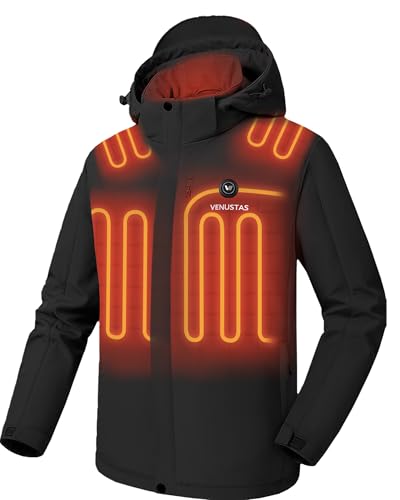
Venustas takes a smart approach: instead of just generating more heat, they engineered the jacket to retain heat better. The combination of premium FELLEX insulation and a silver mylar lining that reflects 97% of body heat back inward means this jacket works harder on insulation than any other option in this lineup. In real terms, you can run lower heat settings and still feel warmer, which translates directly to longer battery life per charge cycle. The 36Wh certified battery delivers 10 hours on low, 6 hours on medium, and 3 hours on high — honest, predictable numbers.
Five enlarged ultra-thin carbon fiber heating elements cover the left and right shoulders, left and right bust, and back. Shoulder heating is one of those features you don't realize you've been missing until you have it — shoulders are constantly exposed on lift rides, and warming them reduces the chill that creeps down your arms. The 30% larger heating area claim relative to earlier models is backed by the element placement, and the single-button interface keeps operation gloves-friendly. On-mountain, that matters: you're not fiddling with apps or multi-step controls when your hands are cold.
The windproof insulated shell earns its keep in exposed ridgeline conditions and high-speed lift rides. For skiers planning trips to technical terrain — think ski touring approaches described in our ski touring beginner's guide — the Venustas handles variable conditions without requiring you to swap layers constantly. The detachable hood adds adaptability. Overall, Venustas delivers a sophisticated balance of active heating and passive insulation that outperforms jackets with higher zone counts but weaker heat retention.
Pros:
- Silver mylar lining reflects 97% of body heat — outstanding passive insulation
- Shoulder heating elements — rare and genuinely effective on cold lifts
- Predictable 10/6/3-hour runtime by setting
- Single-button glove-friendly control
- FELLEX insulation for warmth without bulk
Cons:
- 5 zones versus 6+ on the Brimekey
- No arm heating — some users want that coverage
7. Fieldsheer Mobile Warming Men's Denali Snow Jacket — Best Dedicated Ski Shell
Every other jacket on this list is primarily a heated garment that happens to work in ski conditions. The Fieldsheer Denali is a purpose-built ski jacket that happens to be heated — and that distinction changes everything about how it performs on the mountain. The waterproof design with taped seams means you're fully protected in wet snow, sleet, and spring slush, not just "water resistant" like most heated competitors. The breathable liner manages moisture during active skiing without trapping heat-generated sweat, which is a real problem with less-engineered heated outerwear.
The RECCO rescue reflector is the detail that separates this jacket from every other option in the roundup. If you ski in avalanche terrain — even resort skiing on days with elevated avalanche danger — RECCO makes you searchable by rescue teams using standard RECCO detectors carried by mountain safety personnel. Hood and waist draw-cord closures seal out cold at both ends, which matters when you're carving at speed and wind finds every gap. The Denali also includes Mobile Warming's connectivity for app-based heat control, giving you the ability to adjust zones without removing your gloves.
For serious skiers who want their heated jacket to function as their primary ski shell rather than an extra layer, the Denali is the correct answer in 2026. The feature set — waterproofing, taped seams, RECCO, breathable liner, app connectivity — represents dedicated ski jacket engineering that casual heated outerwear simply doesn't include. Review your full layering strategy alongside the resort outfit checklist to build the most effective system around this jacket.
Pros:
- Fully waterproof with taped seams — ski-specific weather protection
- RECCO rescue reflector for backcountry and resort safety
- Breathable liner manages active skiing moisture
- Hood and waist draw-cord closures seal against wind
- App-based heat control via Mobile Warming connectivity
Cons:
- Higher price point reflects the ski-specific engineering
- Less versatile as everyday casual outerwear vs. softshell competitors
Choosing the Right Heated Ski Jacket: A Buying Guide
The heated jacket market has expanded significantly heading into 2026, and picking the right one requires understanding a few key technical differences that separate genuinely effective products from those that disappoint. Use this guide alongside the full ski gear reviews section to make an informed decision across your entire kit.
Heating System: Voltage, Zone Count, and Technology
The most important number in a heated jacket spec sheet is the battery voltage. 7.4V systems heat faster, reach higher temperatures, and maintain warmth more effectively than 5V alternatives. If you're skiing in temperatures below 20°F or spending extended time on exposed lifts, choose 7.4V. Five-volt systems are better suited for mild winter commutes or light outdoor activity where maximum heat output isn't critical.
Zone count matters, but placement matters more. A jacket with 6 strategically placed zones — covering back, collar, shoulders, and both arms — outperforms a 3-zone system even if the 3-zone system claims higher output. Look for:
- Back panel: Non-negotiable. Every heated jacket includes this.
- Collar/neck: Highly effective — the collar sits close to major blood vessels.
- Shoulders: Excellent for lift rides where wind hits your upper body.
- Arms/sleeves: Useful for extreme cold; adds battery consumption.
- Chest/pockets: Warms the core from the front; good for standing and static activity.
Graphene heating elements, as used in the ALTWEIWEN, distribute heat more evenly than carbon fiber because of the material's exceptional thermal conductivity. If consistent temperature distribution is your priority, graphene technology is worth the premium.
Battery Life, Charging, and Power Management
Battery life claims are always stated at the lowest heat setting. A jacket rated for "10 hours" delivers roughly 4–5 hours on medium and 2–3 hours on high. Plan accordingly for a full ski day: if you ski 6–7 hours and run medium heat primarily, you need a battery rated for at least 12–14 hours at low to stay comfortable all day without recharging.
USB-C charging is the current standard you should insist on in 2026 — proprietary connectors create problems when cables are lost or damaged. Jackets with pass-through USB ports let you charge your phone or GPS device simultaneously, reducing how much you carry. Digital battery percentage displays eliminate guesswork and let you make informed decisions about heat settings throughout the day.
Weather Protection and Construction
There's a meaningful difference between "water-resistant" and "waterproof with taped seams." Water-resistant jackets handle light snow and brief moisture exposure but saturate in sustained wet snow or rain. Taped seams prevent moisture from wicking through stitching lines — critical in wet coastal mountain conditions like those you'd encounter at destination resorts. If you ski in the Pacific Northwest, the Alps, or anywhere known for wet snow, waterproofing is non-negotiable.
Insulation type affects both passive warmth and pack weight. Down insulation provides the best warmth-to-weight ratio but loses effectiveness when wet — a real consideration in ski conditions. Synthetic insulation like FELLEX maintains warmth when damp. Uninsulated softshell heated jackets work best as mid-layers under a separate hardshell, giving you maximum layering flexibility.
Fit, Mobility, and Ski-Specific Features
A heated jacket that restricts your arm swing, limits your hip rotation, or bunches under a harness defeats its purpose on the slopes. When evaluating fit, consider how you'll actually wear it: as a standalone outer layer or as a mid-layer under a ski shell. Mid-layer use demands a trimmer cut that doesn't create bulk under your shell; outer-layer use can accommodate a more relaxed fit without penalty.
Ski-specific features to look for beyond heating include RECCO reflectors (avalanche rescue), helmet-compatible hoods, powder skirts or internal gaiters, lift pass pockets, and goggle-wipe pockets. These details separate jackets designed for skiers from generic winter outerwear that happens to work on the mountain. Check your full outfit layering plan — including gloves — against resources like our heated glove reviews to ensure every piece of your system works together.
Questions Answered
How long do heated ski jackets actually last on a single charge?
Real-world battery life depends entirely on which heat setting you use. Manufacturer ratings reflect the lowest setting. On high heat, expect 30–50% of the stated runtime. On medium — where most skiers spend most of their time — plan for roughly 60–70% of the rated maximum. For a full ski day, choose a jacket with a battery rated for at least 10 hours on low and carry a small power bank as backup if you're worried about running out mid-afternoon.
Can I wash a heated ski jacket?
Yes, but you must remove the battery pack first without exception. Most heated jackets are machine washable on a gentle cold cycle after you disconnect and remove the battery. Turn the jacket inside out, use a mild detergent, and skip the dryer — air dry flat or hang dry. The heating elements themselves are sealed in fabric panels and handle washing fine as long as the battery compartment is protected. Always check the specific care label, as some models require hand washing only.
Is a 5V heated jacket enough for skiing, or do I need 7.4V?
For temperatures above 25°F and moderate activity levels, 5V heated jackets are adequate. Below 25°F, on prolonged lift rides, or in windy exposed conditions, a 7.4V system delivers noticeably more heat output and holds temperature better. If you're primarily skiing resort groomers in mild conditions, 5V saves money and weight. If you ski in genuine cold or spend time in the backcountry, the higher voltage is worth it.
Can I wear a heated jacket as my only outer layer, or does it need to go under a shell?
It depends on the jacket's weather protection. Fully waterproof models with taped seams like the Fieldsheer Denali function as standalone ski shells. Water-resistant softshell models work as outer layers in dry cold but need a hardshell over them in wet or heavy snow conditions. Uninsulated heated jackets are specifically designed as mid-layers and should always have a weatherproof outer shell over them. Check the manufacturer's waterproof rating before deciding on your layering strategy.
Are heated ski jackets safe to wear while skiing?
Yes. Reputable heated jacket batteries are certified by UL, CE, or FCC — these certifications verify the battery meets safety standards for temperature control and overcharge protection. The heating elements themselves operate well below the temperature threshold for skin damage at their maximum settings (typically under 150°F). The main safety consideration is ensuring you buy from brands with certified batteries rather than uncertified knockoffs. All seven jackets reviewed here carry appropriate battery certifications.
What's the difference between a heated vest and a heated jacket for skiing?
A heated vest focuses all warmth on the core torso and is typically lighter and less restrictive for active skiing. It pairs with insulated ski pants and relies on arm coverage from a separate layer. A heated jacket adds sleeve coverage and full-length zipper protection, making it the better standalone option in extreme cold. If you already own a quality ski shell with good insulation and want supplemental core heat, a heated vest is the efficient choice. If you're replacing your primary mid-layer or outer layer, a jacket provides better overall coverage.
Buy on Walmart
- Brimekey Heated Jackets for Men with Fleece Lining, 20000mAh — Walmart Link
- ActionHeat 5V Men's Softshell Battery Heated Jacket 3XL — Walmart Link
- ORORO Men's 4 Heat-Zone Heated Jacket with USB-C Rechargeabl — Walmart Link
- DEWALT Men's DCHJ091 Heated Jacket Kit, Battery, Charger, an — Walmart Link
- ALTWEIWEN Heated Down Jacket for Men and Women with Power Ba — Walmart Link
- Venustas Men's Heated Jacket with Battery pack 7.4V, Windpro — Walmart Link
- Fieldsheer Mobile Warming Men's Denali Snow Jacket, Black - — Walmart Link
Buy on eBay
- Brimekey Heated Jackets for Men with Fleece Lining, 20000mAh — eBay Link
- ActionHeat 5V Men's Softshell Battery Heated Jacket 3XL — eBay Link
- ORORO Men's 4 Heat-Zone Heated Jacket with USB-C Rechargeabl — eBay Link
- DEWALT Men's DCHJ091 Heated Jacket Kit, Battery, Charger, an — eBay Link
- ALTWEIWEN Heated Down Jacket for Men and Women with Power Ba — eBay Link
- Venustas Men's Heated Jacket with Battery pack 7.4V, Windpro — eBay Link
- Fieldsheer Mobile Warming Men's Denali Snow Jacket, Black - — eBay Link
Next Steps
- Identify your primary use case — decide whether you need a standalone ski shell (choose the Fieldsheer Denali), a versatile daily/ski jacket (Brimekey or Venustas), or a mid-layer to pair under your existing shell (ActionHeat or ORORO), then cross-reference that decision against the buying guide's weather protection section.
- Check current prices on Amazon for your top two choices — prices on heated jackets fluctuate significantly by season, and early or late-season sales can save you 20–30% on the same models reviewed here.
- Build out your full heated layering system — a heated jacket works best when paired with quality heated ski gloves and insulated base layers; review our complete heated gear guides to close any gaps in your cold-weather setup.
- Verify the battery certification — before finalizing your purchase, confirm the jacket's battery carries a UL, CE, or FCC certification listed in the product description; avoid uncertified batteries regardless of claimed runtime.
- Register your jacket and battery after purchase — most manufacturers offer warranty extensions or battery replacement programs for registered products, giving you coverage if a cell degrades in the first season.
 |
 |
 |
 |

About Frank V. Persall
Frank Persall is a lifelong skier originally from the United Kingdom who has spent years pursuing the sport across premier resorts in Europe, North America, and beyond. His passion for skiing has taken him from the Alps to the Rocky Mountains, giving him a broad perspective on resort terrain, snow conditions, gear performance across price points, and the practical realities of ski travel with a family. At SnowGaper, he covers ski resort guides, gear reviews, and skiing technique and travel resources for enthusiasts of every level.
You can get FREE Gifts. Or latest free skiing books here.
Disable Ad block to reveal all the info. Once done, hit a button below
|
|
|
|