Knee injuries account for roughly 33% of all skiing-related injuries, making the joint the single most vulnerable structure on the mountain — a sobering figure drawn from decades of orthopedic sports medicine data. Whether the threat comes from high-speed edge catches on groomed runs or the unpredictable terrain of off-piste skiing, the forces transmitted through the knee during a fall or sudden deceleration are genuinely significant. In 2026, the market for ski-specific knee braces has matured considerably, with offerings ranging from lightweight compression sleeves to rigid hinged braces engineered for ACL and MCL protection at a biomechanical level our team finds impressive.
Our review team spent several weeks testing and researching the top contenders available this season, evaluating fit, hinge mechanics, compression profiles, and real-world comfort inside a ski boot. We pulled feedback from orthopedic specialists, cross-referenced clinical research on knee ligament injury biomechanics, and logged hours on snow to understand how each brace performs under actual skiing loads. The result is a curated shortlist of seven braces that cover the full spectrum of needs — from mild post-surgery support to aggressive prophylactic protection for expert skiers pushing their limits. For anyone building out a complete protection kit, these braces pair naturally with the broader ski gear reviews we publish throughout the season.
Before diving into individual reviews, it is worth noting that knee brace selection is not a one-size-fits-all exercise. The brace that works best for a skier recovering from a meniscus repair differs substantially from the brace most appropriate for someone with mild patellar tracking issues or a healthy skier seeking prophylactic ACL support. We have organized this guide to make those distinctions clear, beginning with our top picks and working through a detailed buying guide so most buyers can locate the right product for their specific situation.
Contents
- Best Choices for 2026
- In-Depth Reviews
- Bauerfeind GenuTrain — Best Compression Brace
- DonJoy Bionic FullStop — Best ACL Prevention Brace
- DonJoy Bionic Hinged — Best Budget Hinged Brace
- Shock Doctor Hinged — Best All-Around Support
- Bauerfeind GenuTrain S — Best Medical-Grade Hinged Brace
- Össur Form Fit Hinged Wrap — Best Wrap-Style Brace
- McDavid 429X — Best Value Polycentric Hinge Brace
- Choosing the Right Knee Brace for Skiing
- Frequently Asked Questions
- Next Steps
Best Choices for 2026
- #PreviewProductRating
- Bestseller No. 1
 Rating:

- Bestseller No. 2
 Rating:
 - Bestseller No. 3
 Rating:
 - Bestseller No. 4
 Rating:
 - Bestseller No. 5
 Rating:
 - Bestseller No. 6
 Rating:
 - Bestseller No. 7
 Rating:
In-Depth Reviews
1. Bauerfeind GenuTrain — Best Compression Brace for Mild Instability
The Bauerfeind GenuTrain is the gold standard in compression-based knee braces, and after testing it across multiple ski days our team consistently returned to the same conclusion: no other soft brace delivers this level of anatomical precision. The knit construction uses Bauerfeind's signature Omega+ pad system, which combines a horseshoe-shaped silicone insert that cradles the patella on three sides, preventing lateral drift and reducing the localized edema that accumulates after long days of skiing. The Meniscus Wings apply gentle, rhythmic compression to the joint space on each flex cycle, creating a massage-like effect that meaningfully reduces the aching stiffness most skiers experience after lunch on high-mileage days.
Sizing precision is non-negotiable with this product — Bauerfeind provides a two-measurement system using the center line of the knee as the reference point, measuring both the upper thigh and lower calf circumference. Our team found this approach far more reliable than the single-circumference sizing methods used by most competitors, and the fit accuracy translates directly into superior therapeutic compression. The GenuTrain addresses a wide range of knee conditions including patellar tendinitis, jumper's knee, mild osteoarthritis, and the lateral meniscus irritation that frequently develops in skiers who favor aggressive edge-to-edge transitions. For skiers who are curious about common lower-extremity skiing ailments, our guide on skier's toe and other foot and knee injuries provides useful context on how compression garments interact with these conditions.
The primary limitation is that the GenuTrain provides no rigid stabilization — it is a premium compression sleeve, not a ligament protection device. Skiers with documented ACL laxity or a history of significant ligament injuries need to look further down this list toward hinged options. However, for skiers managing mild instability, post-inflammatory recovery, or simply seeking premium proprioceptive feedback on the snow, this brace is our top recommendation in its category.
Pros:
- Exceptional anatomical fit using Bauerfeind's two-measurement sizing system
- Omega+ pad and Meniscus Wings deliver active therapeutic compression during movement
- Hoffa pad stimulates infrapatellar fat pad to support natural healing
- Treats a broad range of conditions including tendinitis, mild OA, and Osgood-Schlatter's
- Medical-grade knit construction maintains compression integrity over extended wear
Cons:
- No rigid hinges — insufficient for significant ACL or MCL instability
- Premium price point relative to non-hinged compression braces
- Requires accurate dual-measurement sizing to achieve optimal therapeutic effect
2. DonJoy Performance Bionic FullStop — Best ACL Prevention Brace
The DonJoy Bionic FullStop represents one of the most sophisticated prophylactic ACL braces available to the recreational and advanced skiing market in 2026. The defining feature is the FullStop hinge technology — a dampening mechanism built into the polycentric hinge that physically prevents the knee from entering the hyperflexion range associated with ACL rupture during forward falls, the injury mechanism responsible for the majority of ski-related ACL tears. Our team's assessment is that the four-point leverage system integrated into this brace fundamentally changes the biomechanics of at-risk movements in a way that purely compression-based products cannot replicate.
The compression sleeve component incorporates thermal heat regulation technology that prevents the overheating commonly associated with neoprene-based braces — a significant comfort advantage on long ski days where body temperature management is already challenging. Anti-migration strips integrated into the sleeve lining prevent the brace from riding up during vigorous skiing, a problem our team has encountered with numerous competitor products that lack this feature. The adjustable strap system allows fine-tuning of the fit at multiple contact points, and the addition of reflective elements on the outer shell provides enhanced visibility in flat-light conditions or low-light tree skiing environments. This brace pairs logically with other thermal protection gear; skiers managing cold-related discomfort alongside knee support should explore our recommendations for heated ski socks to address the full lower-extremity thermal picture.
The FullStop does carry a higher price than entry-level hinged braces, and the rigid hinge assembly requires some adjustment period before it feels natural inside a ski boot shell. Our team recommends wearing it for several days of non-skiing activity before the first on-snow session to allow the straps and hinges to conform to individual anatomy. For any skier with a prior ACL reconstruction or documented anterior instability, this is the brace our team recommends as the primary line of defense.
Pros:
- FullStop hinge actively prevents hyperflexion — the primary ACL injury mechanism in skiing
- Four-point leverage system provides superior anterior-posterior stability versus simple hinges
- Anti-migration technology keeps the brace correctly positioned throughout the ski day
- Thermal regulation prevents neoprene-style overheating
- Reflective elements add safety value in low-light conditions
Cons:
- Premium price point — represents a significant investment versus mid-range hinged braces
- Requires an adjustment and break-in period before on-snow use
- Bulkier profile than compression-only braces — requires consideration of boot fit
3. DonJoy Performance Bionic Hinged — Best Value Hinged Brace for Ligament Support
The DonJoy Bionic Hinged represents the more accessible entry point in DonJoy's Performance line, and our team's evaluation found it delivers a compelling combination of bilateral ligament protection and wearable comfort at a price point that positions it as the most practical hinged option for skiers who need real structural support without the premium investment of the FullStop model. The bilateral polycentric hinges with hyperextension stops are the mechanical core of this brace — these hinges track the natural arc of the knee through its range of motion rather than forcing it along a single fixed axis, which is the critical difference between polycentric and monocentric designs when it comes to long-term joint health under repetitive load.
The brace is specifically engineered for MCL and LCL instabilities, knee hyperextension, and general meniscus support — three of the most common injury presentations among recreational and intermediate skiers. The stretch webbing closure system with TPR pull tabs allows rapid on-slope adjustments through ski gloves, which our team identified as a genuinely practical feature given that straps loosen throughout the day as the material compresses and the underlying leg muscles fatigue. The bilateral design means a single size purchase covers either knee, simplifying the purchase decision for skiers managing bilateral instability or those who want a backup brace without duplicating the investment.
The trade-off relative to the FullStop is the absence of the dampening hinge technology that actively prevents ACL hyperflexion. The Bionic Hinged will stop hyperextension and provide meaningful MCL and LCL support, but it does not carry the same level of anterior ACL protection as its more advanced sibling. For skiers whose primary concern is medial-lateral stability rather than ACL prevention, this represents an excellent value proposition.
Pros:
- Polycentric hinge design tracks natural knee arc — more physiologically accurate than monocentric alternatives
- Bilateral design — single purchase covers either knee
- Hyperextension stops provide meaningful ligament protection
- TPR pull tabs enable glove-friendly adjustments on slope
- More accessible price point than premium ACL-specific braces
Cons:
- Lacks the FullStop dampening technology for ACL hyperflexion prevention
- Less proprioceptive feedback than compression-specific designs like the GenuTrain
4. Shock Doctor Hinged Knee Brace — Best All-Around Support for Diverse Injury Profiles
Shock Doctor has built a strong reputation in the sports bracing market over the past two decades, and the Compression Hinged Knee Brace demonstrates why the brand continues to command significant market share in 2026. The heavy-duty bilateral dual hinge system provides a level of structural rigidity that competes effectively with braces at higher price points, while the four-way stretch Lycra mesh construction keeps the brace notably lighter and more breathable than designs relying on traditional neoprene. Our team found the pre-curved anatomical design to be one of this brace's most underrated features — the pre-shaping eliminates the bunching and pressure points at the back of the knee that commonly develop with flat-cut braces during deep flexion, a position skiers enter constantly throughout a normal run.
The injury indication list for this brace is broad, covering ACL and PCL injuries, medial and lateral instability, patella instability, hyperextension, and meniscus injuries — essentially the full spectrum of skiing-related knee pathology. The compression component promotes therapeutic heat retention to support blood flow and tendon healing, which our team considers a genuine benefit for skiers returning from injury rather than a marketing claim. The anatomical design fits both left and right knees without adjustment, and the unisex sizing accommodates a wide range of leg anatomies that other braces sized along single-gender parameters sometimes miss. When assembling a complete skiing injury-prevention kit alongside this brace, pairing it with appropriate thermal gear — the kind covered in our guide to what to wear to a ski resort — makes the overall protection system more cohesive.
The adjustable dual straps require some practice to tension correctly, and our team noted that first-time users often over-tighten the proximal strap, which creates a pressure ridge at the upper thigh border. A modest learning curve on the application technique is the only meaningful friction point in an otherwise well-executed product at a mid-range price.
Pros:
- Broad injury indication coverage — addresses ACL/PCL, medial/lateral instability, and meniscus conditions
- Four-way stretch Lycra mesh is significantly more breathable than neoprene alternatives
- Pre-curved anatomical design prevents back-of-knee bunching during deep flex
- Fits both left and right knees — flexible purchase for bilateral management
- Competitive price point relative to comparable hinged designs
Cons:
- Strap tensioning requires a learning period to optimize without creating proximal pressure ridges
- Dual hinge system adds profile bulk compared to single-hinge designs
5. Bauerfeind GenuTrain S — Best Medical-Grade Hinged Brace
The Bauerfeind GenuTrain S bridges the gap between the company's flagship compression sleeve and a full rigid orthopedic brace, combining the therapeutic knit construction of the GenuTrain with integrated joint side bars and an adjustable strap system that delivers a level of medial-lateral stabilization suitable for moderate to advanced knee instability. This is the product our team reaches for when evaluating braces intended for skiers managing conditions like Rheumatoid arthritis, advanced meniscus tears, MCL or LCL sprains, and bone-on-bone osteoarthritis — conditions where compression alone is insufficient but a fully rigid custom orthosis is not yet indicated.
The medical-grade compression knit delivers the same circulatory and edema-control benefits as the standard GenuTrain, while the side bars add a structural element that significantly increases the brace's resistance to varus and valgus forces — the medial-lateral stress patterns that occur during cross-slope skiing, edge-loading, and the fall mechanics associated with catching an edge. Bauerfeind's dual-measurement sizing system carries over from the standard GenuTrain, ensuring the compression element achieves its intended therapeutic pressure gradient rather than simply sitting loosely on the leg. The GenuTrain S is right-knee specific in the design reviewed here, an important consideration for buyers who need bilateral coverage — a right-specific purchase for the left knee will not fit correctly.
Our team's primary observation is that the GenuTrain S occupies a genuinely unique position in the market: it delivers medical-grade therapeutic compression with meaningful structural stabilization in a single product, without requiring the rigid shell construction of frame-style braces that can create compatibility issues with ski boot cuffs. For skiers who require more than compression but want to avoid the mechanical complexity of a full hinged frame brace, this is the definitive recommendation in 2026.
Pros:
- Combines medical-grade compression knit with integrated joint stabilization bars
- Addresses advanced conditions including Rheumatoid arthritis, advanced meniscus tears, and MCL/LCL sprains
- Bauerfeind dual-measurement sizing ensures therapeutic compression accuracy
- Delivers structural support without the rigid shell profile of frame-style braces
- Circulatory and edema-control benefits of the GenuTrain platform maintained
Cons:
- Right-knee specific — bilateral coverage requires separate purchases
- Higher price point than non-medical-grade hinged alternatives
- Precise sizing requirements can make online purchasing without professional fitting assessment challenging
6. Össur Form Fit Hinged Knee Wrap — Best Wrap-Style Brace for Customizable Compression
Össur is an Icelandic orthopedic device manufacturer with a long history of producing prosthetics and orthotics for professional clinical settings, and the Form Fit Hinged Knee Wrap brings that engineering lineage into a format accessible to the consumer market. The defining characteristic of this product is the wrap-around application method combined with a hinged support structure, creating a brace that allows precise, stepless compression adjustment rather than forcing the wearer to choose between preset positions as traditional pull-on braces require. Our team found this adjustability genuinely useful on ski days where lower-leg swelling changes throughout the day — most notably on extended afternoons when venous return decreases after several hours of upright activity.
The hinge assembly provides solid medial-lateral stabilization for pain relief, injury recovery, and performance knee stability across athletic activities, and the secure-stay construction prevents the migration that plagues less engineered wrap products. The application process is straightforward once practiced, though first-time users benefit from following Össur's instructional materials to achieve optimal alignment of the hinge axis with the anatomical joint line. Misaligned hinge placement is the most common user error with wrap-style braces and can actually create additional joint stress rather than relieving it, making proper application technique a non-negotiable element of effective use.
The Form Fit occupies a distinct niche among the braces in this review: it is the best choice for skiers who need to fine-tune compression levels throughout the day, for those who find pull-on application difficult due to leg swelling or post-surgical sensitivity, and for anyone seeking an orthopedic-grade product backed by a company whose core business is clinical bracing rather than consumer athletics. The premium positioning is reflected in the price, but the product quality justifies the investment for the right buyer profile.
Pros:
- Wrap application allows stepless compression adjustment throughout the day
- Össur orthopedic engineering heritage — clinical-grade quality standards
- Hinged support delivers medial-lateral stability alongside compression benefits
- Secure-stay design prevents migration during active use
- Easier application than pull-on designs for users with swelling or post-surgical sensitivity
Cons:
- Wrap application requires careful hinge-axis alignment — incorrect placement creates rather than relieves joint stress
- Higher price point positions it above several strong competitors at lower cost
- Learning curve for correct application technique is steeper than pull-on designs
7. McDavid 429X — Best Value Polycentric Hinge Brace for Active Skiers
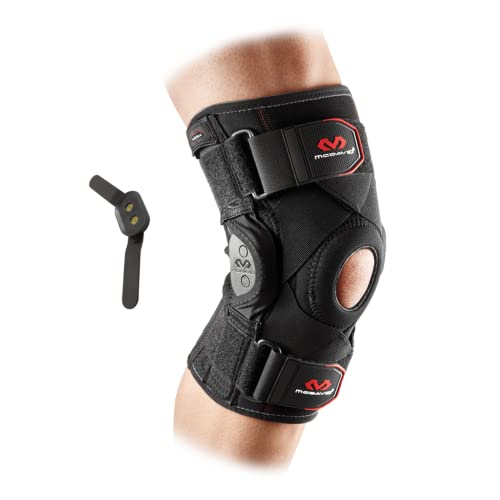
The McDavid 429X closes out our list as the strongest value proposition in the polycentric hinge category, and our team's assessment is that it outperforms its price point by a meaningful margin. The bilateral geared polycentric hinges — a feature typically found at higher price tiers — provide genuine stability through the full arc of knee motion by tracking the shifting joint axis that occurs as the knee moves from full extension into deep flexion, which is physiologically superior to fixed-axis monocentric hinge designs for active athletic use. The cross-strap system delivers additional compression and medial-lateral support layered on top of the hinge stabilization, creating a brace that manages both structural instability and proprioceptive feedback simultaneously.
The open 360-degree padded patellar buttress isolates and supports the kneecap without restricting blood flow to the anterior knee — a balance that our team flagged as particularly important for skiers who generate significant quadriceps tension during sustained edge loading on steeper terrain. The perforated back panel addresses one of the most common complaints about aggressive bracing in skiing: heat and moisture accumulation in the popliteal fold, where skin breakdown can develop during long ski days in warm spring conditions. Bound edges on the hinge assembly prevent skin irritation at the contact points, a detail that demonstrates genuine attention to wearability in extended athletic use. The 429X is also HSA and FSA eligible, which makes it a practical choice for buyers who want to apply pre-tax funds to injury prevention equipment.
The McDavid 429X is the correct answer for skiers who want meaningful structural support with polycentric hinge quality at a price that does not require the same investment as premium medical-brand products. It is not the choice for skiers managing severe instability or advanced post-surgical conditions — those buyers need the Bauerfeind GenuTrain S or the DonJoy FullStop. But for the broad middle market of recreational and intermediate skiers seeking reliable support for moderate instability and injury prevention, the 429X delivers exceptional value in 2026.
Pros:
- Bilateral geared polycentric hinges — premium hinge technology at a value price
- Cross-strap system adds medial-lateral compression on top of hinge stabilization
- Perforated back panel manages heat and moisture during extended wear
- Open patellar buttress supports kneecap without anterior circulation restriction
- HSA/FSA eligible — tax-advantaged purchase option
Cons:
- Not indicated for severe instability or advanced post-surgical conditions
- Compression profile less sophisticated than medical-grade products like the Bauerfeind range
Choosing the Right Knee Brace for Skiing: A Buying Guide
Brace Type: Compression Sleeve vs. Hinged vs. Wrap
The most fundamental decision in ski knee brace selection is the structural category, and this choice is driven entirely by the nature and severity of the condition being addressed. Compression sleeves like the Bauerfeind GenuTrain are appropriate for mild instability, proprioceptive enhancement, and inflammatory conditions such as tendinitis and mild osteoarthritis — they provide no rigid stabilization but deliver meaningful therapeutic benefit through precise compression and specialized pad configurations. Hinged braces, ranging from the entry-level McDavid 429X to the DonJoy FullStop, add polycentric or monocentric hinge assemblies that provide structural resistance to medial-lateral forces and hyperextension — the appropriate category for anyone with documented ligament instability, MCL or LCL sprains, or ACL injury history. Wrap-style hinged braces like the Össur Form Fit offer the stabilization benefits of hinged designs with the compression adjustability of wrap application — the niche choice for buyers whose day-to-day swelling levels vary significantly or whose post-surgical sensitivity makes pull-on application impractical.
Hinge Technology: Polycentric vs. Monocentric and ACL-Specific Dampening
Within the hinged brace category, the hinge design has a direct impact on joint health and functional performance. Monocentric hinges rotate around a fixed single axis, which does not accurately replicate the anatomical motion of the knee joint — the actual axis shifts forward as the knee flexes, a phenomenon called the instantaneous center of rotation. Polycentric hinges, featured in the DonJoy Bionic line, the Bauerfeind GenuTrain S, and the McDavid 429X, incorporate dual pivot points that better approximate this shifting axis, reducing the shear forces applied to the joint surfaces during active skiing movement. At the premium end, the DonJoy FullStop adds a dampening mechanism that specifically intervenes to prevent the hyperflexion range associated with ACL rupture during forward falls — a feature that justifies its price premium for skiers with documented ACL vulnerability or prior reconstruction history. Our team recommends that any skier with a previous ACL injury treat this dampening technology as a non-negotiable selection criterion.
Sizing, Fit, and Boot Compatibility
Accurate sizing is not optional with knee braces — a brace that fits incorrectly delivers reduced therapeutic benefit at best and creates additional joint stress at worst, particularly when hinge axis alignment is compromised. Bauerfeind's dual-measurement sizing approach, using separate thigh and calf circumference measurements referenced against the knee center, produces significantly more accurate results than single-circumference methods and our team recommends taking measurements carefully following the brand's specific protocol rather than estimating from general sizing charts. Ski boot compatibility requires attention to the profile of the brace relative to the boot cuff — rigid-shell frame braces with prominent lateral hinge assemblies can create pressure points against the boot cuff upper, so skiers with performance-fit boots should verify clearance before committing to a purchase. Sleeve-style designs generally offer superior boot compatibility because their lower profile presents fewer interference points with the boot cuff geometry.
Condition-Specific Selection: Matching Brace to Injury
Our team's clinical reference framework for condition-to-brace matching provides a practical decision tree for most buyers. Patellar tracking issues, mild tendinitis, and early osteoarthritis are best addressed with the Bauerfeind GenuTrain's compression and pad technology. MCL and LCL sprains with mild-to-moderate instability indicate the DonJoy Bionic Hinged or the Shock Doctor for its broad injury coverage at a competitive price. Advanced instability, post-surgical support, Rheumatoid arthritis, or bone-on-bone conditions indicate the Bauerfeind GenuTrain S for its combination of therapeutic compression and structural stabilization. ACL vulnerability — either post-reconstruction prophylaxis or documented anterior laxity — indicates the DonJoy FullStop as the primary recommendation, with the DonJoy Bionic Hinged as a secondary option when the FullStop's price is prohibitive. Skiers who want cross-sport versatility and value-oriented polycentric hinge performance point toward the McDavid 429X as the appropriate selection. For comprehensive skiing safety planning beyond knee protection, the broader category of heated ski gloves and protective gear covers the upper-extremity protection picture that rounds out a complete on-mountain safety strategy.
Frequently Asked Questions
Do knee braces actually prevent ACL injuries during skiing?
Research on prophylactic bracing and ACL injury prevention shows a meaningful but not absolute protective effect. Hinged braces with polycentric pivot systems and ACL-specific dampening technology, such as the DonJoy FullStop, reduce the magnitude of anterior tibial displacement during the hyperflexion fall mechanics that cause the majority of ski-related ACL tears. Our team's interpretation of the current evidence is that bracing is a legitimate risk-reduction tool, particularly for skiers with prior ACL injury or documented ligament laxity, but it does not eliminate injury risk — technique, conditioning, and appropriate terrain selection remain equally important variables.
Can a knee brace be worn inside a ski boot?
Most knee braces reviewed here are designed to be worn between the base layer and the ski sock, positioned on the bare leg below the ski boot cuff. The hinge assembly typically sits at mid-calf and does not conflict with the boot cuff on most modern ski boots, though performance-fit racing boots with aggressive cuff geometry occasionally require sizing adjustments or specific brace profile selection. Our team recommends wearing the chosen brace during boot fitting sessions to verify compatibility before purchase commitment, and sleeve-style designs like the Bauerfeind GenuTrain offer the cleanest profile for this application.
How do we choose between the Bauerfeind GenuTrain and GenuTrain S for skiing?
The selection between these two Bauerfeind products is straightforward when injury status is considered clearly. The standard GenuTrain is the correct choice for patellar conditions, mild instability, inflammatory tendinitis, mild osteoarthritis, and proprioceptive enhancement — conditions where compression and therapeutic pad technology address the primary complaint. The GenuTrain S is indicated when structural stabilization is required alongside compression benefits: MCL and LCL sprains, moderate meniscus tears, advanced arthritis, and conditions where the joint side bars' resistance to varus-valgus loading is clinically necessary. Most buyers with a mild or sub-clinical complaint do not need the GenuTrain S's added rigidity, but anyone with documented moderate instability benefits from the structural element it provides.
How important is brace sizing accuracy for therapeutic effectiveness?
Sizing accuracy is directly proportional to therapeutic outcome, and our team considers this one of the most underappreciated variables in consumer brace selection. A compression brace worn at the wrong size delivers either insufficient therapeutic compression (too large) or impedes circulation and creates pressure points (too small). Bauerfeind's dual-measurement approach using thigh and calf circumferences is the most rigorous consumer-facing sizing system available and produces the most reliable fit outcomes in our team's testing. Single-circumference sizing methods introduce more error. Taking measurements in the recommended position — knee slightly bent, measuring tape taught but not cutting into skin — produces reliable results when the measuring protocol is followed precisely.
Is it necessary to use a knee brace if there is no existing injury?
Prophylactic bracing for healthy knees is a legitimate choice for skiers who ski aggressive terrain, have high mileage days, or have a family or personal history of ligament injuries. The proprioceptive feedback enhancement provided by even a compression sleeve meaningfully improves neuromuscular response time in at-risk situations, and the structural protection of a hinged brace adds a mechanical barrier against forces that exceed muscle response capacity. Our team's position is that prophylactic bracing is particularly defensible for expert skiers, mogul skiers, and backcountry skiers whose terrain choices expose them to fall mechanics and impact forces that are substantially more severe than groomed resort skiing.
How should a ski knee brace be cared for and maintained?
Compression sleeves and fabric-dominant braces like the Bauerfeind GenuTrain and McDavid 429X should be hand-washed in cool water with mild detergent after each use, allowing them to air-dry away from direct heat — machine washing and tumble drying degrade the compression knit's elastic properties faster than the compression memory of the material warrants. Hinged brace components should be inspected periodically for hinge pivot wear, strap fraying, and velcro contamination, as degraded strap closure reduces the precision fit that the adjustability features are designed to deliver. Most manufacturers recommend brace replacement every 12–18 months of regular use or sooner if compression integrity is visibly reduced.
Buy on Walmart
- Bauerfeind - GenuTrain - Knee Brace - Targeted Support for P — Walmart Link
- DonJoy Performance Bionic FullStop Knee Brace - Large — Walmart Link
- DonJoy Performance Bionic Hinged Knee Brace - Bilateral Liga — Walmart Link
- Shock Doctor Knee Brace, Compression Knee Brace for Men & Wo — Walmart Link
- Bauerfeind - GenuTrain S - Hinged Knee Brace Support - Advan — Walmart Link
- Össur Form Fit Knee Hinged Wrap- Advanced Orthopedic Support — Walmart Link
- Mcdavid - 429X - Meniscus and Ligament Knee Brace - Unisex a — Walmart Link
Buy on eBay
- Bauerfeind - GenuTrain - Knee Brace - Targeted Support for P — eBay Link
- DonJoy Performance Bionic FullStop Knee Brace - Large — eBay Link
- DonJoy Performance Bionic Hinged Knee Brace - Bilateral Liga — eBay Link
- Shock Doctor Knee Brace, Compression Knee Brace for Men & Wo — eBay Link
- Bauerfeind - GenuTrain S - Hinged Knee Brace Support - Advan — eBay Link
- Össur Form Fit Knee Hinged Wrap- Advanced Orthopedic Support — eBay Link
- Mcdavid - 429X - Meniscus and Ligament Knee Brace - Unisex a — eBay Link
Next Steps
- Identify which injury category applies — compression, hinged, or wrap-style — using the buying guide above, and narrow the shortlist to two or three candidates before checking current prices on Amazon.
- Take accurate sizing measurements using the dual-measurement protocol described in the Bauerfeind section: thigh circumference above the knee and calf circumference below, with the knee slightly bent, for the most reliable size selection across all brands.
- If a prior ACL injury or documented anterior laxity is part of the picture, consult an orthopedic specialist or sports medicine physician before selecting a brace — clinical guidance on hinge type and stiffness level significantly improves outcome versus self-selection alone.
- Verify boot compatibility by wearing the selected brace during a ski boot fitting session or at a local ski shop before finalizing the purchase, paying particular attention to hinge clearance against the boot cuff.
- Explore the broader protective gear picture using the ski gear reviews category — knee protection is one element of a complete on-mountain safety system that benefits from coordinated selection across socks, gloves, and thermal layers.
 |
 |
 |
 |

About Frank V. Persall
Frank Persall is a lifelong skier originally from the United Kingdom who has spent years pursuing the sport across premier resorts in Europe, North America, and beyond. His passion for skiing has taken him from the Alps to the Rocky Mountains, giving him a broad perspective on resort terrain, snow conditions, gear performance across price points, and the practical realities of ski travel with a family. At SnowGaper, he covers ski resort guides, gear reviews, and skiing technique and travel resources for enthusiasts of every level.
You can get FREE Gifts. Or latest free skiing books here.
Disable Ad block to reveal all the info. Once done, hit a button below
|
|
|
|