You've just peeled off your ski boots after a long day on the mountain, and they're soaked through — liner, shell, the works. You toss them in the corner of your lodge room thinking they'll dry overnight, but by morning they're still damp, cold, and starting to smell. Sound familiar? If you've been skiing more than a weekend, you know that wet boots are one of the fastest ways to ruin the next day's ride. A good boot dryer solves this completely, and in 2026 there are some genuinely excellent options available at every price point.
Ski boot dryers work by circulating warm air through the boot's interior, pushing moisture out through the liner and shell. The difference between passive dryers (just warm tubes) and active models (fan-forced warm air) is enormous in practice — we're talking 8–12 hours versus 1–3 hours. For serious skiers logging back-to-back days, an active dryer isn't a luxury. It's essential gear, right up there with your ski boot bag and heated gloves. Browse the full ski gear reviews category for more picks across every piece of kit you need on the hill.
We tested and researched the top boot dryers available in 2026, focusing on drying speed, noise level, build quality, and value. Whether you need something compact for travel or a powerful home station that handles two pairs at once, the five picks below cover every situation. Here's what actually works.
Contents
Editor's Recommendation: Top Picks of 2026
- #PreviewProductRating
- Bestseller No. 1
 Rating:

- Bestseller No. 2
 Rating:
 - Bestseller No. 3
 Rating:
 - Bestseller No. 4
 Rating:
 - Bestseller No. 5
 Rating:
Our Hands-On Reviews

1. PEET Advantage Plus Boot Dryer — Best Overall
PEET has been making boot dryers in the USA for decades, and the Advantage Plus is their best home-use model yet. The core of what makes it work is the AirChamber and DryPort system — ETL-certified (meaning it's been independently safety-tested) fan-forced air drives warm, circulating air through dedicated channels that run up into the boot's liner rather than just blowing at the opening. That distinction matters enormously. Many cheaper dryers warm the air around the boot but never effectively pull moisture out of the deep interior foam. The Advantage Plus actually dries from the inside out.
You get two operating modes. Fan plus gentle heat (220 watts) drops a thoroughly soaked ski boot down to dry in one to four hours depending on how wet it went in. Fan-only mode (36 watts) is whisper-quiet and safe for sensitive synthetic materials or any liner you don't want to cook. Switching between the two is a single physical toggle — no fussing with apps or timers. The base handles two full pairs simultaneously, which covers the whole family after a day at the resort without running multiple drying cycles overnight. If you want to expand, PEET sells optional Helmet DryPort and Glove DryPort attachments (sold separately) so you can dry your full kit from a single unit. For tall boots over 11 inches, 12-inch boot extension tubes are available as well.
Build quality is exactly what you'd expect from an American-made product with a five-year warranty. The base is heavy and stable — it won't tip when you're shoving a stiff ski boot onto it. The DryPorts themselves are sized generously enough to fit wide-last ski boots, which some cheaper dryers can't accommodate. If you're a serious skier logging five or more days a season, this is the one to buy. Yes, it's pricier than the budget options below, but the warranty, the drying speed, and the expandability make it the obvious long-term choice.
Pros:
- Fan-plus-heat mode dries ski boots in 1–4 hours
- Handles 2 full pairs at once on a stable, wide base
- Expandable with helmet, glove, and extension accessories
- ETL certified and made in the USA with a 5-year warranty
- Fan-only mode (36W) is quiet and safe for delicate materials
Cons:
- Accessories sold separately add to total cost
- Larger footprint than travel-oriented models
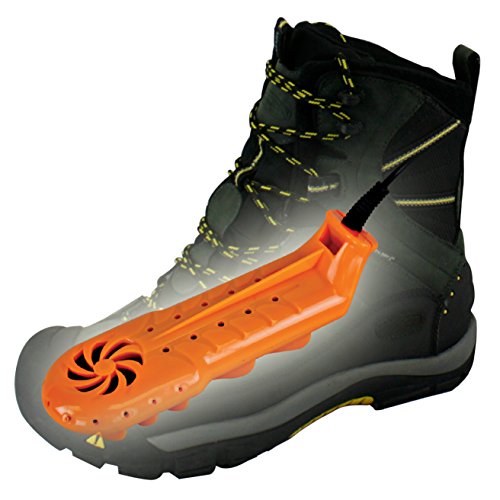
2. DryGuy Travel Dry DX Boot Dryer — Best for Travel
If you travel to ski destinations regularly, the PEET's size becomes a liability. The DryGuy Travel Dry DX was built specifically for skiers who need performance they can pack. The design is compact enough to fit inside most boots for storage, and the AC/DC power adapter means you can run it off the car's 12V outlet on the drive home from the mountain — a genuinely useful feature if you're heading straight to another location without an overnight stop. This is the kind of practical detail that makes you realize the designers actually ski.
Technically, the Travel Dry DX uses a hybrid system combining forced air and convection heating. It heats up to 99°F — warm enough to drive moisture out effectively without being hot enough to damage liner foam, adhesives, or synthetic shells. Compared to most other portable dryers, it dries footwear noticeably faster thanks to the fan-assist. It's not as fast as the PEET with its 220W heat element, but for a device this small it performs well above its weight class. The tubes are slim and fit inside narrow-profile ski boot shells without forcing the tongue open awkwardly.
You do give up the two-pair simultaneous capacity of the PEET — the Travel Dry DX handles one pair at a time. For solo skiers or couples willing to run two cycles, that's fine. For a family of four post-ski-day, you'll be running this thing in shifts, which undercuts the convenience argument. But as a personal travel dryer to toss in your luggage alongside your heated ski socks, it earns its spot in any serious skier's kit bag. The dual AC/DC power option is genuinely unique at this price point.
Pros:
- Compact enough to pack inside boots for storage
- AC/DC adapter works at home or in the car
- Hybrid forced-air and convection system dries faster than passive alternatives
- Slim tubes fit inside narrow ski boot shells
Cons:
- Dries only one pair at a time
- Less powerful than full-size home dryers
3. DryGuy Wide Body DX Electric Dryer — Best Quiet Dryer
The DryGuy Wide Body DX takes a different approach from the travel-focused sibling above. This is a four-port home dryer designed around a central forced-air blower (a rotary blower, specifically — the type used in HVAC systems for its quiet operation) that circulates air evenly through all four drying ports at once. That means you can dry two pairs of ski boots simultaneously, or one pair of boots and one pair of gloves running in the same cycle. In practice, the evenly distributed airflow means you don't get one boot drying faster than the other, which is a real problem with some single-blower designs that favor the port closest to the fan.
The standout feature here is the noise level. DryGuy describes it as whisper-quiet, and that's not marketing exaggeration. If you've ever been kept awake by a boot dryer humming in the corner of a small lodge room, you'll understand why this matters. Running the Wide Body DX overnight in a bedroom is genuinely unobtrusive. Drying times land in the 1–3 hour range depending on saturation — a soaking wet ski boot liner after a full powder day sits at the longer end of that range, while damp boots from a mild spring day dry in well under two hours.
Build quality is solid without being exceptional. The ports accept a wide range of boot widths including most ski boot last widths, and the convection heating is gentle enough to be safe on nearly any boot material. One thing worth noting: this model does not include an auto-shutoff timer. You're responsible for remembering to turn it off, which is a minor annoyance. That said, the low operating temperature means leaving it on a bit longer than necessary isn't going to damage anything. If silence is your top priority and you don't need travel portability, this is your dryer.
Pros:
- Whisper-quiet rotary blower — ideal for bedroom or lodge use
- Four ports dry two pairs simultaneously
- Even airflow distribution through all ports
- Gentle convection heat safe for all boot materials
- 1–3 hour drying time at home
Cons:
- No auto-shutoff timer included
- Not portable or travel-friendly
4. KOODER Boot Dryer — Best Budget Pick
If budget is the deciding factor and you're not ready to commit to a premium dryer, the KOODER is the honest answer. It uses a PTC (Positive Temperature Coefficient) heat element — the same type used in many commercial-grade warmers — which provides self-regulating, precise temperature control. PTC elements automatically reduce their heat output as they approach target temperature, which prevents overheating without requiring a separate thermostat circuit. That's genuinely good engineering for a dryer at this price. The 360-degree air distribution design, with both vertical and horizontal vents throughout the cabinet, does a better job of surrounding the boot with warm air than simple tube-type dryers that only push air from below.
The KOODER's construction is functional rather than impressive. The heat-resistant surface is smooth and doesn't crack or discolor from heat cycles, which is the bare minimum you want to see. The form factor is compact — two tubes extend from a small base, and the whole unit takes up minimal counter space. It lacks the fan-forced power of the PEET or DryGuy units, so drying times are longer, especially for a fully saturated ski boot liner. Expect 3–5 hours for a genuinely wet boot rather than the 1–3 hours you get from the fan-assisted models above.
Where the KOODER genuinely delivers is odor control. The consistent low-level heat circulation breaks the moisture cycle that lets bacteria and mold grow, which is the actual source of boot odor. Fungal infections like athlete's foot thrive in damp, warm environments — a damp ski boot is essentially an ideal incubator. Even at the KOODER's modest performance level, keeping boots consistently dry between ski days eliminates that problem entirely. If you ski a few weekends a season and just need something reliable that won't break after a year, the KOODER earns its budget crown.
Pros:
- PTC heat element provides safe, self-regulating temperature control
- 360-degree vent design distributes heat all around the boot
- Very compact and easy to store
- Budget-friendly entry point into active boot drying
Cons:
- No fan — drying times are longer (3–5 hours for soaked boots)
- No auto-shutoff or timer
- Limited capacity — one pair at a time
5. JobSite Boot Dryer Mighty Dry — Best with Built-In Timer
The JobSite Mighty Dry earns its place on this list with one feature that none of the other dryers above include out of the box: a built-in 3-hour automatic shutoff timer. That single addition changes the user experience meaningfully. You set it, you forget it. No checking in at midnight to turn it off. No worrying about overdrying. The timer cuts power after three hours, which is long enough to dry most damp ski boots and gloves without running the unit unnecessarily through the rest of the night.
Performance-wise, the Mighty Dry is a genuine fan-forced warm-air dryer — 200 watts of heating power at operating temperatures between 98°F and 110°F. That temperature range is solidly within the safe zone for ski boot liners, thermoformed plastics, and adhesive bonding. The warm-up phase takes about 15 minutes before the drying air reaches optimal temperature. Damp boots — ones you've worn for a half-day or on a dry-snow day — come out dry in 30–60 minutes. Fully soaked boots from wet spring conditions or a rainy resort day take closer to 2–3 hours. You can run two pairs simultaneously on the four extending tubes.
The build is utilitarian in the best sense: solid plastic, no unnecessary complexity, easy to clean. The extending tube design works well with both ski boots and work boots, and the ports are wide enough to fit most ski boot shells without pinching the tongue. If you also use the Mighty Dry for work boots, hunting boots, or other outdoor gear between ski seasons, it handles all of it. The one thing you're giving up versus the PEET is expandability — no helmet or glove attachments here. But at its price, with a timer and solid fan-forced performance, the JobSite Mighty Dry is the most practical all-around choice for skiers who want reliable drying without paying flagship prices.
Pros:
- Built-in 3-hour auto-shutoff timer — prevents overdrying
- Fan-forced warm air (200W) dries ski boots in 1–3 hours
- Handles 2 pairs simultaneously
- Works on ski boots, work boots, gloves, and other outdoor gear
- Operating temp (98–110°F) is safe for ski boot liners and plastics
Cons:
- No expandable accessory system like PEET
- Not designed for travel use
Choosing the Right Ski Boot Dryer: A Buying Guide
Ski boot dryers aren't complicated devices, but the differences between models matter more than they appear. Here's what to actually evaluate before you buy.
Fan-Forced vs. Passive Convection
This is the most important spec on the page. Passive convection dryers (warm tubes with no fan) rely on rising warm air to slowly pull moisture out of your boots. They work, but they're slow — 8 to 12 hours for a fully wet ski boot. Fan-forced dryers actively push or pull air through the boot's interior, cutting that time to 1–4 hours. If you ski consecutive days or need your boots ready by early morning, a fan-forced model is non-negotiable. Every pick on this list uses some form of active airflow.
Heat Temperature and Material Safety
Ski boot liners are made from thermoformable foams and synthetic materials that can degrade if exposed to excessive heat. Safe operating temperature for boot dryers is generally considered to be 100–115°F. All five models on this list operate within that range. You should be skeptical of any boot dryer that doesn't list its operating temperature — it usually means the manufacturer doesn't know or doesn't care. High heat is especially risky for custom-molded liners, which can lose their shape and cost hundreds of dollars to replace. When in doubt, use the fan-only or lower-heat setting on any variable unit.
Capacity: Single vs. Multi-Pair
How many pairs do you need to dry in a single cycle? Solo skiers can usually get by with a single-pair dryer running one cycle overnight. Couples and families need multi-port models — the PEET Advantage Plus, DryGuy Wide Body DX, and JobSite Mighty Dry all handle two pairs simultaneously. If you're also drying gloves, helmets, or other gear alongside your boots, look at expandable systems or four-port models with flexible port configurations. Running two drying cycles sequentially adds hours to your preparation time, which matters a lot if you're heading out early.
Timer, Safety, and Certifications
An auto-shutoff timer isn't just about convenience — it's a meaningful safety feature. Boot dryers are typically left running unattended overnight. A timer that kills power after 2–3 hours eliminates the risk of a device running for eight hours while you sleep. The JobSite Mighty Dry includes a built-in timer; the others do not (though you can use an external outlet timer with any of them). Beyond timers, look for ETL or UL certification on any dryer you plan to leave unattended overnight. The PEET Advantage Plus is ETL-certified, which means it's been independently tested for electrical safety — a meaningful credential for a heating device. A good boot dryer is also a natural complement to other protective gear; if you're serious about extending the life of your equipment, also check out the guide to the best ski bindings to make sure your full setup is optimized.
Frequently Asked Questions
How long does it take a boot dryer to dry ski boots?
Fan-forced electric boot dryers typically dry damp ski boots in 30–60 minutes and fully soaked boots in 1–4 hours. Passive convection dryers without a fan take 8–12 hours. The PEET Advantage Plus in fan-plus-heat mode sits at the faster end of the active range; the KOODER, which uses convection-only heating, sits at the slower end of the active spectrum at around 3–5 hours for a soaked boot.
Are boot dryers safe to use overnight?
Yes, with some conditions. Models that operate at 100–115°F are safe to run on ski boot liners, thermoformed plastics, and synthetic materials without causing damage. For added safety, choose a model with an auto-shutoff timer like the JobSite Mighty Dry, or plug any dryer into an external outlet timer set to 3–4 hours. ETL-certified models like the PEET Advantage Plus have been independently tested for electrical safety.
Will a boot dryer damage my ski boot liners?
Not if you use it correctly. Custom-molded liners are the most heat-sensitive component — excessive heat can soften and distort the foam, losing your custom fit. Use fan-only mode or the low-heat setting on any variable-temperature dryer when dealing with molded liners. Standard heat settings in the 100–115°F range are safe for factory liners and most synthetic boot materials. Never use a clothes dryer or radiator to dry ski boots — those sources apply uncontrolled, often excessive heat directly to one area.
Can I dry ski gloves in a boot dryer?
Yes. Several models on this list accommodate gloves. The DryGuy Wide Body DX's four-port setup lets you run one pair of boots and one pair of gloves in the same cycle. The PEET Advantage Plus supports optional Glove DryPort attachments. Standard tube-type dryers can dry gloves by sliding them over the warm tubes, though coverage isn't as thorough as a dedicated glove port. If you're frequently drying gloves alongside boots, an expandable system or multi-port dryer is worth the upgrade. For serious cold-weather use, pairing your dryer with a good set of insulated gloves makes a big difference — see the full heated ski gloves guide for top picks.
What's the difference between a boot dryer and just leaving boots near a heater?
A boot dryer actively circulates air through the boot's interior, drying the liner foam from the inside out. Leaving boots near a space heater or radiator warms the outside of the boot shell but does very little to dry the inner liner — moisture stays trapped inside. Worse, direct radiant heat from a heater or fireplace can warp the boot shell or delaminate adhesive bonds. A boot dryer is the right tool specifically because it targets interior moisture without applying surface heat.
How do boot dryers help with odor?
Boot odor comes from bacteria and fungi that reproduce in warm, moist environments. A wet ski boot liner after a full day on the mountain is an ideal breeding ground for these microorganisms. A boot dryer eliminates that moisture within a few hours of use, breaking the cycle before bacterial populations can grow. Consistent use of a boot dryer — every night after skiing — virtually eliminates odor problems over a season. This is also why ski hygiene matters from a health standpoint beyond just comfort.
Buy on Walmart
- PEET Advantage Plus Boot Dryer with Fan and Heat - Portable — Walmart Link
- DryGuy Travel Dry DX Boot Dryer and Shoe Dryer, Orange & Bla — Walmart Link
- DryGuy Shoe, Boot, Garment & Gear Electric Dryer, Quick Dryi — Walmart Link
- KOODER Boot Dryer,Shoe Dryer,Foot Dryer ! Eliminate bad odor — Walmart Link
- JobSite Boot Dryer - Mighty Dry with Heat Blower Fan - Fast — Walmart Link
Buy on eBay
- PEET Advantage Plus Boot Dryer with Fan and Heat - Portable — eBay Link
- DryGuy Travel Dry DX Boot Dryer and Shoe Dryer, Orange & Bla — eBay Link
- DryGuy Shoe, Boot, Garment & Gear Electric Dryer, Quick Dryi — eBay Link
- KOODER Boot Dryer,Shoe Dryer,Foot Dryer ! Eliminate bad odor — eBay Link
- JobSite Boot Dryer - Mighty Dry with Heat Blower Fan - Fast — eBay Link
Dry boots tomorrow morning aren't a luxury — they're the difference between a great second day on the mountain and one you spend fighting cold, damp misery from the first chairlift.
 |
 |
 |
 |

About Frank V. Persall
Frank Persall is a lifelong skier originally from the United Kingdom who has spent years pursuing the sport across premier resorts in Europe, North America, and beyond. His passion for skiing has taken him from the Alps to the Rocky Mountains, giving him a broad perspective on resort terrain, snow conditions, gear performance across price points, and the practical realities of ski travel with a family. At SnowGaper, he covers ski resort guides, gear reviews, and skiing technique and travel resources for enthusiasts of every level.
You can get FREE Gifts. Or latest free skiing books here.
Disable Ad block to reveal all the info. Once done, hit a button below
|
|
|
|