Which ski boot actually fits narrow feet without painful pressure points, heel lift, or the dreaded foot slosh that wrecks your edge control? If you've been jamming your narrow foot into a standard 102mm last and wondering why your skiing feels sloppy, the answer is simpler than you think: you need a low-volume boot designed for exactly your foot shape. After testing and analyzing the best narrow-last ski boots available for 2026, one boot rises above the pack — the Lange RS 130 LV — but the right choice depends on your skill level, terrain preferences, and how much customization you need.
Narrow feet — typically defined as feet that fit best in a last width of 97mm to 100mm — create a specific problem in ski boots. When the shell is too wide, your foot moves laterally inside the boot, delaying power transfer to the ski and forcing your muscles to compensate all day. Ski boot fit is considered the single most critical factor in ski performance, and low-volume (LV) designs address this directly by tapering the heel pocket, ankle wrap, and instep to hold your foot in a locked, precise position. Every boot on this list targets that exact fit profile. You'll find options ranging from 97mm to 99mm lasts, flex indexes from 110 to 130+, and technologies spanning dual BOA closures to ZipFit custom liners.
This guide covers seven of the strongest narrow-foot ski boots for 2026, pulled from the leading brands in alpine performance: Lange, Atomic, Tecnica, Fischer, and Rossignol. Whether you're carving groomers at a resort or pushing into demanding off-piste terrain, there's a boot here calibrated for your skiing. For a broader look at essential gear to complement your new boots, the ski gear reviews hub covers everything from bindings to outerwear in the same detail-first approach used here.

Contents
- Standout Models in 2026
- Detailed Product Reviews
- Lange RS 130 LV — Best Overall for Expert Skiers
- Atomic HAWX Ultra 130 S Dual BOA — Best for Customizable Fit
- Tecnica Mach1 LV 130 — Best All-Mountain Performer
- Fischer RC4 PRO LV BOA 130 ZipFit — Best for Advanced Precision
- Rossignol Vizion 4B Elite 130 LV — Best for Easy Entry and Exit
- Atomic Hawx Ultra 110 S GW — Best for Intermediate to Advanced
- Lange Shadow 130 LV — Best for Aggressive On-Piste Skiing
- Key Features to Consider When Choosing
- Frequently Asked Questions
Standout Models in 2026
- #PreviewProductRating
- Bestseller No. 1
 Rating:

- Bestseller No. 2
 Rating:
 - Bestseller No. 3
 Rating:
 - Bestseller No. 4
 Rating:
 - Bestseller No. 5
 Rating:
 - Bestseller No. 6
 Rating:
 - Bestseller No. 7
 Rating:
Detailed Product Reviews
1. Lange RS 130 LV — Best Overall for Expert Skiers
The Lange RS 130 LV is the benchmark against which every other narrow-foot performance boot gets measured in 2026. Lange built the RS line around a true racing heritage, and the RS 130 LV carries that DNA into an all-mountain expert package. The shell is constructed from high-grade polyurethane with a 97mm last — one of the narrowest available in a production boot — delivering the kind of heel-and-ankle lockdown that lets you initiate turns with surgical accuracy. Every watt of leg pressure transfers directly to your edges, with no energy lost to lateral foot movement inside the shell.
At a flex index of 130, this boot is designed for advanced to expert male skiers who ski aggressively on hardpack, groomed runs, and variable snow. The MyFit liner provides a warm, snug wrap around the foot and is heat-moldable for a personalized fit. Lange's Dual Core shell construction blends two densities of PU — softer at the toe for comfort, stiffer at the cuff for power — and the result is a boot that feels responsive without punishing your shins on long days. The four-buckle system uses aluminum buckles that close with precision and hold their micro-adjustment settings reliably through repeated use. Lange backs the construction with a one-year warranty.
One real-world consideration: the RS 130 LV's 97mm last is genuinely narrow. If your foot is on the wider side of "narrow" — say, closer to 99mm — you'll want to try the boot on before committing. For true narrow-foot skiers, though, this boot provides the most direct, locked-in feel of any model in this roundup. Pair it with a quality boot sole protector (see our guide to the best ski boot sole protectors for 2026) to protect the Grip Walk sole between sessions.
Pros:
- 97mm last delivers exceptional lockdown for narrow feet
- 130 flex provides aggressive, responsive power transfer
- Heat-moldable MyFit liner for personalized customization
- Racing-heritage construction with Dual Core shell
Cons:
- 97mm last may be too narrow for skiers near the upper range of narrow feet
- Stiff 130 flex is unforgiving for intermediate-level skiers
2. Atomic HAWX Ultra 130 S Dual BOA — Best for Customizable Fit
The Atomic HAWX Ultra 130 S Dual BOA represents the most technically advanced closure system available on a narrow ski boot in 2026. Rather than traditional buckles, this boot uses Boa's dial-based system — two independent dials, one wrapping the cuff and one cinching the foot — so you can micro-tune the fit at each zone independently with one-handed precision, even while wearing thick gloves on the chairlift. The Dual BOA Fit System Alpine provides a level of fit dialing that buckle-based boots simply cannot replicate.
The shell features Atomic's Memory Fit 3D Gold technology, using heat-moldable plastics concentrated in the heel and ankle areas of the liner. When heated in a boot fitter's oven (or via Atomic's own heat-fitting process), those materials conform exactly to your heel and ankle anatomy, which is where narrow-foot skiers most commonly experience pressure issues. The boot also ships with Atomic's Power Shift system, giving you three adjustable forward lean settings: 13°, 15°, or 17°. This is a meaningful feature — forward lean angle affects how naturally your body loads the boot in a skiing stance, and getting that angle right can eliminate shin bang and improve your balance over the ski.
The 130 flex index targets the same expert market as the Lange RS 130 LV, but the HAWX Ultra 130 S offers more adjustability out of the box. Skiers who want a truly bespoke fit without visiting a specialty bootfitter will find the combination of BOA micro-adjustment and heat-moldable heel materials gives them more control over fit than any other boot at this price point. The narrow last (98mm) provides excellent heel hold for narrow-foot skiers across a wide range of terrain types.
Pros:
- Dual BOA closure allows independent zone-by-zone micro-adjustment
- Heat-moldable heel and ankle liner for anatomical customization
- Three-position Power Shift forward lean adjustment (13°/15°/17°)
- 98mm last suitable for a broad range of narrow feet
Cons:
- BOA system adds mechanical complexity compared to traditional buckles
- Higher price point than comparable buckle-based alternatives
3. Tecnica Mach1 LV 130 — Best All-Mountain Performer
The Tecnica Mach1 LV 130 has earned a reputation as one of the most versatile high-performance narrow boots on the market, and the 2026 MY25 update keeps that reputation intact. Tecnica's approach to the LV formula centers on the Custom Adaptive Shape (C.A.S.) system — a full-shell heat-moldable technology that custom-forms not just the liner but the shell itself to your foot. Full C.A.S. is the most comprehensive customization system available in a production ski boot, giving narrow-foot skiers a fit solution that adjusts to foot geometry rather than forcing the foot to adapt to a generic shell.
The Floating Tongue design is another meaningful differentiator on the Mach1 LV 130. Unlike fixed-tongue boots where the tongue is integrated into the shell, the floating tongue moves somewhat independently, allowing natural flex without the hard pressure points that some skiers experience on the shin. Tecnica uses co-injected shell construction — two different materials molded together — to tune the flex characteristics so the boot resists torsional twist (which would reduce edge control) while maintaining smooth forward flex through the full range of motion. The PU Quick Instep feature facilitates entry into the boot, a practical benefit for an expert-flex shell that would otherwise be stiff to enter.
This boot targets aggressive all-mountain skiers who spend time on everything from groomed carving runs to variable off-piste terrain. The 130 flex and LV last keep it firmly in the expert category, but the C.A.S. moldability means it accommodates a wider range of narrow-foot shapes than boots with fixed geometry. If your narrow feet also come with any quirks — high instep, prominent ankle bones, unusual heel shape — the Mach1 LV 130 is the most adaptable boot in this comparison.
Pros:
- Full C.A.S. shell heat-molding for complete custom fit
- Floating Tongue design reduces shin pressure and improves flex quality
- Co-injected shell tunes flex and torsional stiffness independently
- Versatile across groomed and off-piste terrain
Cons:
- C.A.S. fitting requires a qualified boot fitter with an oven — not DIY
- Pricier than boots with liner-only heat molding
4. Fischer RC4 PRO LV BOA 130 ZipFit — Best for Advanced Precision
Fischer's RC4 PRO LV BOA 130 ZipFit is the most specification-intensive boot in this roundup, combining three premium technologies into a single narrow-last shell: a BOA closure system, a 130+ aggressive flex index, and the ZipFit liner. Understanding what each brings to the package clarifies why this boot commands attention from the most demanding narrow-foot skiers in 2026. The ZipFit liner is arguably the most advanced production ski boot liner available — it uses a cork-foam fill that distributes pressure evenly around your entire foot, self-molds to your anatomy over time, and maintains heel hold across thousands of ski days in a way that standard foam liners cannot.
The BOA closure on the RC4 PRO LV functions similarly to the Atomic HAWX system — micro-adjustable, glove-friendly, and capable of dialing in fit at the cuff and foot zones independently. Fischer rates the flex at 130+, indicating this shell is stiffer than a conventional 130 — it targets elite-level racers and extremely aggressive all-mountain skiers. The narrow last is designed specifically for skiers with slim heel-to-forefoot profiles, and the combination of BOA precision and ZipFit liner means heel lift is effectively eliminated when the boot is properly fitted. Fischer markets this boot to advanced and expert skiers who want lasting heel hold without relying on repeated heat-molding sessions.
The 2026 yellow colorway is distinctive, and if aesthetics matter to your buying decision, Fischer delivers. More importantly, the RC4 PRO LV BOA earns its position on this list through functional excellence. The ZipFit liner does require a brief break-in period as the cork fill conforms to your foot shape, but after the first several runs, the fit becomes notably more personalized than a standard foam liner. For skiers who have struggled to maintain heel hold in other LV boots, this is the boot to investigate.
Pros:
- ZipFit cork liner provides long-term, self-molding heel hold
- BOA closure system for precision micro-adjustment
- 130+ flex targets the most aggressive expert skiers
- Narrow-lasted design optimized for slim foot profiles
Cons:
- ZipFit liner requires a break-in period before peak performance
- 130+ flex is excessive for anyone below advanced skill level
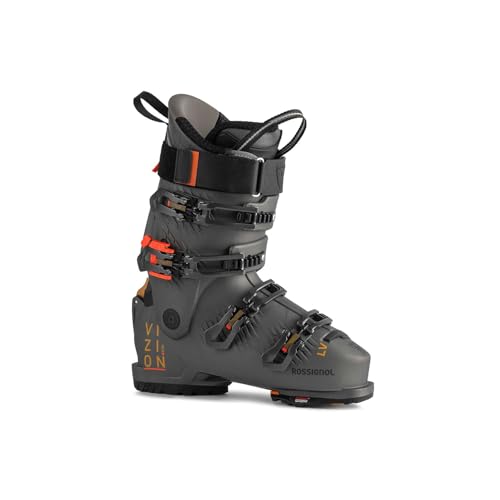
5. Rossignol Vizion 4B Elite 130 LV — Best for Easy Entry and Exit
The Rossignol Vizion 4B Elite 130 LV solves a problem that nobody else on this list has addressed: getting in and out of a 98mm last expert boot without a 10-minute battle on the lodge bench. Rossignol's engineering team developed an innovative spoiler and steel spine mechanism that allows the entire rear of the boot to open wide when you release the Double Buckle system. The result is slipper-like entry into a boot that closes into a locked, 130-flex performance shell — a combination that sounds contradictory but works exactly as advertised.
The Double Buckle on the lower cuff handles two jobs. First, it releases the spoiler so the rear of the boot opens for entry. Second, when closed, it engages the steel spine that locks the boot into full alpine performance mode. This mechanism is not a gimmick — the Grip Walk sole outsole supports natural walking gait between runs, and the steel spine engagement ensures no performance is sacrificed when you're skiing. The overlap shell design maintains the structural integrity that gives the 130 flex its power-transmission characteristics, and the 98mm last maintains proper lateral containment for narrow feet throughout the range of motion.
For skiers who deal with mobility limitations, cold fingers on early morning chairlifts, or simply dislike the ritual struggle of forcing a stiff expert boot onto their foot, the Vizion 4B Elite 130 LV delivers a genuine quality-of-life improvement without asking you to compromise on skiing performance. The Metal Bronze colorway is understated and professional. If you're investing in these boots, consider pairing them with a quality boot dryer to extend liner life — see the roundup of the best ski boot dryers for 2026 for compatible models.
Pros:
- Rear-opening spoiler mechanism enables effortless entry and exit
- Steel spine locks in full 130-flex performance when engaged
- 98mm last provides proper narrow-foot containment
- Grip Walk sole supports natural walking gait
Cons:
- Spine and spoiler mechanism adds mechanical complexity and potential failure points
- Heavier than boots without the rear-opening system
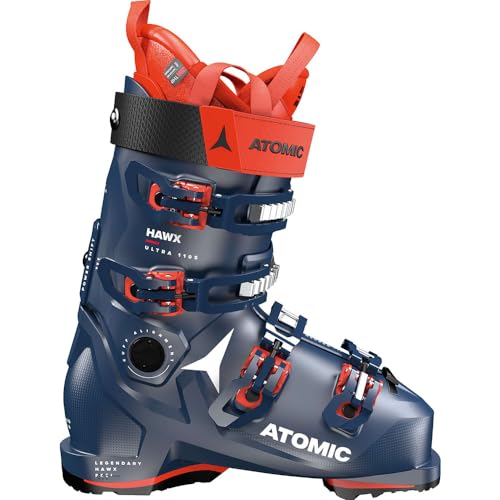
6. Atomic Hawx Ultra 110 S GW — Best for Intermediate to Advanced
Not every narrow-foot skier is skiing at expert level, and the Atomic Hawx Ultra 110 S GW acknowledges that reality. At a 110 flex index, this boot occupies the sweet spot between intermediate-level forgiveness and advanced-level precision, making it the most accessible boot in this roundup without sacrificing the LV narrow-last engineering that narrow-foot skiers require. The 110 S designation indicates both the flex index and the narrow-last (S for Slim) construction, so you're getting genuine narrow-foot engineering, not just a marketing label.
Atomic equips the Hawx Ultra 110 S GW with its Power Shift forward lean adjustment system and Energy Backbone technology — a rigid spine that runs along the back of the cuff to improve energy transmission from leg to ski. The True Flex PU shell and cuff provide consistent flex behavior across a wide temperature range, which matters on cold mornings when other boots become unpredictably stiff. The Grip Walk (GW) outsole makes walking between the car park and the lift more comfortable, and the dual-sided cuff alignment system allows you to angle the cuff to match your natural lower-leg alignment, addressing one of the most common fit issues for skiers with anatomical asymmetry.
For a skier who is progressing from intermediate to advanced and needs a boot that will perform at their current level while still having headroom as their skills develop, the Hawx Ultra 110 S GW is the logical choice. The 110 flex won't overpower a developing skier's technique, but it's stiff enough to provide meaningful power transfer on groomed runs and moderate off-piste. The narrow last keeps your foot locked in with the precision that narrow-foot skiers need. Considering an upgrade to your complete boot setup? The best ski bindings for 2026 pairs naturally with this boot's Grip Walk sole compatibility.
Pros:
- 110 flex suits a wide range of intermediate to advanced skiers
- Narrow-last (S) shell delivers genuine LV fit for slim feet
- Grip Walk sole for comfortable off-snow walking
- Dual-sided cuff alignment accommodates anatomical asymmetry
Cons:
- 110 flex may feel underpowered for expert-level aggressive skiers
- Lacks the BOA closure system found on the 130 S model
7. Lange Shadow 130 LV — Best for Aggressive On-Piste Skiing
The Lange Shadow 130 LV is the 2026 addition to Lange's lineup that narrows the gap between the race-derived RS 130 LV and the broader all-mountain market. What distinguishes the Shadow from its sibling is the updated liner and the Suspension Blade combined with Dual Pivot Technology — a mechanical system in the cuff that allows the boot to flex more progressively and return energy more efficiently than a conventional single-pivot design. The Dual Pivot system means the boot doesn't just flex forward — it stores and returns energy through the entire range of the flex cycle, which translates directly to better rebound and more dynamic skiing at high speeds.
The Shadow 130 LV uses a low-volume shell geometry that matches the aggressive narrow-last philosophy Lange has perfected over decades. The updated liner improves terrain connection — Lange's term for the tactile feedback you receive from the snow through the boot — making the Shadow a boot that rewards skilled skiers who want to feel exactly what their skis are doing at all times. At 130 flex, this boot is not for casual or intermediate skiers. It's designed for expert-level on-piste carving, where the ability to load a ski edge hard and hold it through a high-speed arc separates great skiers from good ones.
The Shadow 130 LV arrived for 2026 as Lange's answer to skiers who found the RS 130 LV almost too narrowly specialized for racecourse use and wanted something with a touch more versatility. The Dual Pivot cuff makes the Shadow feel slightly more forgiving in transition than the RS, while the low-volume shell maintains the narrow-foot precision that defines the LV line. For skiers who spend most of their time on groomed pistes and want a boot built for that environment specifically, the Shadow 130 LV is the most purpose-built choice available. Keep your investment protected between seasons with a good boot bag — see the best ski boot bags for 2026 for storage and transport options.
Pros:
- Suspension Blade + Dual Pivot Technology improves energy return through full flex cycle
- Updated liner enhances terrain connection and tactile feedback
- Low-volume design maintains expert narrow-foot precision
- More versatile cuff feel than the racier RS 130 LV
Cons:
- Optimized for on-piste skiing — less versatile in deep or variable off-piste snow
- 130 flex demands advanced skiing technique to use effectively
Key Features to Consider When Choosing Ski Boots for Narrow Feet
Last Width: The Foundation of Fit
Last width is the single most important specification when buying ski boots for narrow feet. The last is the width measurement of the boot shell at its widest point — the ball of the foot — expressed in millimeters. Standard ski boots typically measure 100mm to 104mm. Low-volume (LV) boots for narrow feet range from 97mm to 100mm. A mismatch of even 2mm can mean the difference between locked-in power transfer and sloppy, fatiguing foot movement inside the shell.
To find your correct last width, visit a specialty ski boot fitter who can measure your foot on a Brannock device and assess your heel-to-ball width alongside your foot length. Do not rely on shoe size alone — foot width varies independently of length, and two skiers with the same shoe size can require very different last widths. All seven boots in this roundup target the 97mm to 99mm range, but within that range, the right choice depends on your specific anatomy. If you've previously experienced pressure points at the ankle bones or persistent heel lift in standard boots, you're almost certainly a narrow-foot candidate.
Flex Index: Matching Stiffness to Skill Level
Flex index describes how much resistance the boot offers to forward bending. Higher numbers mean stiffer flex. The range among the boots reviewed here runs from 110 (Atomic Hawx Ultra 110 S GW) to 130+ (Fischer RC4 PRO LV BOA). Matching flex to your skill level and skiing style is not optional — it's a functional requirement.
A boot that is too stiff for your technique will resist the forward lean that initiates turns, causing you to ski in the back seat and fight the boot all day. A boot that is too soft for an aggressive expert skier will collapse under hard pressure, losing the energy transfer that defines high-performance skiing. As a general benchmark: 110 suits strong intermediate to solid advanced skiers; 120 fits aggressive advanced skiers; 130 is for expert and near-race-level athletes. The flex index also responds to temperature — all PU boots stiffen in cold conditions, so if you regularly ski at very low temperatures, consider sizing down one flex step from what you'd choose in a warm shop.
Liner Technology and Heat Molding
The liner is the padded inner boot that contacts your foot directly. Stock liners vary significantly in quality and customizability. Heat-moldable liners — like the MyFit liner in the Lange RS 130 LV or the Memory Fit system in the Atomic HAWX Ultra — can be shaped in a boot fitter's oven to conform to your specific foot geometry. Full shell molding, as offered by the Tecnica Mach1 LV's C.A.S. system, goes further by conforming the shell itself.
At the premium end, the ZipFit liner in the Fischer RC4 PRO LV BOA uses cork-foam fill that self-molds over time and distributes pressure more evenly than standard foam, while also lasting significantly longer before packing out. Liner quality directly determines how long your boots maintain their original fit — a low-quality liner that compresses and packs out after 30 ski days effectively changes the last width of the boot, undoing the precision narrow-foot fit you paid for. Invest in a boot with a quality liner and maintain it with a boot dryer after each session to maximize liner life.
Closure Systems: Buckles vs. BOA
Traditional ski boot closures use aluminum or plastic buckles — typically four on a standard alpine boot — with micro-adjustable ladder straps. Buckle systems are proven, durable, easy to repair, and provide a wide range of tension adjustment. Every boot in this roundup except the Atomic HAWX Ultra 130 S and Fischer RC4 PRO LV BOA uses a buckle system.
BOA closure systems, by contrast, use a dial-and-cable mechanism that tightens or loosens the boot with single-handed rotation, even with gloves on. Dual BOA systems offer independent control over cuff and foot zones, allowing precision customization that a buckle system approximates less precisely. The trade-off is mechanical complexity: BOA cables and dials are serviceable but add failure points that buckles don't have. For skiers who prioritize fit precision and on-hill adjustability, BOA is worth the premium. For skiers who prioritize simplicity and field repairability, buckles remain the standard for good reason.
Frequently Asked Questions
What last width is considered narrow for ski boots?
Ski boots with a last width of 97mm to 100mm are classified as low-volume or narrow-last boots. Standard boots measure 100mm to 104mm. If you have a foot width that falls below 98mm when measured at the widest point, you'll achieve better fit, control, and comfort in an LV boot. All seven boots reviewed here fall within the 97mm to 99mm range.
Can I use custom footbeds in narrow ski boots?
Yes, and for narrow-foot skiers especially, custom footbeds are strongly recommended. Custom orthotics or aftermarket footbeds — such as Superfeet or Sidas — fill the void under the arch, prevent the foot from collapsing inward, and improve alignment from the foot up through the knee. In a narrow boot that already provides excellent lateral containment, a custom footbed adds the longitudinal arch support that the stock liner typically lacks. Have your footbeds made before your final boot fitting so the fitter can account for the additional volume.
How do I know if my ski boots are too narrow?
Signs that your boots are too narrow include: persistent numbness or tingling in the toes during skiing (indicating impingement on the nerves or blood vessels), pressure point pain on the sides of the foot that persists beyond the break-in period, and bruising or redness on the lateral edges of the foot after skiing. Some initial tightness is normal and will ease as the liner packs out and heat-molds. Structural pressure from the shell itself — which feels hard and unyielding — indicates the shell is too narrow and requires either stretching or a different model.
What flex index should I choose for a 130 LV boot?
A 130 flex index is appropriate for expert-level skiers who ski aggressively on hardpack, groomed runs, moguls, and variable terrain. It requires you to ski with good technique — specifically, maintaining a forward stance and driving the shin into the tongue of the boot during turn initiation. If you're still developing your technique or primarily ski groomed blues and moderate blacks, a 110 to 120 flex will serve you better. The Atomic Hawx Ultra 110 S GW is the right starting point for skiers below the expert level who still need a narrow last.
Do narrow ski boots require special break-in procedures?
All ski boots require some break-in, and narrow LV boots are no exception. The liner will compress and conform to your foot shape over the first 5 to 10 ski days. During this period, you may experience moderate pressure in areas that will ease as the liner molds. Heat molding at a boot fitter before your first ski day significantly accelerates this process and reduces discomfort. For boots with foam liners, avoid leaving them in a freezing car overnight before early sessions — cold foam compresses unpredictably. A boot dryer run for 30 to 60 minutes after each session keeps the liner supple and extends its useful life.
Are low-volume ski boots only for men?
No. LV (low-volume) refers to shell geometry — specifically last width and heel pocket dimensions — not gender. While most LV boots are marketed to men because narrow feet are statistically more common among male skiers, women with narrow feet benefit equally from LV designs. Many women's ski boot lines also offer LV variants. The seven boots reviewed here are marketed as men's models, but fit should always be assessed on an individual foot measurement basis, regardless of how a boot is categorized by the manufacturer.
Buy on Walmart
- Lange - Men's RS 130 LV Vibrant Blue Ski Boots - Men - Size — Walmart Link
- Atomic HAWX Ultra 130 S Dual BOA Men's Ski Boots (Black/Red, — Walmart Link
- Tecnica Mach1 LV 130 All Mountain/High Performance Men's Dow — Walmart Link
- Fischer, RC4 PRO LV BOA 130 ZipFit Boot - 2026, Yellow, 29.5 — Walmart Link
- ROSSIGNOL Men's Vizion 4B Elite 130 Low-Volume Grip Walk Hig — Walmart Link
- Atomic Hawx Ultra 110 S GW Men's Ski Boots — Walmart Link
- Lange Shadow 130 LV Ski Boots 2026 — Walmart Link
Buy on eBay
- Lange - Men's RS 130 LV Vibrant Blue Ski Boots - Men - Size — eBay Link
- Atomic HAWX Ultra 130 S Dual BOA Men's Ski Boots (Black/Red, — eBay Link
- Tecnica Mach1 LV 130 All Mountain/High Performance Men's Dow — eBay Link
- Fischer, RC4 PRO LV BOA 130 ZipFit Boot - 2026, Yellow, 29.5 — eBay Link
- ROSSIGNOL Men's Vizion 4B Elite 130 Low-Volume Grip Walk Hig — eBay Link
- Atomic Hawx Ultra 110 S GW Men's Ski Boots — eBay Link
- Lange Shadow 130 LV Ski Boots 2026 — eBay Link
The right narrow ski boot doesn't just fit your foot — it fits your skiing, and the skier who takes time to match last width, flex, and liner technology to their specific anatomy and ability level will always outperform the one who buys on brand alone.
 |
 |
 |
 |

About Frank V. Persall
Frank Persall is a lifelong skier originally from the United Kingdom who has spent years pursuing the sport across premier resorts in Europe, North America, and beyond. His passion for skiing has taken him from the Alps to the Rocky Mountains, giving him a broad perspective on resort terrain, snow conditions, gear performance across price points, and the practical realities of ski travel with a family. At SnowGaper, he covers ski resort guides, gear reviews, and skiing technique and travel resources for enthusiasts of every level.
You can get FREE Gifts. Or latest free skiing books here.
Disable Ad block to reveal all the info. Once done, hit a button below
|
|
|
|