Roughly 10.7 million Americans hit the slopes every year, and nearly every one of them has wrestled with armloads of skis, poles, and boots while trudging across an icy parking lot. Ski carrier straps are one of those pieces of gear that look almost laughably simple — a strap, some velcro, maybe a shoulder pad — yet the right one genuinely transforms your day at the mountain. The wrong one leaves edge gouges on your bases, slips off your shoulder every thirty seconds, or snaps after two seasons of use.
In 2026, the market is full of options ranging from dead-simple single-strap designs to full kit systems that bundle ski straps, pole carriers, and boot slings into one package. Sorting through them matters because not all ski carrier straps are built equally, and the differences between a good one and a frustrating one are often invisible on the product listing page. This guide cuts through the noise. Whether you're shopping for yourself, your kids, or the whole family, you'll find a clear recommendation here. You can also browse our full ski gear reviews section for more category-specific picks.
We've evaluated seven of the most popular options on the market, looking at materials, adjustability, edge protection, comfort under load, and long-term durability. We also considered how each strap performs when you're wearing gloves — because fumbling with fasteners in subzero temperatures is nobody's idea of a good time. Here's everything you need to know before you buy.
Contents
- Best Choices for 2026
- In-Depth Reviews
- Dakine Ski Straps — Best Overall
- Blulu 4 Pack Ski Carrier Straps — Best for Families
- FIREOR Ski Carrier Strap Kit — Best Complete Kit
- Black Diamond Ski Strap — Best for Backcountry
- Volk Ski Strap and Pole Carrier — Best 2-Pack Value
- Gradient Fitness Boot Carrier Straps — Best Boot Carrier
- Toko x Utah Ski Gear Collab Straps — Best for Storage & Travel
- Key Features to Consider When Choosing
- Questions Answered
- Key Takeaways
Best Choices for 2026
- #PreviewProductRating
- Bestseller No. 1
 Rating:

- Bestseller No. 2
 Rating:
 - Bestseller No. 3
 Rating:
 - Bestseller No. 4
 Rating:
 - Bestseller No. 5
 Rating:
 - Bestseller No. 6
 Rating:
 - Bestseller No. 7
 Rating:
In-Depth Reviews
1. Dakine Ski Straps — Best Overall
Dakine has been making snow sports accessories for decades, and their ski straps are the clearest example of why a brand with deep category knowledge beats a generic competitor every time. The standout feature here is the molded EVA foam pad that holds your ski bases apart, which sounds minor until you've spent two hours sharpening edges that got dinged because you used a cheap strap that let the bases clatter against each other. That pad earns its keep on every single run to and from the lift.
The hook-and-loop closure is noticeably more robust than what you'll find on budget straps. It grips firmly and doesn't peel back after a season of use the way cheaper velcro tends to. What really sets these apart for cold-weather use is the webbing tab — a small but clever touch that lets you grab and cinch the strap even when you're wearing thick ski gloves. When you're rushing to get in one more run before the lift closes, you don't want to fight your gear. These straps get out of your way.
They're not a multi-piece kit. You're not getting a boot sling or a pole carrier here — just the ski straps, done right. If you only need to bundle your skis for the walk from the car to the lodge, this is the cleanest, most reliable option on the market in 2026. For most skiers, this is the one to buy. Pair these with a solid set of ski boot bags and you've got your gear transport dialed in completely.
Pros:
- Molded EVA pad actively separates ski bases and protects edges
- High-quality hook-and-loop holds reliably through repeated use
- Webbing tab makes operation easy with gloves on
- Trusted brand with consistent quality control
Cons:
- No pole carrier or boot sling included — skis only
- Sold as a set but sizing is fixed, so very wide skis may feel snug
2. Blulu 4 Pack Ski Carrier Straps — Best for Families
If you're heading to the mountain with a family of four, buying individual straps for everyone adds up fast. The Blulu 4-pack solves that problem directly — you get four complete shoulder carrier straps in one purchase, which immediately makes this the most cost-effective option on this list for households with multiple skiers. The nylon construction is wear-resistant and holds up to the constant buckling and unbuckling that comes with getting kids in and out of gear all day.
The adjustability range on these straps is genuinely impressive. They run from about 26 inches at the shortest to 47 inches fully extended, which means a small child and a full-grown adult can both use the same strap without issue. The shoulder-carry design is comfortable for short hauls across parking lots and base areas, and the nylon material grips ski surfaces well enough to prevent slipping even when you're moving quickly. The real value proposition here is versatility and quantity — you're covering everyone in your group with one purchase.
The trade-off is that these don't include the edge-protective foam pads you get with the Dakine straps. If you're carrying high-end skis with freshly sharpened edges, that's worth noting. For most recreational family skiers using mid-range rental-style equipment, it's not a dealbreaker. For a family that wants everyone geared up without spending a fortune, the Blulu 4-pack delivers solid function across all sizes and ages.
Pros:
- Four straps per pack — enough for the whole family in one purchase
- Wide adjustability range (26 to 47 inches) fits kids and adults
- Durable nylon construction resists wear over multiple seasons
- Budget-friendly price point per strap
Cons:
- No EVA foam pad to protect ski bases and edges
- Simpler construction may not satisfy performance-focused skiers
3. FIREOR Ski Carrier Strap Kit — Best Complete Kit
Most ski carrier straps only solve half the problem. You strap your skis together, but then you're still carrying your boots by hand and your poles are tucked awkwardly under one arm. The FIREOR kit takes a more complete approach: you get two adjustable straps in the package — one designed to bundle skis and poles together, and a separate strap specifically engineered for boot carrying. That second strap alone changes how you move through a resort.
The build quality reflects the more comprehensive design. FIREOR uses strong nylon, EVA cushioning, and a tough buckle system that's built to last multiple seasons. The shoulder sling for skis and poles keeps everything consolidated into one manageable bundle that rides on your shoulder rather than dangling from your fists. The boot carrier strap is versatile enough to handle roller skates and ice skates too, which is a nice bonus if you use multiple types of footwear through the winter. The long extending band accommodates different ski widths, and the adjustable shoulder configuration works well for both adults and kids.
Where the FIREOR kit excels is in the overall solution it provides. If you've ever tried to navigate a crowded lodge or cross an icy parking lot with both skis and boots in your hands, you understand immediately why having a dedicated boot strap changes the equation. It's more economical than a ski bag and takes up almost no space in your gear pile. For anyone who wants to handle all their equipment in one organized carry, this is the kit to get. Just note that if you're carrying premium skis, you'll want to add edge protectors — the bundling system doesn't separate bases the way the Dakine foam pads do.
Pros:
- Complete kit with both a ski/pole strap and a dedicated boot carrier
- Strong nylon, EVA cushioning, and durable buckle hardware
- Boot strap works for roller skates and ice skates as well
- Adjustable for both adult and child sizing
Cons:
- No dedicated foam pad to separate and protect ski bases
- More components to keep track of than a simpler single-strap option
4. Black Diamond Ski Strap 25 in. — Best for Backcountry
Black Diamond doesn't make casual gear. Their entire product philosophy is built around equipment that performs under the most demanding technical conditions — and their ski strap follows that philosophy. This is backcountry-focused hardware designed for users who earn their turns. If you're skinning up couloirs, touring in the sidecountry, or doing any kind of technical ski mountaineering, the Black Diamond strap is engineered for that context in a way that consumer-grade alternatives simply aren't.
At 25 inches, the strap length is finely tuned for efficient ski bundling without excess material flopping around when you're moving through technical terrain. The construction is minimal and deliberate — Black Diamond's design team has optimized every element for specific end use, which means there's nothing wasted and nothing missing. For resort skiers who just need to carry their skis from the car to the lift, this is probably more strap than you need. But if you're a serious backcountry skier who wants gear that won't fail when conditions get harsh, Black Diamond's track record speaks for itself.
The price reflects the brand positioning, so you'll pay more per strap here than for most of the other options on this list. Whether that premium is justified depends entirely on how you ski. For resort-only skiers, the Dakine straps offer better value. For backcountry and touring skiers who already trust Black Diamond for their packs, poles, and avalanche safety equipment, adding their ski strap to the kit is a natural choice. You can also pair this with a look at ski bindings if you're building out a complete touring setup.
Pros:
- Built to Black Diamond's demanding backcountry performance standards
- Minimal, purposeful design with no wasted material
- Trusted by serious technical skiers and mountaineers
- 25-inch length is well-suited for efficient ski bundling on the go
Cons:
- Premium price point may be overkill for resort-only skiers
- No shoulder carry system — pure bundling strap only
5. Volk Ski Strap and Pole Carrier — Best 2-Pack Value
Two complete sets per pack. That's the headline with Volk, and it's a compelling one. For couples, parent-child pairs, or anyone who wants a backup set, the Volk carrier comes ready to cover two skiers right out of the box. The adjustable length means the same strap that works for an adult can be shortened for a smaller skier — you're not buying two different products for two different people. The value proposition is clear and the execution is solid.
The Volk design focuses on shoulder-carry comfort, and it delivers on that front. The strap keeps your skis and poles bundled against your shoulder without requiring constant readjustment, which makes a bigger difference than you might expect over a long walk from a distant parking area or up a base area ramp. The branding leans into a "wolf pack" identity that will either appeal to you or not — the functionality underneath that marketing is what matters, and functionally these straps work well for recreational skiing.
Where Volk sits in the market is squarely at the "good value for the average resort skier" tier. You're not getting the edge-protective features of the Dakine, the complete kit approach of the FIREOR, or the backcountry pedigree of Black Diamond. What you're getting is two reliable, comfortable shoulder carriers at a price that makes equipping two people straightforward. For skiers heading out as a pair who want to spend more time skiing and less time worrying about their carry system, this is a genuinely good buy in 2026.
Pros:
- Two complete sets per pack — ideal for couples or parent/child pairs
- Adjustable length covers both adult and junior sizing
- Comfortable shoulder-carry design reduces fatigue on long walks
- Good value per strap relative to buying individual units
Cons:
- No base-protective foam pads included
- Branding-heavy marketing doesn't always match the simplicity of the product
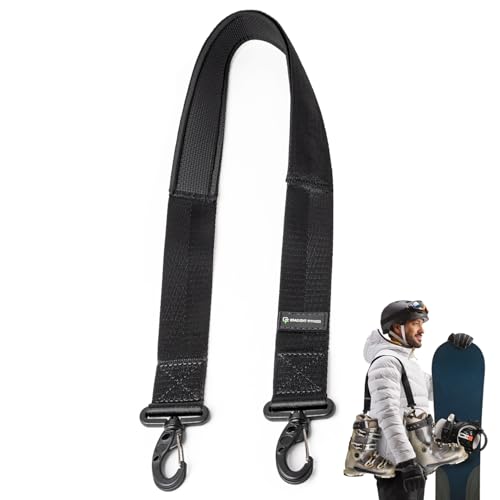
6. Gradient Fitness Boot Carrier Straps — Best Boot Carrier
Ski boots are heavy. A quality pair of performance boots can weigh 10 pounds or more, and carrying them by hand — especially across a long parking lot or up a ramp — is genuinely exhausting before you've even clicked into your bindings. The Gradient Fitness boot carrier strap attacks this problem directly. It's designed specifically to sling your boots over your shoulder so your hands stay free for poles, coffee, or your kid's hand. This is the most targeted boot-carry solution on this list, and if carrying boots comfortably is your primary concern, it's the one to get.
The cushioned shoulder pad is the feature that separates this from lesser boot carriers. It's thick enough to actually distribute the weight of two heavy boots rather than just concentrating it on a single pressure point on your shoulder. More importantly, the anti-slip material on the pad grips your jacket — even slippery winter jackets that send cheap straps sliding off constantly. That anti-slip feature solves one of the most common complaints about budget boot carriers. You put these on, and they stay on while you walk.
The weight distribution benefit is real for longer distances. Ski resorts often involve more walking than people expect — from distant lots, across base areas, up stairs. Carrying boots in one hand throws off your balance on icy surfaces, which is an actual safety issue. Having them slung over your shoulder keeps both hands free for stability and leaves you in a much better position. If you're shopping for the best ski boots for wide feet or any other premium boot, a dedicated carrier like this is an easy add-on that pays dividends every single trip. The Gradient straps also work for snowboard boots, making them genuinely versatile for mixed households.
Pros:
- Cushioned shoulder pad distributes boot weight effectively
- Anti-slip pad material stays put on slippery winter jackets
- Frees both hands for poles, children, or balance on icy terrain
- Works for both ski boots and snowboard boots
Cons:
- Boot-only design — no ski or pole bundling capability
- Newer brand with a shorter track record than established players
7. Toko x Utah Ski Gear Collab Ski Straps — Best for Storage & Travel
The collaboration between Toko and Utah Ski Gear produced something that fills a genuinely underserved niche: a premium ski strap designed as much for storage and travel as for carrying. The bright yellow colorway isn't just aesthetic — it makes your gear instantly visible in a pile of black bags and equipment, which anyone who's dug through a gear room at the end of a trip will appreciate. These straps are built to be the last ones you'll need to buy.
The protective foam pad included with each strap is notably thick. It sits between your ski bases and keeps them separated properly, which protects your wax job, your edge structure, and the base material itself. This matters for storage as much as for carrying — the straps are good enough that you can leave them on your skis in your garage all offseason without worrying about base-to-base contact. The strong velcro ski fastening system holds securely without the peeling and degradation you see in cheaper alternatives after a season or two of heavy use.
The versatility here is real. These work for downhill skis, all-mountain setups, cross-country skis, and ski poles, which makes them a smart choice if you have multiple setups in your quiver or if you're buying straps for a family with different ski types. They attach cleanly to ski and snowboard roof racks for transport and organize well in ski bags for travel. If you're the type of skier who treats your equipment seriously — waxing regularly, maintaining edges, storing gear properly — the Toko x USG collaboration straps align with that approach. The yellow pair is also easy to spot when you're loading up after a long day and your brain is running on fumes and resort chili.
For a deeper look at how ski equipment has evolved over the decades, the history of materials and construction is genuinely fascinating and helps explain why base protection matters as much as it does with modern ski construction.
Pros:
- Thick foam pad protects wax, edges, and base structure during storage and carry
- High-visibility yellow colorway makes gear easy to identify
- Works for downhill, all-mountain, and XC skis plus poles
- Strong velcro maintains hold through repeated use over multiple seasons
Cons:
- No shoulder carry sling — designed for bundling and storage rather than hands-free carrying
- Bold yellow color may not appeal to skiers who prefer a minimal look
Key Features to Consider When Choosing Ski Carrier Straps
Edge and Base Protection
This is the first thing to evaluate, especially if you own quality skis. When two ski bases press together without a barrier, the edges can contact each other and cause micro-nicks that dull your tune faster than anything else. Look for straps with a molded foam or EVA pad between the bases — the Dakine and Toko x USG straps both include this, while several others on this list don't. If base protection isn't included, you can add rubber edge guards separately, but having it built into the strap is more convenient. For skiers who wax and tune regularly, this feature alone justifies spending a few extra dollars on the right strap.
Adjustability and Fit Range
Ski carrier straps need to accommodate different ski widths — your quiver might include 65mm waist groomer skis and 110mm powder boards, and a strap that fits one snugly may be useless for the other. Check the adjustment range before buying. A good strap should span from narrow to wide without leaving excess material that flaps around or a cinch so tight it distorts the ski. Shoulder carry straps have a second dimension of adjustability: the strap length itself should accommodate both shorter and taller skiers. The Blulu 4-pack and FIREOR kit both handle this well across a wide size range.
Shoulder Carry vs. Pure Bundling
Not all straps are designed the same way. Some, like the Black Diamond and Toko x USG options, are pure bundling straps — they hold your skis together neatly but don't provide a shoulder sling. Others, like the FIREOR, Blulu, and Volk options, are built for shoulder carry with a sling integrated into the design. Think honestly about how you use your gear. If you're walking long distances across a resort, shoulder carry matters enormously. If you're mostly loading skis onto a roof rack or storing them in a garage, a simple bundling strap does the job with less hardware.
Material Durability and Cold-Weather Performance
Velcro-style fasteners have a known enemy: ski debris, snow crystals, and ice. Cheap hook-and-loop systems clog and lose grip after a season or two. High-quality velcro — the kind Dakine and Black Diamond use — maintains grip wash after wash and doesn't degrade under cold temperatures the way lower-grade materials can. Nylon webbing is the correct choice for the strap body: it resists abrasion, handles cold without becoming brittle, and doesn't stretch under load the way elastic alternatives might. If you're buying straps to last five seasons rather than one, material quality is the differentiator worth paying for. You should also take care of the soles of your ski boots with the same long-term approach — good gear maintained properly lasts far longer than cheap gear replaced annually.
Questions Answered
Do I really need ski carrier straps, or are they just a nice-to-have?
They're genuinely useful, not just a gimmick. Carrying skis loose means your edges can contact other gear, walls, cars, and people — causing damage or injury. A good strap keeps everything consolidated and safe. If you walk any distance from parking to the lift, your arms will thank you too. They're inexpensive enough that there's no real argument for going without them.
How do I know what size ski strap to buy?
For most adult skis, a standard 18–25 inch bundling strap works well. If you ski fat powder boards (90mm+ waist), you may want a longer strap with more adjustment range. The adjustable shoulder-carry straps on this list are generally designed to accommodate a wide range of ski widths, so adjustability matters more than a specific measurement for those designs.
Can the same strap work for both skis and snowboards?
Some can and some can't. The FIREOR kit explicitly includes a strap sized and designed for snowboards, and the Toko x USG straps also handle wider setups. Standard ski straps are generally too short to wrap around a snowboard's width properly. If you use both, look for a product that specifically lists snowboard compatibility in its features.
Will ski carrier straps damage my ski bases?
They can, if you use the wrong kind. Straps that press your two bases directly together without a protective pad can cause edge-to-edge contact that dulls your tune. The solution is simple: use straps with built-in foam or EVA pads between the bases, or add rubber edge protectors before strapping. The Dakine and Toko x USG straps solve this with their included pads. This matters more for freshly tuned skis than for worn rental equipment.
How many ski straps do I need per pair of skis?
Two straps per pair is the standard recommendation — one near the tips and one near the tails. This distributes the load evenly and prevents the skis from twisting against each other during carry. Some skiers use a single strap through the middle for short distances, but two is more secure and better for your ski bases over the long term.
Are ski carrier straps allowed on ski lifts and gondolas?
Yes, in virtually all resort contexts. Strapping your skis together is standard practice and helps with gondola and lift loading since bundled skis are easier to rack and store than loose ones. Some resorts actually prefer that skiers arrive at gondola queues with their skis strapped for safety and efficiency. Check your specific resort's guidelines, but using carrier straps is universally accepted at resorts across North America and Europe in 2026.
Buy on Walmart
- Dakine Ski Straps - Black, One Size — Walmart Link
- Blulu 4 Pack Ski Carrier Straps Adjustable Shoulder with Cus — Walmart Link
- FIREOR Ski Carrier Strap, Snowboard, Pole and Boot Carry Sli — Walmart Link
- Black Diamond BD102141BLACK25 in. Ski Strap 25 in Black 25 i — Walmart Link
- Volk Ski Strap and Pole Carrier - 2 Sets per Pack - Skiing A — Walmart Link
- Gradient Fitness Boot Carrier Straps for Ski & Snowboard, An — Walmart Link
- Toko x Utah Ski Gear Collab Ski Straps Pair – Bright Yellow — Walmart Link
Buy on eBay
- Dakine Ski Straps - Black, One Size — eBay Link
- Blulu 4 Pack Ski Carrier Straps Adjustable Shoulder with Cus — eBay Link
- FIREOR Ski Carrier Strap, Snowboard, Pole and Boot Carry Sli — eBay Link
- Black Diamond BD102141BLACK25 in. Ski Strap 25 in Black 25 i — eBay Link
- Volk Ski Strap and Pole Carrier - 2 Sets per Pack - Skiing A — eBay Link
- Gradient Fitness Boot Carrier Straps for Ski & Snowboard, An — eBay Link
- Toko x Utah Ski Gear Collab Ski Straps Pair – Bright Yellow — eBay Link
Key Takeaways
- The Dakine Ski Straps are the best overall pick for most skiers in 2026 — the molded EVA base pad and glove-friendly webbing tab justify the buy over cheaper alternatives.
- The FIREOR Ski Carrier Kit is the most complete solution if you want to carry skis, poles, and boots without juggling separate accessories.
- The Blulu 4-Pack wins on family value — four adjustable straps in one purchase at a price that makes equipping every skier in your group easy.
- If you're a backcountry or touring skier, the Black Diamond Ski Strap is built to the technical standards your terrain demands and pairs naturally with the rest of your Black Diamond kit.
 |
 |
 |
 |

About Frank V. Persall
Frank Persall is a lifelong skier originally from the United Kingdom who has spent years pursuing the sport across premier resorts in Europe, North America, and beyond. His passion for skiing has taken him from the Alps to the Rocky Mountains, giving him a broad perspective on resort terrain, snow conditions, gear performance across price points, and the practical realities of ski travel with a family. At SnowGaper, he covers ski resort guides, gear reviews, and skiing technique and travel resources for enthusiasts of every level.
You can get FREE Gifts. Or latest free skiing books here.
Disable Ad block to reveal all the info. Once done, hit a button below
|
|
|
|