Ski Gear ›
Best Goggles for Flat Light Conditions: Reviews, Buying Guides, and FAQs 2026
by Frank V. Persall
You're standing at the top of a groomer with the sky dumping a flat, gray blanket over everything — no shadows, no depth, just a featureless white world where every bump is a surprise. That's flat light, and if you've skied or boarded in it without the right goggles, you already know how fast a mellow run can turn into a guessing game. Choosing the right goggle lens tint and technology for flat light conditions is one of the most underrated decisions you'll make before a day on the mountain.
Flat light happens when the sun is hidden behind thick cloud cover, usually on overcast or stormy days, and it strips away the contrast (the visual separation between light and shadow) that your eyes depend on to read the terrain. The wrong goggle — say, a dark mirrored lens built for bright bluebird days — makes things dramatically worse, turning that already-flat landscape into a total whiteout. What you need is a goggle with a high-VLT (visible light transmission) lens, meaning one that lets more light through, ideally paired with a contrast-enhancing tint like rose, copper, or amber. Many top models in 2026 solve this with interchangeable or photochromic lenses, so you're covered no matter what the forecast says.
We've tested and researched the best flat-light goggles across price points and riding styles. Whether you're charging the backcountry or lapping the resort on a cloudy afternoon, you'll find an option here worth your attention. For more ski gear to round out your kit, browse through our full ski gear reviews — and if fogging is a concern as much as flat light, check our detailed look at the best anti-fog ski goggles in 2026.
Contents
- Editor's Recommendation: Top Picks of 2026
- Product Reviews
- SMITH Squad MAG — Best Overall Flat Light Goggle
- Anon M4 Toric — Best for OTG & All-Day Comfort
- Dragon NFX2 — Best Style-Forward Option
- Giro Contour RS — Best Peripheral Vision
- SCOTT Faze II — Best Budget-Friendly Pick
- Julbo Razor Edge REACTIV — Best Photochromic Lens
- POC Fovea Mid — Best Minimalist Design
- Buying Guide
- FAQs
Editor's Recommendation: Top Picks of 2026
- #PreviewProductRating
- Bestseller No. 1
 Rating:

- Bestseller No. 2
 Rating:
 - Bestseller No. 3
 Rating:
 - Bestseller No. 4
 Rating:
 - Bestseller No. 5
 Rating:
 - Bestseller No. 6
 Rating:
 - Bestseller No. 7
 Rating:
Product Reviews

1. SMITH Squad MAG Snow Goggles — Best Overall Flat Light Goggle
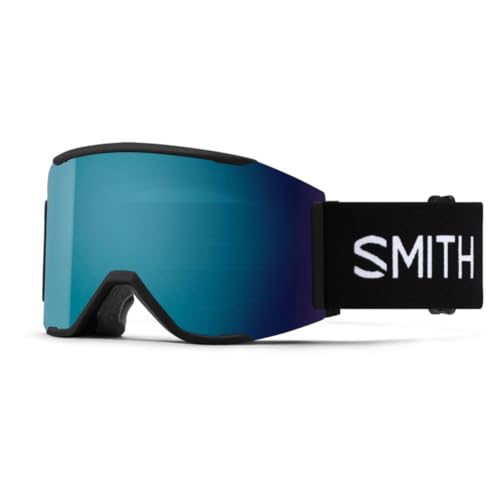
The SMITH Squad MAG is one of the most versatile flat-light goggles you can buy in 2026, and its popularity among skiers and snowboarders who deal with unpredictable weather is well earned. It ships with two interchangeable lenses — a Sun lens for bright days and a Blue Mirror lens that lifts contrast dramatically in low-light and overcast conditions. The MAG system (short for magnets) lets you swap those lenses in seconds without fumbling with clips or tabs, which means you can change them at the lift or in the lodge without losing half your break time to the process.
ChromaPop technology is the real headline here. Smith's lens coating is designed to filter two specific wavelengths of light that cause color confusion, enhancing definition and making terrain features pop even when the sky is flat and featureless. On a gray morning when every mogul looks like a gentle ripple, you'll notice a clear difference versus a standard lens. The cylindrical lens shape (curved on one axis only, like a wrapped-around sheet) provides a wide horizontal field of view, and the smudge- and moisture-resistant coatings mean you're not constantly wiping the lens after a snowfall.
The Squad MAG fits a wide range of face shapes comfortably, and the foam triple-layer seal does a solid job of keeping cold air off your face. If you're already using a compatible Smith helmet, the integration is seamless. For days when you're hitting technical terrain and need to read every shadow and roll, this goggle is a confident choice — and the included Sun lens makes it a true two-season companion for mountain use.
Pros:
- ChromaPop lens dramatically improves contrast in flat light conditions
- MAG magnetic lens swap system is genuinely fast and intuitive
- Comes with two lenses (low-light and bright-day) in the box
- Moisture- and smudge-resistant coatings for easier maintenance
Cons:
- Cylindrical lens can show slight distortion at the edges compared to spherical designs
- Premium pricing puts it out of reach for budget-conscious buyers
2. Anon M4 Toric Ski & Snowboard Goggles — Best for OTG & All-Day Comfort
If you wear prescription glasses on the mountain, finding a goggle that fits over them without pressure points or fogging is its own challenge on top of everything else. The Anon M4 Toric is specifically designed with a roomy frame that accommodates most prescription eyewear — the OTG (over-the-glasses) compatibility is a core feature, not an afterthought. The frame runs unisex in a medium-to-large fit and ships with two toric lenses (toric means curved on two axes, like a contact lens, which reduces distortion and improves peripheral vision significantly).
The Magna-Tech magnetic lens system uses N52 rare-earth magnets — among the strongest available — to create a secure, gap-free seal around the lens perimeter. You can swap lenses in five seconds or less, and the connection is firm enough that the lens won't shift during a fall. The included Variable Blue lens is well-suited to the range of cloudy-to-mixed-light conditions that flat-light riders often encounter, letting in more light without washing out contrast. Full-perimeter venting combined with top-tier anti-fog coating keeps the lens clear even during high-output laps.
The magnetic face mask integration (MFI) system is a practical bonus if you ride in brutally cold conditions — the included face mask attaches directly to the goggle frame with magnets, eliminating the cold-air gap that forms between a balaclava and the goggle foam on really harsh days. This is a goggle built for riders who want a complete system rather than just an optic, and the 1-year warranty backs up that positioning. If you're also shopping for gloves to complete your layering system, our best cross country ski gloves guide for 2026 covers several excellent cold-weather options.
Pros:
- Roomy OTG frame fits comfortably over most prescription eyewear
- N52 Magna-Tech magnets create an extremely secure, fast lens swap
- Toric lens shape reduces distortion and improves peripheral vision
- Magnetic face mask integration seals the cold-air gap effectively
- Includes compatible face mask, storage case, and sock protector
Cons:
- Larger frame may feel bulky on smaller faces
- Full system features (MFI, OTG) add cost over simpler alternatives
3. Dragon NFX2 Snow Goggles — Best Style-Forward Option
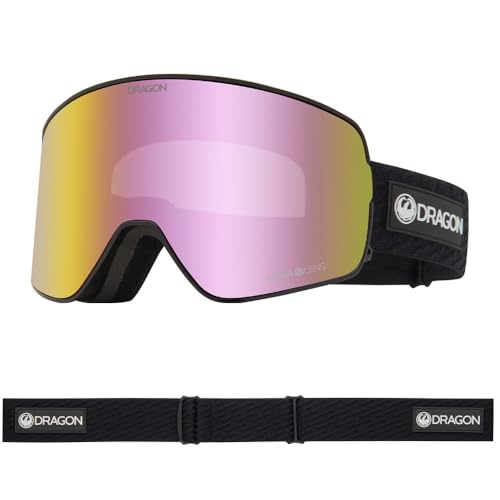
Dragon has always had a strong following among riders who want their gear to look as good as it performs, and the NFX2 delivers on both counts. The Icon Pink colorway with LL Pink Ionized and LL Midnight lenses is an eye-catching combination, but the performance underneath the style is what earns it a spot on this list. The injected cylindrical polycarbonate lens is optically clear with very low distortion, and the LL (Lumalens) tint family is specifically engineered to boost contrast and terrain definition in variable and low-light conditions — exactly the scenario flat-light riders face.
Dragon's Swiftlock lens system is among the faster tab-and-slot mechanisms on the market, though it works differently from the magnet systems on the Smith and Anon — you press and slide rather than pull straight out. It takes a little practice, but once you get the feel for it, swaps are quick and the connection is firm. The Super Anti-Fog coating on the inner lens surface holds up well through extended sessions, and the Armored Venting (reinforced foam around the vent channels) allows airflow while blocking snow and debris from working their way through during a storm.
What makes the NFX2 stand out for flat-light use is the LL Midnight lens, which carries a VLT (visible light transmission) high enough to be genuinely useful at dusk or in heavy overcast, while the rose-toned contrast boost makes the snow surface readable again instead of flat and featureless. If you're heading somewhere like Beaver Mountain, where overcast days are common throughout the season, the NFX2's dual-lens setup gives you solid coverage across the full range of conditions you're likely to encounter.
Pros:
- LL Midnight lens is purpose-built for extreme low-light and flat conditions
- Injected cylindrical polycarbonate lens offers excellent optical clarity
- Armored venting keeps debris out while maintaining airflow
- Distinctive style that stands out from the crowd
Cons:
- Swiftlock system has a steeper learning curve than magnet-based alternatives
- Cylindrical lens may show some edge distortion compared to toric designs
4. Giro Contour RS Snow Goggles — Best Peripheral Vision
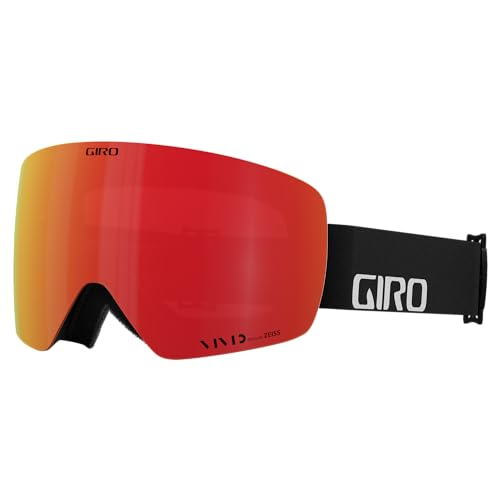
Giro built the Contour RS around one obsession: seeing more of the mountain. The EXV (Expansion View) technology starts with a helmet-compatible goggle frame and then trims down the frame rim while adding frameless zones along the edges of the lens — the result is an unusually wide field of view that feels almost borderless when you're wearing it. In flat light, where you're already working harder to read terrain, that expanded peripheral vision gives you meaningful extra information about what's coming at you from the sides, which is especially useful at speed.
The VIVID lens technology, developed with Zeiss, is Giro's answer to contrast-enhancing optics. The Vivid Ember tint in this configuration is a warm amber-rose color that dramatically improves terrain definition in overcast and low-contrast conditions — it essentially re-draws the shadows that flat light erases. The Quick-Change Lens System uses self-locating magnets to help align the lens during swaps, and four snap pins lock it firmly in place once seated, so you get the convenience of magnets with the security of a mechanical lock.
EVAK Vent Technology uses a non-absorbent foam material around the vent channels that wicks moisture away from the lens interior rather than soaking it up and holding it there. Standard goggle foam can become saturated on wet days, blocking airflow and causing fog — EVAK is designed specifically to prevent that cycle. The large spherical lens (curved on two axes for a more panoramic, less distorted view) adds to the optical quality, and the overall package is one of the most technically complete goggles on this list for riders who prioritize vision range above everything else.
Pros:
- EXV frameless zones deliver exceptional peripheral vision
- VIVID Ember lens restores contrast beautifully in flat, overcast conditions
- EVAK non-absorbent foam prevents moisture buildup and fogging
- Magnetic + snap-pin lens system combines convenience with security
Cons:
- Large spherical lens may not fit smaller or narrower face shapes well
- Priced at the higher end of the performance goggle market
5. SCOTT Faze II Goggles — Best Budget-Friendly Pick
Not every rider needs — or wants — to spend top dollar on a goggle, and the SCOTT Faze II is the best argument for the mid-range on this list. The Mineral White frame with Illuminator Blue Chrome lens is a clean, understated combination that looks sharp without trying too hard. More importantly, the Illuminator tint is SCOTT's purpose-built flat-light lens — it's a high-VLT (visible light transmission) blue-tinted coating that lifts contrast and sharpens definition on cloudy, shadowy, or storm-condition days when the mountain goes visually flat.
The Faze II uses a cylindrical lens design with solid optical clarity for its price tier. The anti-fog inner coating holds up reasonably well through moderate sessions, and the triple-layer foam around the frame provides a comfortable seal across a range of face shapes. The helmet compatibility is broad, meaning you don't need to worry as much about gaps between the goggle and your existing lid. For a rider upgrading from a basic goggle or buying their first serious pair, the Faze II delivers the flat-light performance essentials without demanding a premium-tier budget.
Where the Faze II falls short of the more expensive options on this list is in lens-swap convenience — it uses a traditional tab mechanism rather than a magnetic system, which means changing lenses takes more time and attention. If you're a rider who switches lenses frequently mid-day based on changing conditions, you might find the process frustrating after a while. But if you typically pick one lens at the start of the day and commit to it, the trade-off is minimal, and the money you save can go toward the rest of your kit — like a solid pair from our best cross-country ski pants guide for 2026.
Pros:
- Illuminator lens tint specifically engineered for flat-light and overcast conditions
- Solid value at a mid-range price point
- Wide helmet compatibility with comfortable triple-layer foam seal
Cons:
- Traditional tab lens swap is slower and less convenient than magnetic systems
- Anti-fog performance may lag behind higher-end options in demanding conditions
- Limited color and lens options compared to competitors at similar price points
6. Julbo Razor Edge REACTIV Goggles — Best Photochromic Lens
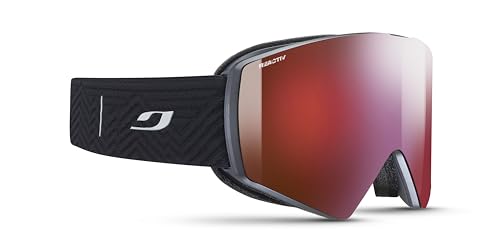
If you want a goggle that adapts to the light automatically — no lens swaps, no carrying a second lens in your jacket pocket — the Julbo Razor Edge with REACTIV technology is the most compelling answer on this list. REACTIV is Julbo's photochromic (light-reactive) lens system, and the 0-4 High Contrast version covers an extraordinary range: it can transition from a nearly clear, high-transmission state in complete overcast to a dark, fully tinted state in blinding sunlight, all without you doing anything. You just ski, and the lens adjusts.
The High Contrast tint profile adds a rose-copper color shift that specifically targets contrast enhancement in flat light — so even at its lightest, clearest state, the lens is working to make terrain features more visible rather than just letting light through neutrally. The frame design is fully frameless (no rim around the lens perimeter), which gives the Razor Edge an impressively wide field of view with minimal visual obstruction. The oversized cylindrical lens and slim, minimalist frame make this goggle a popular choice for backcountry riders and resort chargers alike who want maximum vision without maximum hardware on their face.
The trade-off with photochromic lenses is transition speed — REACTIV reacts quickly by photochromic standards, but there's still a lag of 30 seconds to a few minutes between a significant light change and full adaptation, which matters if you're ducking in and out of tree lines repeatedly. For lift-served skiing or long backcountry pitches where conditions are more consistent, that lag is rarely a problem. The strap is inserted directly into the frame rather than being a separate component, which contributes to the clean, minimal aesthetic and eliminates the bulk of traditional goggle strap hardware. According to Wikipedia's overview of photochromic lens technology, the reaction is driven by UV exposure — which means the lens transitions even through cloud cover, making it genuinely useful in the flat-light scenarios this goggle is built for.
Pros:
- REACTIV 0-4 photochromic range covers every light condition from full overcast to bright sun
- High Contrast tint actively improves contrast even at maximum transmission
- Fully frameless design maximizes peripheral and vertical field of view
- No lens swap required — the goggle manages itself throughout the day
Cons:
- Photochromic transition takes time — not instantaneous in rapid light changes
- Higher price point than traditional dual-lens alternatives
7. POC Fovea Mid — Best Minimalist Design
POC is a Swedish brand best known for its helmet and goggle safety engineering, and the Fovea Mid represents their mid-coverage approach — bigger than a traditional goggle lens, smaller than the oversized frameless designs, landing in a sweet spot that works well for a wide range of face sizes and riding styles. The "Fovea" name references the fovea centralis, the part of your eye responsible for sharp central vision, and the design is centered on delivering the clearest, most optically precise view of the snow directly in front of you.
The Fovea Mid's lens is optimized for contrast and clarity in variable conditions, and POC's Clarity lens technology (developed with the Zeiss optical company) is specifically calibrated to improve definition in low-light and flat-light scenarios by fine-tuning the wavelength filtering for maximum terrain readability. The construction is clean and purposeful — no unnecessary texture or styling elements, just a well-built goggle with solid foam, reliable venting, and an uncomplicated strap system that works with helmets without a fuss.
Where the Fovea Mid is honest with you is in its positioning: it's not trying to compete with the Giro Contour RS on peripheral vision, or the Julbo Razor Edge on photochromic adaptability, or the Anon M4 on OTG accommodation. It's a focused, well-executed goggle that does its job reliably and lets the riding take center stage. If you appreciate gear that disappears into the background rather than announcing itself, the Fovea Mid is worth a serious look. It also pairs naturally with POC's helmet lineup for those who prefer to match their equipment within a single brand ecosystem.
Pros:
- Clarity lens technology (co-developed with Zeiss) delivers excellent optical precision
- Mid-coverage frame fits a broad range of face shapes and sizes comfortably
- Clean, minimalist design that integrates well with POC helmets
- Reliable venting and anti-fog performance in everyday conditions
Cons:
- Fewer premium features (no magnetic swap, no photochromic) compared to higher-priced rivals
- Mid-coverage lens means slightly less peripheral vision than oversized alternatives
Buying Guide: How to Choose the Best Goggles for Flat Light Conditions
Understand VLT — The Most Important Spec for Flat Light
VLT stands for visible light transmission, and it's the percentage of available light that passes through a goggle lens and reaches your eyes. A lens with a VLT of 80% lets most of the light through — ideal for dark, overcast, or storm conditions. A lens with a VLT of 10% blocks most of the light — designed for bright, high-altitude bluebird days. For flat light specifically, you want a lens in the 50–90% VLT range, which means more light reaches your eyes and your brain has more visual information to work with when reconstructing depth and terrain from a washed-out landscape.
Most goggle manufacturers list VLT in the product specs, and many brands offer lens categories like S1 or S2 (low-light), S3 (all-purpose), and S4 (bright conditions) using the European scale. When you're shopping, filter your search by light category — not just by color or style — and you'll quickly narrow the field to options genuinely suited to flat-light riding. A goggle with the wrong VLT is almost worse than no goggle at all in extreme flat light, so this spec deserves your first attention.
Contrast-Enhancing Tints vs. Clear Lenses
High VLT alone doesn't fully solve flat light — you also want a lens tint that actively enhances contrast rather than just letting more light through neutrally. Clear or very lightly tinted lenses with high VLT pass a lot of light but don't add the contrast differentiation that makes snow surface texture readable. Contrast-enhancing tints — typically in the rose, amber, copper, or yellow family — selectively filter specific wavelengths of light in a way that makes shadows pop, terrain rolls become visible, and the difference between packed snow and powder more apparent.
Rose and pink tints are the most common flat-light specialists and are represented on nearly every goggle in this guide. Amber and yellow work similarly, with amber offering slightly better performance in mixed bright-to-cloudy transitions. If you can only choose one lens color for unpredictable mountain weather, rose or copper is a more versatile choice than a purely bright-day blue mirror — even if it looks less flashy on the lift.
Lens Swap Systems vs. Photochromic — Which Is Right for You?
There are two main approaches to handling variable light conditions with a single goggle: carry a second lens and swap it when conditions change, or use a photochromic (auto-adjusting) lens that transitions continuously based on light level. Both work, but they suit different riding habits and priorities. Magnetic lens swap systems like the Smith MAG and Anon Magna-Tech are genuinely fast — you can swap a lens at the top of the lift without removing your gloves, and you get the full optical benefit of a lens tuned exactly to current conditions. The cost is carrying a second lens and remembering to bring it.
Photochromic lenses like the Julbo REACTIV remove that decision entirely — the goggle manages itself, and you never think about lens swaps. The trade-off is transition speed (not instantaneous) and cost (photochromic lenses are more expensive to manufacture). For resort riders who hit multiple terrain types across a full day with shifting weather, photochromic is a compelling argument. For backcountry riders or anyone who monitors conditions closely and likes to optimize for specific light, an interchangeable system gives you more direct control. Think honestly about your riding style before committing to one approach.
Fit, Foam, and Helmet Compatibility
Even the best optics don't help you if cold air is leaking in around the frame, or if the goggle is creating pressure points that make you want to take it off every few runs. Triple-layer foam — with a moisture-wicking inner layer, a medium padding layer, and a firm outer layer — is the standard for comfort and seal quality on premium goggles. Thinner or single-layer foam is a common cost-saving measure on budget models and usually shows up as earlier discomfort or more frequent fogging in wet conditions.
Helmet compatibility is worth verifying before you buy, especially if you already have a helmet you love. Most goggles advertise broad compatibility, but the fit between a specific helmet brim and goggle frame can still leave a forehead gap that channels cold wind directly at your face. If you can, try the combination in person before buying. Many manufacturers — Smith, Anon, Giro, POC — sell matching helmets and goggles designed to integrate precisely, which eliminates the guesswork entirely. If you're also evaluating goggles for night skiing, note that night and flat-light requirements overlap significantly at the high-VLT end of the spectrum, and several goggles on this list perform well in both scenarios.
FAQs
What VLT percentage is best for flat light skiing?
For flat light and overcast conditions, look for a goggle lens with a VLT (visible light transmission) of 50% to 90%. The higher the VLT, the more light reaches your eyes, which is exactly what you need when cloud cover reduces available light on the mountain. Many dedicated flat-light lenses fall in the 60–80% range, paired with a rose or amber tint that adds contrast on top of the increased transmission.
Can I use a photochromic goggle for flat light conditions?
Yes — a photochromic goggle like the Julbo Razor Edge REACTIV is an excellent choice for flat light because it automatically shifts to its highest transmission setting in low ambient light. The 0-4 range on the REACTIV means it adjusts from near-clear (high flat-light transmission) to dark (for bright sunny days) continuously. The main limitation is transition speed, which can take up to a few minutes in sudden light changes, but for most resort and backcountry scenarios this is not a meaningful problem.
What lens color is best for flat light snow conditions?
Rose, amber, copper, and yellow lens tints are the best choices for flat light skiing and snowboarding. These tints selectively filter wavelengths of light that cause visual confusion in low-contrast environments, which makes terrain features, snow surface texture, and shadows pop more clearly. Clear or lightly tinted lenses with high VLT let more light through but don't add contrast enhancement, so a tinted high-VLT lens generally outperforms a clear one in flat light.
Are magnetic lens swap systems worth the extra cost?
For most riders, yes. Magnetic lens systems like Smith's MAG, Anon's Magna-Tech, and Giro's Quick-Change make swapping lenses fast enough that you'll actually do it on the mountain rather than skipping it because it's too much hassle. Traditional tab-and-clip systems work fine but take significantly longer, and in cold temperatures with gloves on, the difference is pronounced. If you ride in highly variable conditions and want to optimize your lens for the light you're actually in, a magnetic system is worth the investment.
Do flat light goggles work for night skiing as well?
Many do, particularly those with a VLT above 70% and a high-contrast rose or yellow tint. Night skiing shares some visual challenges with flat light — limited contrast, reduced depth perception, and the need to see terrain features under artificial lighting — so a high-VLT contrast-enhancing lens serves double duty in both environments. If you ski at night regularly, check our dedicated best goggles for night skiing guide for lenses optimized specifically for that scenario.
How do I prevent fogging in my flat light goggles on heavy snow days?
Anti-fog performance depends on three things working together: quality inner lens coating, adequate venting to let moist air escape, and keeping the inner lens surface free of fingerprints and moisture from wiping. Don't wipe the inside of a goggle lens — if moisture builds on the inside surface, shake it off or wait for venting to clear it, because wiping damages the anti-fog coating over time. Look for goggles with non-absorbent foam venting (like Giro's EVAK system) on heavy-weather days, and make sure your helmet and goggle fit together without blocking the top vents, which is the most common cause of preventable fogging.
Buy on Walmart
- SMITH Squad MAG Snow Goggles with ChromaPop Lens – Performan — Walmart Link
- Anon M4 Unisex Toric Ski & Snowboard Goggles – Interchangeab — Walmart Link
- Dragon NFX2 Unisex Snow Goggles - Icon Pink/LL Pink Ionized — Walmart Link
- Giro Contour RS Snow Goggles 2023 - Black Wordmark Frame wit — Walmart Link
- SCOTT Goggle Faze II (Mineral White;illuminator blue chrome/ — Walmart Link
- Julbo Razor Edge REACTIV Goggles Goggles - Black Frame - Tra — Walmart Link
- POC Fovea Mid — Walmart Link
Buy on eBay
- SMITH Squad MAG Snow Goggles with ChromaPop Lens – Performan — eBay Link
- Anon M4 Unisex Toric Ski & Snowboard Goggles – Interchangeab — eBay Link
- Dragon NFX2 Unisex Snow Goggles - Icon Pink/LL Pink Ionized — eBay Link
- Giro Contour RS Snow Goggles 2023 - Black Wordmark Frame wit — eBay Link
- SCOTT Goggle Faze II (Mineral White;illuminator blue chrome/ — eBay Link
- Julbo Razor Edge REACTIV Goggles Goggles - Black Frame - Tra — eBay Link
- POC Fovea Mid — eBay Link
The best flat light goggle is the one whose lens tint you'll actually switch to when the sky turns gray — so prioritize the swap system and the contrast technology over everything else, and the mountain will take care of the rest.
 |
 |
 |
 |

About Frank V. Persall
Frank Persall is a lifelong skier originally from the United Kingdom who has spent years pursuing the sport across premier resorts in Europe, North America, and beyond. His passion for skiing has taken him from the Alps to the Rocky Mountains, giving him a broad perspective on resort terrain, snow conditions, gear performance across price points, and the practical realities of ski travel with a family. At SnowGaper, he covers ski resort guides, gear reviews, and skiing technique and travel resources for enthusiasts of every level.
You can get FREE Gifts. Or latest free skiing books here.
Disable Ad block to reveal all the info. Once done, hit a button below
|
|
|
|