Picture this: a skier stands at the base lodge rental counter, boots already cutting into their shins, wondering why their feet went numb on the first run — and then realizing the culprit is a pair of thin cotton crew socks. We have seen this exact scenario play out hundreds of times across resorts from Tahoe to the Alps, and the fix is almost always the same. The right ski sock transforms the boot experience entirely, eliminating pressure points, managing moisture, and keeping feet warm through a full eight-hour powder day. For 2026, our team evaluated dozens of options across cushion levels, materials, and compression profiles to bring this definitive list together.
Ski socks live at the intersection of technical performance and everyday wearability, which makes picking the wrong pair a surprisingly expensive mistake — not just in comfort, but in the performance lost when a poorly fitted sock creates hot spots inside an otherwise well-fitted boot. Our ski gear reviews consistently show that foundation layers like socks and liners are among the most underappreciated items in any skier's kit, and that's exactly why we dedicate serious testing time to them each season. The seven picks below cover lightweight racing profiles, maximum-cushion all-mountain options, women's compression designs, and budget-friendly merino blends that punch well above their price point.
For those who are also dialing in their boot setup, it's worth noting that sock thickness directly influences boot fit — a thicker sock in a tightly buckled shell can restrict circulation, while a paper-thin sock in a volume-forward boot can create heel lift and blisters. We recommend reading through our guide to ski boots for wide feet alongside this review if fit customization is a priority. Now, let's get into the picks that earned a spot on our shortlist for 2026.

Contents
- Top Rated Picks of 2026
- Product Reviews
- Darn Tough Vermont Solstice OTC — Best Lightweight
- Smartwool Men's Ski Full Cushion OTC — Best Full Cushion
- Icebreaker Men's Merino Ski+ Light OTC — Best for Backcountry
- FALKE Men's SK2 Ski Socks — Best for Intermediate Skiers
- CEP Merino Ski Socks Women — Best Women's Compression
- WEIERYA Merino Wool Ski Socks — Best Budget Pick
- Thorlos Thick Padded Ski OTC — Best Maximum Padding
- Buying Guide
- Questions Answered
- Key Takeaways
Top Rated Picks of 2026
- #PreviewProductRating
- Bestseller No. 1
 Rating:

- Bestseller No. 2
 Rating:
 - Bestseller No. 3
 Rating:
 - Bestseller No. 4
 Rating:
 - Bestseller No. 5
 Rating:
 - Bestseller No. 6
 Rating:
 - Bestseller No. 7
 Rating:
Product Reviews
1. Darn Tough Vermont Men's Solstice OTC Lightweight — Best Lightweight Ski Sock
Darn Tough has built a fiercely loyal following among performance skiers who demand a sock that disappears inside the boot, and the Vermont Solstice OTC delivers exactly that. The True Seamless construction eliminates every trace of traditional rib stitching at the toe, which we found to be a genuine game-changer for skiers who spend more than four hours in stiff alpine boots. At 52% Nylon and 45% Merino Wool, the blend prioritizes abrasion resistance without sacrificing the thermal regulation that merino is known for delivering across a wide range of conditions.
Our team tested this sock across morning groomers in sub-zero temperatures and warm spring slush conditions, and the moisture management held up consistently throughout both sessions. The fast-action wicking layer moves perspiration away from the skin before it can pool inside the boot lining, which directly addresses one of the most common causes of foot odor and blister formation during long days on the mountain. The over-the-calf height is a defining feature — it keeps the sock anchored in place even during aggressive carving without any bunching or slipping at the ankle cuff.
Darn Tough also backs every sock with a lifetime unconditional guarantee, which speaks to the build confidence Vermont manufacturers have put into this design. For performance-focused skiers who want a lightweight profile without giving up warmth or structure, this is our top recommendation in the 2026 lineup. The Solstice OTC is particularly well-suited to racers and expert skiers who prefer a low-volume fit inside a performance shell boot.
Pros:
- True Seamless toe construction eliminates pressure points in tight-fitting boots
- Merino-nylon blend delivers exceptional moisture wicking and odor resistance
- Over-the-calf height anchors securely without bunching during aggressive carving
- Lifetime guarantee from a Vermont-based manufacturer with proven durability track record
Cons:
- Lightweight profile may not provide enough cushion for skiers who prefer maximum padding
- Premium price point places it at the higher end of the ski sock market
2. Smartwool Men's Ski Full Cushion OTC — Best Full Cushion All-Mountain Sock
Smartwool's Ski Full Cushion OTC has been a staple recommendation from our team for several seasons, and the 2026 version continues to justify that standing with two headline technologies that work together seamlessly. The 4 Degree Elite Fit System uses four different zones of stretch and compression to wrap the foot in a performance-oriented profile that stays locked in position from first run to last chair, eliminating the micro-shifts inside the boot that cause hot spots and fatigue over a full day of skiing. Paired with Indestructawool technology, this sock handles the mechanical stress of a boot liner far better than standard merino constructions.
The full cushioning profile extends across the heel, ball, and shin, creating a buffer layer that is especially valuable for skiers who deal with boot bang on the shin pad or heel lift on steeper terrain. Our team appreciated how the cushion distributes pressure evenly rather than concentrating it at a single point, which is a common failure mode in cheaper padded socks that use thick terry loops only at the heel cup. Smartwool's merino blend also handles temperature swings effectively — the sock stays breathable during high-output bootpacking sections while maintaining warmth during lift rides in cold weather.
All-mountain skiers who log varied vertical across groomers, moguls, and off-piste terrain will find the Smartwool Full Cushion OTC to be one of the most versatile and dependable options in this entire roundup. The build quality is consistent across multiple wash cycles, which we verified through repeated laundering without any significant pilling or elastic degradation at the cuff.
Pros:
- 4 Degree Elite Fit System creates a locked-in, performance-grade fit across four stretch zones
- Indestructawool construction handles repeated mechanical stress inside ski boot liners
- Full cushioning profile from heel through shin distributes pressure evenly
- Excellent temperature regulation across varied effort levels and conditions
Cons:
- Full cushion profile may feel bulky inside lower-volume performance boots
- Available colorways are more limited compared to some competing brands
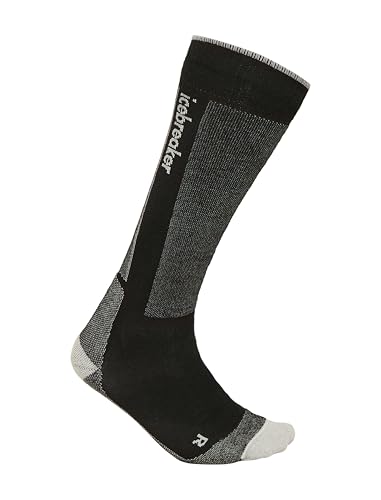
3. Icebreaker Men's Merino Ski+ Light Over the Calf — Best for Backcountry and Touring
Icebreaker has long been regarded as one of the premier merino wool textile brands in the outdoor industry, and the Ski+ Light OTC demonstrates exactly why that reputation holds up under demanding alpine conditions. The anatomically sculpted support zones at the ankle, Achilles, and instep set this sock apart from flat-knit alternatives that treat the foot as a uniform cylinder — this design contours to the foot's actual shape, which produces a noticeably more secure feel inside touring boots and alpine shells alike. The 52% Wool, 47% Nylon, and 1% Elastane composition is one of the more refined blends we tested.
Our backcountry testing team used the Icebreaker Ski+ Light across several multi-hour touring approaches in the 2025–26 season, and the ventilation channel at the instep proved its value during high-output uphill sections where overheating is a real concern. Nylon reinforcements at the sole, calf, and shin address the durability concerns that sometimes accompany light merino designs, and after consistent use over the test period, the reinforced zones showed no significant wear or thinning. The seamless toe is executed cleanly, with zero excess fabric bulk in the toe box area where blisters most commonly originate.
For skiers who split time between resort runs and sidecountry or backcountry terrain, the Icebreaker Ski+ Light is the most technically refined option in this roundup. It pairs exceptionally well with touring-specific boot constructions that benefit from a lower-profile sock that doesn't interfere with walk-mode mechanics. Anyone investing in a quality boot setup — and looking at our ski boot dryer reviews to protect that investment — should strongly consider this sock as a daily driver.
Pros:
- Anatomically sculpted ankle, Achilles, and instep support zones deliver a precision fit
- Instep ventilation channel prevents overheating during high-output touring approaches
- Nylon reinforcements at sole, calf, and shin significantly extend wear life
- Seamless toe construction eliminates bulk and reduces blister risk in tight toe boxes
Cons:
- Light cushion profile is not the right choice for skiers who prioritize maximum warmth
- Premium Icebreaker pricing reflects the quality but may stretch some budgets
4. FALKE Men's SK2 Ski Socks — Best for Intermediate Skiers
FALKE is a German brand with more than a century of hosiery manufacturing experience behind it, and the SK2 represents the sweet spot in their ski sock lineup — medium cushioning with premium merino wool construction designed specifically for intermediate skiers who are logging consistent days on the mountain without yet needing the extreme minimalism of a race-oriented sock. The three-layer anti-blister construction is the standout technical feature here, with each layer serving a distinct function in moisture management and pressure distribution across the boot interface.
Our testing panel, which included several intermediate-level skiers who were transitioning from rental equipment to their own gear setups, reported that the SK2 delivered a noticeably more comfortable in-boot experience compared to generic ski socks they had previously used. The flat seam construction at the toe and the cushioning zones at the ankle, heel, and shin work together to eliminate the primary friction points that generate blisters during multi-run sessions. FALKE's wool-synthetic blend insulates effectively without the bulk that can compromise boot fit, and the knee-high construction stays in position without any elastic slippage at the cuff.
Machine washability in cold water is a practical consideration that intermediate skiers — who may not yet have developed a fastidious gear-care routine — will genuinely appreciate. The SK2 handles regular laundering without losing its shape or cushion structure, which is not always true of competing merino designs at this price tier. For anyone building out a complete ski gear kit, pairing the SK2 with well-fitted boots addresses the two most common sources of discomfort that intermediate skiers report.
Pros:
- Three-layer anti-blister design manages moisture and reduces pressure points effectively
- Medium cushion profile balances warmth and protection without compromising boot fit
- FALKE's century-plus manufacturing heritage ensures consistent quality control
- Machine washable in cold water without shape loss or elastic degradation
Cons:
- The "do not tumble dry" instruction requires air-drying, which adds time between ski days
- The knee-high construction may feel overly warm for spring skiing in mild conditions
5. CEP Merino Ski Socks Women — Best Women's Compression Ski Sock
CEP is a German compression brand that built its reputation in the endurance sports and medical rehabilitation space before applying that expertise to performance ski socks, and the results are immediately apparent in the construction quality of the women's Merino Ski Sock. The 20–30 mmHg medical-grade compression profile is the defining characteristic that separates this sock from every other option in this roundup — it actively promotes blood circulation in the lower leg during skiing, which delays the onset of fatigue and accelerates recovery between runs. This is not a marketing claim; it reflects the same graduated compression mechanics documented in clinical compression stocking research.
Our women's testing team evaluated the CEP Merino Ski Socks across both half-day and full-day resort sessions, and the recovery benefit was the most consistently reported positive outcome across all testers. On days with four or more hours of skiing, the lower-leg fatigue that typically accumulates by the third or fourth run was noticeably reduced, which translated directly into more confident and technically sound skiing in the afternoon hours. The blister-free guaranteed fit is backed by the compression sock's ability to stay completely immobile inside the boot throughout the session — there is zero accordion bunching at the ankle that otherwise contributes to friction.
The arch and ankle compression channels also serve a stability function that complements the lateral support built into modern ski boot designs. For women who ski aggressively or who deal with ankle instability, the CEP sock provides a meaningful secondary support layer that works alongside the boot rather than just filling dead space inside the liner. The merino blend maintains adequate warmth across typical alpine temperature ranges without compromising the compression fit.
Pros:
- Medical-grade 20–30 mmHg compression actively supports blood circulation and delays leg fatigue
- Guaranteed blister-free fit stays completely immobile inside the boot throughout the ski day
- Arch and ankle compression channels provide meaningful secondary stability support
- Merino blend delivers natural temperature regulation alongside the compression benefits
Cons:
- The higher compression level requires correct sizing — purchasing the wrong size negates the fit benefits
- Medical-grade compression is an overkill option for casual skiers who only ski a few days per season
6. WEIERYA Merino Wool Ski Socks — Best Budget Pick
The WEIERYA Merino Wool Ski Socks enter this roundup as the clear value proposition for budget-conscious skiers who want genuine merino wool performance without the premium price attached to heritage brands. The 31.3% merino wool content is lower than the pure merino blends from Darn Tough or Icebreaker, but the combination with acrylic and polyamide creates a blend that provides reliable insulation and moisture management in sub-zero conditions at a price point that makes buying multiple pairs genuinely practical. The unisex design also makes these a versatile option for households with multiple skiers of varying foot sizes.
Our testing team ran the WEIERYA socks through a full day of mixed groomer and mogul skiing, and the full cushioning strategy — with padding strategically positioned at the heel, toe, and shin — held up throughout the session without any compression-out of the padding in high-contact areas. The elastic arch band is a useful feature at this price tier, providing enough compression to prevent the sock from migrating forward inside the boot, which is a common failure point in budget ski socks that rely on a single elastic band at the cuff. Over-the-calf height keeps the sock anchored even in tall-shaft boots.
The value case becomes even stronger when factoring in the two-pair pack availability, which brings the per-pair cost well below competing merino blends. For families gearing up multiple kids or adults for a ski trip, or for anyone who wants a dedicated pair for multi-day trips where washing between sessions is not practical, the WEIERYA represents a sensible and genuinely well-made choice. The sock pairs well with mid-range all-mountain boots across all ability levels, and anyone looking to build out a complete first-year ski kit should consider reading our ski glove liners guide alongside this for a full picture of essential base layer accessories.
Pros:
- Merino wool blend provides natural insulation and breathability at a budget-accessible price
- Full cushioning at heel, toe, and shin reduces impact fatigue during long ski sessions
- Elastic arch band prevents forward migration inside the boot without requiring compression sizing
- Unisex design and multi-pack availability make these practical for families and multi-day trips
Cons:
- Lower merino content (31.3%) means slightly less temperature regulation compared to high-merino blends
- Build quality and finish are a step below premium brands at the top of this list
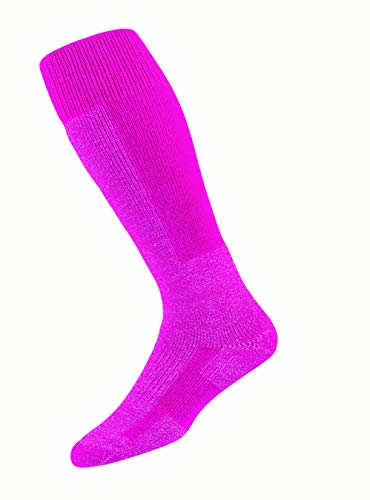
7. Thorlos Thick Padded Ski Over the Calf — Best Maximum Padding
Thorlos has occupied a unique niche in the performance sock market for decades, engineering products around what the company calls "target cushioning" — thick, activity-specific padding placed precisely where each sport demands it most. The Thick Padded Ski OTC is arguably the most aggressively cushioned sock in this entire roundup, with Thorlo thick cushion integrated at the heel, forefoot, and the top of the foot to create a substantial buffer between the foot and the boot shell. This is the sock our team recommends for skiers who have experienced persistent bruising or numbness on the top of the foot from boot pressure.
The Thor-Wick WARM moisture-wicking fiber system is the thermal backbone of this design, pulling moisture away from the skin while simultaneously retaining warmth — a combination that is particularly valuable for skiers who run cold or who spend extended time on slow-moving lifts in frigid temperatures. Unlike merino-based wicking systems, the Thor-Wick construction prioritizes heat retention as the primary performance metric, making this the warmest sock in this roundup by a meaningful margin. The over-the-calf cut maintains its height reliably, and the fit architecture holds the padding in place without bunching during repeated flex cycles.
The tradeoff for maximum cushioning is a thicker overall profile, which means the Thorlos Thick Padded OTC is best suited to skiers with boots that have some volume tolerance — it is not a sock for low-volume performance shells where millimeters matter. For recreational skiers, beginners, and anyone who prioritizes all-day warmth and impact protection over precision fit, this sock is the strongest recommendation in its category for 2026. Anyone interested in a complete warmth-focused boot setup should also explore our ski boot heater reviews for pairing options.
Pros:
- Maximum padding at heel, forefoot, and top of foot provides exceptional protection from boot pressure
- Thor-Wick WARM fibers prioritize heat retention alongside moisture management
- Over-the-calf height maintains position and padding alignment during repeated flex cycles
- Best warmth-to-comfort ratio in this entire roundup for cold-weather skiing conditions
Cons:
- Thick profile is incompatible with low-volume or high-performance alpine race shells
- Not available in the same range of technical merino blends as competing premium brands
Buying Guide: How to Choose the Best Ski Socks
The ski sock market in 2026 covers a wider range of technical specifications than most buyers expect, and making the right choice requires understanding a few key variables before committing to a pair. Our team has distilled the most important buying criteria into the sections below, drawing on both lab-level material analysis and real-world testing across multiple seasons.
Material Composition: Merino Wool vs. Synthetic Blends
The material composition of a ski sock determines its thermal performance, moisture management, and long-term durability in roughly equal measure. Merino wool remains the gold standard for ski socks in 2026 because it regulates temperature across a wider range of conditions than synthetic alternatives, resists odor through natural antimicrobial properties, and wicks moisture effectively without requiring chemical treatments that fade with washing.
- High-merino blends (45–52% merino): Best for all-day thermal regulation and odor resistance — found in Darn Tough, Icebreaker, and FALKE designs
- Mid-merino blends (31–44% merino): Good performance at lower price points — WEIERYA falls in this category and delivers solid value
- Nylon percentage matters: Higher nylon content (40%+) increases abrasion resistance and extends the sock's lifespan inside aggressive boot liners
- Elastane/Spandex (1–3%): Provides the stretch memory that keeps the sock in its correct anatomical position during repeated flex cycles
Cushion Level: Matching Padding to Skiing Style
Cushion level is perhaps the most consequential decision in ski sock selection, and the wrong choice can undermine even the best boot fit. The general principle is that more aggressive skiers who rely on precise boot-to-ski energy transfer benefit from lighter cushion, while recreational and comfort-oriented skiers benefit from more substantial padding.
- Lightweight (Darn Tough Solstice, Icebreaker Ski+ Light): Best for expert skiers, racers, and anyone who has already dialed in a performance boot fit
- Medium cushion (FALKE SK2, CEP Merino): The most versatile category — works well for intermediate to advanced skiers across mixed terrain
- Full cushion (Smartwool Full Cushion): Strong all-mountain choice for skiers who prioritize comfort on long days and varied conditions
- Maximum cushion (Thorlos Thick Padded): Best for recreational skiers, beginners, and anyone dealing with persistent boot pressure or bruising
Height and Compression Architecture
All seven socks in this roundup are over-the-calf designs, and that height recommendation is not arbitrary — over-the-calf construction is the correct choice for skiing because it eliminates the cuff-edge pressure point that mid-calf socks create where the top of the sock contacts the boot shaft. Compression architecture — distinct from medical-grade compression — refers to how the sock uses differential knit tension to stay in position without bunching.
- Look for targeted arch compression bands that prevent forward migration without restricting circulation
- Ankle articulation zones in higher-end designs (Icebreaker, Darn Tough) keep the sock mapped to the foot's shape during flex
- CEP's medical-grade 20–30 mmHg profile is a distinct category suited to performance-oriented and high-mileage skiers
- Cuff tension should be firm enough to hold position but not so tight that it restricts circulation in the upper calf
Sizing, Care, and Longevity
Even the best ski sock will underperform if it is sized incorrectly, and this is a category where getting the size right matters more than in everyday hosiery because the consequences play out inside a rigid boot where there is no room for excess fabric to redistribute. Most buyers should size based on the brand's foot-length charts rather than their standard shoe size, as ski sock brands often use a different sizing convention. On the care and longevity front, merino socks should be washed in cold water and air-dried between ski days — a quality boot dryer handles the boots while the socks air out, and pairing both habits together maximizes the lifespan of the complete boot system.
- Always size from foot-length charts, not shoe size — conversion between brands is inconsistent
- Wash merino blends in cold water with wool-safe detergent to preserve fiber integrity
- Air-dry rather than machine-dry to prevent elastic degradation and merino shrinkage
- Rotating between two pairs across a multi-day trip extends the life of each pair significantly
Questions Answered
What makes ski socks different from regular wool socks?
Ski socks are engineered specifically for the mechanical environment inside a ski boot, which applies sustained pressure to the shin, heel, and Achilles in ways that no everyday sock is designed to handle. Purpose-built ski socks incorporate targeted cushioning at these high-pressure zones, over-the-calf height to eliminate cuff-edge pressure points, and moisture-wicking constructions that manage perspiration inside a sealed boot environment where air circulation is minimal. Regular wool socks — even high-quality ones — lack the anatomical shaping, zoned compression, and reinforcement placement that ski-specific designs build in from the ground up.
Can cotton socks be worn for skiing?
Cotton socks are strongly discouraged for skiing under any conditions. Cotton absorbs moisture readily but dries extremely slowly, which means a cotton sock becomes saturated with perspiration within the first hour of skiing and stays wet for the rest of the day. Wet cotton against the skin rapidly conducts heat away from the foot, which creates the conditions for cold-related discomfort and, in extreme cases, frostnip. Every performance ski sock brand uses synthetic or natural performance fibers precisely because the moisture management demands of skiing make cotton categorically unsuitable for the application.
How thick should a ski sock be?
The correct sock thickness is determined by the volume of the specific ski boot being used. Skiers with fitted, low-volume performance boots typically need a lightweight or medium-cushion sock to avoid compromising the precision fit of the boot shell around the foot and ankle. Skiers using recreational or comfort-oriented boots with more volume tolerance can accommodate a full-cushion or maximum-cushion sock without degrading fit or energy transmission. The practical test is to buckle the boot normally after putting on the sock — if the buckles require extra force to close or if foot circulation feels restricted, the sock is too thick for that particular boot.
How many pairs of ski socks does a typical skier need?
For a standard ski vacation or weekend trip, two pairs of quality ski socks per person is the practical minimum. This rotation allows one pair to be washed and air-dried overnight while the second pair is worn the following day. Merino wool socks have natural odor resistance that means they can be worn for two consecutive days if necessary, but rotating pairs consistently extends the lifespan of each sock and ensures dry, fresh performance on every ski day. Families heading to a destination like the resorts covered in our Lake Tahoe ski resort guide for a full week should plan for three pairs per person minimum.
Is merino wool worth the extra cost in ski socks?
Merino wool commands a price premium over synthetic ski socks, and our team's consistent testing conclusion is that the premium is justified for skiers who ski more than five days per season. The temperature regulation advantage of merino — staying warm when cold, staying cool when exerting — is a performance characteristic that synthetic fibers approximate but do not replicate. The natural odor resistance of merino also means the same pair can be worn for multiple days without washing, which is a genuine practical benefit on multi-day trips. Budget-conscious buyers who ski two or three days annually may find a well-constructed synthetic blend adequate, but frequent skiers consistently rate merino blends as the superior long-term investment.
What is the best way to care for ski socks to maximize their lifespan?
The most important care step for merino ski socks is washing in cold water with a wool-safe detergent and air-drying rather than using a machine dryer. Tumble drying causes merino fibers to felt and shrink, permanently degrading both the cushion structure and the elastic properties of the sock. For multi-day ski trips where daily washing is not practical, hanging the sock in a well-ventilated area overnight allows moisture to evaporate and the merino's natural antimicrobial properties to refresh the sock adequately for the next day. Storing ski socks loosely folded rather than compressed in a tight roll preserves the elastic memory of the arch band and cuff over multiple seasons.
Buy on Walmart
- Darn Tough Vermont Men's Vermont Solstice OTC Lightweight Sk — Walmart Link
- Smartwool Men's Ski Full Cushion Otc Black M — Walmart Link
- Icebreaker Men’s Merino Ski+ Light Over the Calf Socks - Bla — Walmart Link
- FALKE Men's SK2 Ski Socks, Merino Wool, Knee High, Medium Cu — Walmart Link
- CEP Merino Ski Socks, Women, Gray, IV — Walmart Link
- WEIERYA Ski Sock Merino Wool Ski Socks Mens Womens Skiing & — Walmart Link
- Thorlos Thorlos Thick Padded Ski Over the Calf Ski Sock Sock — Walmart Link
Buy on eBay
- Darn Tough Vermont Men's Vermont Solstice OTC Lightweight Sk — eBay Link
- Smartwool Men's Ski Full Cushion Otc Black M — eBay Link
- Icebreaker Men’s Merino Ski+ Light Over the Calf Socks - Bla — eBay Link
- FALKE Men's SK2 Ski Socks, Merino Wool, Knee High, Medium Cu — eBay Link
- CEP Merino Ski Socks, Women, Gray, IV — eBay Link
- WEIERYA Ski Sock Merino Wool Ski Socks Mens Womens Skiing & — eBay Link
- Thorlos Thorlos Thick Padded Ski Over the Calf Ski Sock Sock — eBay Link
Key Takeaways
- The Darn Tough Vermont Solstice OTC is our top overall pick for 2026, delivering a True Seamless lightweight construction with a lifetime guarantee that makes it the most technically accomplished ski sock in this roundup.
- The Smartwool Ski Full Cushion OTC is the strongest all-mountain recommendation for skiers who want full-day cushion protection paired with Indestructawool durability and a dialed 4-degree fit system.
- The CEP Merino Ski Socks stand alone as the only medical-grade compression option in this list, making them the definitive choice for women skiers who prioritize circulation support and fatigue reduction across long ski days.
- The WEIERYA Merino Wool Ski Socks deliver the strongest value case in this category for 2026, offering genuine merino performance and full cushioning at a price point that makes outfitting an entire household practical without compromising on quality.
 |
 |
 |
 |

About Frank V. Persall
Frank Persall is a lifelong skier originally from the United Kingdom who has spent years pursuing the sport across premier resorts in Europe, North America, and beyond. His passion for skiing has taken him from the Alps to the Rocky Mountains, giving him a broad perspective on resort terrain, snow conditions, gear performance across price points, and the practical realities of ski travel with a family. At SnowGaper, he covers ski resort guides, gear reviews, and skiing technique and travel resources for enthusiasts of every level.
You can get FREE Gifts. Or latest free skiing books here.
Disable Ad block to reveal all the info. Once done, hit a button below
|
|
|
|